
Mazón, DANA deaths and the affair controversy
229 dead in Spain's Valencia floods amid allegations President Mazón was absent during critical hours due to a personal affair.
English · Original discussion in Spanish · Published
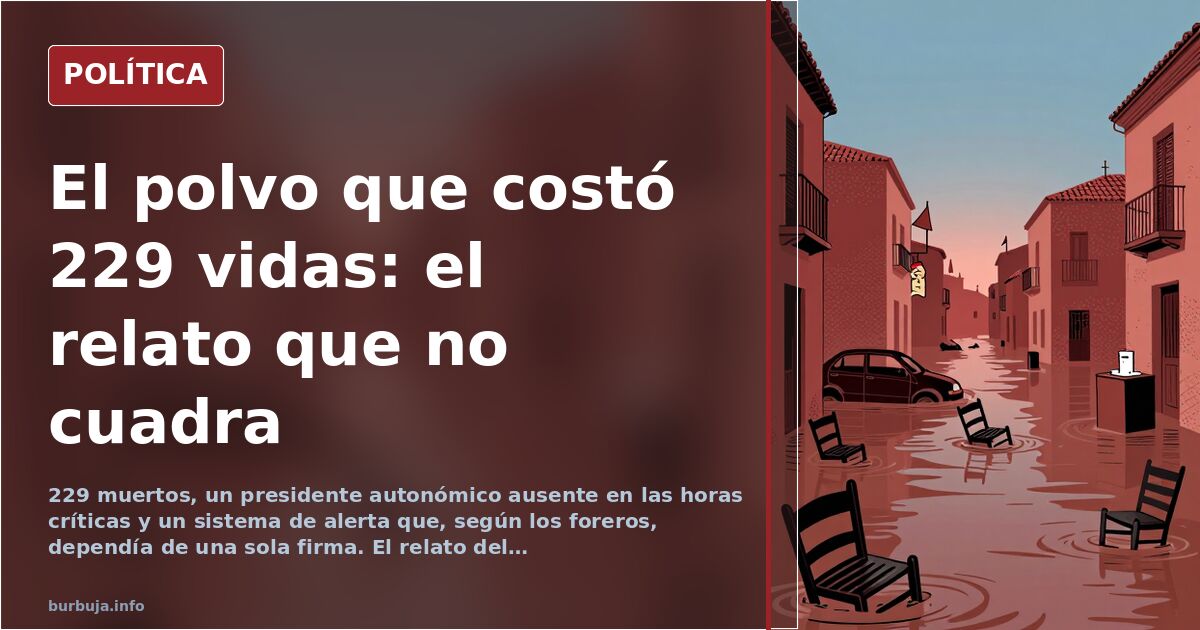
Mazón, the affair and 229 dead: The narrative that doesn't add up
Did 229 people really die because a regional president was having an affair? That is the question hanging over this case since it leaked that Carlos Mazón was not at the command post during the catastrophe's critical hours. The figure stands: 229 bodies. And the narrative, according to conversations, has been built on a single piece: the president didn't give the order because he was occupied. Apparently, the rest of the system did not exist.
What started as a hallway rumor has become the axis of a debate mixing the grotesque with the structural. The question isn't whether Mazón is irresponsible — his own allies assume that — but whether an emergency system can depend on one man's personal agenda. That is the crux.
What actually peine during the DANA's critical hours?
The circulating account claims Mazón was in a private room at a restaurant in Valencia's old town with a journalist who had worked for Canal 9. There was no bed, according to those who know the venue, but there was a lunch that lasted longer than expected. The question nobody answers with data is whether that lunch caused the alert not to be activated, or if it simply coincided with a larger failure.
Some argue that the Hydrographic Confederation and Generalitat Emergencies were focused on the Forata Dam while the Poyo Rambla overflowed without anyone giving the evacuation order. Utiel was already flooded before the situation in Valencia city spiraled out of control. In other words, the collapse wasn't instantaneous: there was margin. And in that margin, the president was absent.
The most benevolent version points to the entire system failing: vice president, emergency departments, UME (Military Emergency Unit), the whole hierarchy. If the alert depended on a single signature, the problem isn't the signer, it's the design. A convenient argument, but it does not exonerate whoever held the pen.
The alert system dependent on one man
The most repeated argument in analyses is that an emergency system cannot depend on whether a guy is having sens or not. If Mazón had suffered a heart attack during those hours, would nobody have raised the alarm? What are the vice president and emergency heads for? The conclusion is uncomfortable: either the system was poorly designed, or nobody wanted to take command while the boss gave no signs.
Some go further, noting that military personnel in Bétera were ready with trucks and shovels for three days waiting for the order to deploy to the Southern Huerta. The order never came. That isn't a problem of an affair: it's a chain-of-command issue. But it is also true that the person who could have short-circuited that chain was the president, and the president was elsewhere.
Comparisons with other episodes are inevitable. Aznar with the Prestige, Rajoy with the plasticine threads, Camps with the suits. The difference here is 229 dead and a specific cause: a flood known to be coming. The weather map was identical to the 1982 Tous dam burst. Anyone with two brain cells would have postponed the lunch.
The works that weren't done and the dead who arrived
The other major block of the issue is what almost nobody wants to look at: channeling works decades overdue, uncleaned riverbeds, resources that never arrived. If the problem were just an affair, changing the president would suffice. But the works still aren't done, and that doesn't depend on anyone's sens life.
Some claim the herd swallows the climate story to avoid demanding real accountability. Others respond that climate change doesn't hold press conferences or sign decrees: politicians do. Both things can be true. The DANA was an extreme phenomenon; the management was a disaster. The latter isn't explained solely by the former.
The figure of 229 dead is what it is. And the question of whether they would have died anyway with Mazón in his office remains unanswered. Probably yes, because the works weren't done. But that doesn't make the lunch irrelevant: it makes the lunch proof that nobody was in charge.
The affair narrative as a smokescreen
The most cynical hypothesis is that the affair is the perfect smokescreen. While everyone argues whether Mazón was having sens or not, nobody discusses why riverbeds weren't cleaned, why the alert wasn't activated in time, why the UME took three days to receive orders. The sensual scandal covers the management scandal.
Some point out that the lunch leak isn't casual: it emerges exactly when investigation committees start digging. Others reply that the affair is irrelevant, that all that matters is the president wasn't where he should have been. Both readings coexist without either dominating.
What seems clear is that the matter won't close with a resignation. Mazón remains in place, the system remains poorly designed, and the works remain undone. The next episode of extreme rain will catch another president in another private room, and the question will be the same.
What happens now with Mazón and the investigation
As of this discussion, there is no sentence or final conviction. What exists is a narrative under construction, a judge listening to versions, and public opinion divided between those who believe the affair explains everything and those who believe it explains nothing. The case remains open.
The only thing that can be stated with available data is that 229 people died in a flood known to be coming, that the regional president was not at his post during critical hours, and that the alert system failed. Everything else — the affair, the private room, the journalist — is packaging. And sometimes, packaging is all that sells.
Did 229 people really die because a regional president was having an affair? That is the question hanging over this case since it leaked that Carlos Mazón was not at the command post during the catastrophe's critical hours. The figure stands: 229 bodies. And the narrative, according to conversations, has been built on a single piece: the president didn't give the order because he was occupied. Apparently, the rest of the system did not exist.
What started as a hallway rumor has become the axis of a debate mixing the grotesque with the structural. The question isn't whether Mazón is irresponsible — his own allies assume that — but whether an emergency system can depend on one man's personal agenda. That is the crux.
What actually peine during the DANA's critical hours?
The circulating account claims Mazón was in a private room at a restaurant in Valencia's old town with a journalist who had worked for Canal 9. There was no bed, according to those who know the venue, but there was a lunch that lasted longer than expected. The question nobody answers with data is whether that lunch caused the alert not to be activated, or if it simply coincided with a larger failure.
Some argue that the Hydrographic Confederation and Generalitat Emergencies were focused on the Forata Dam while the Poyo Rambla overflowed without anyone giving the evacuation order. Utiel was already flooded before the situation in Valencia city spiraled out of control. In other words, the collapse wasn't instantaneous: there was margin. And in that margin, the president was absent.
The most benevolent version points to the entire system failing: vice president, emergency departments, UME (Military Emergency Unit), the whole hierarchy. If the alert depended on a single signature, the problem isn't the signer, it's the design. A convenient argument, but it does not exonerate whoever held the pen.
The alert system dependent on one man
The most repeated argument in analyses is that an emergency system cannot depend on whether a guy is having sens or not. If Mazón had suffered a heart attack during those hours, would nobody have raised the alarm? What are the vice president and emergency heads for? The conclusion is uncomfortable: either the system was poorly designed, or nobody wanted to take command while the boss gave no signs.
Some go further, noting that military personnel in Bétera were ready with trucks and shovels for three days waiting for the order to deploy to the Southern Huerta. The order never came. That isn't a problem of an affair: it's a chain-of-command issue. But it is also true that the person who could have short-circuited that chain was the president, and the president was elsewhere.
Comparisons with other episodes are inevitable. Aznar with the Prestige, Rajoy with the plasticine threads, Camps with the suits. The difference here is 229 dead and a specific cause: a flood known to be coming. The weather map was identical to the 1982 Tous dam burst. Anyone with two brain cells would have postponed the lunch.
The works that weren't done and the dead who arrived
The other major block of the issue is what almost nobody wants to look at: channeling works decades overdue, uncleaned riverbeds, resources that never arrived. If the problem were just an affair, changing the president would suffice. But the works still aren't done, and that doesn't depend on anyone's sens life.
Some claim the herd swallows the climate story to avoid demanding real accountability. Others respond that climate change doesn't hold press conferences or sign decrees: politicians do. Both things can be true. The DANA was an extreme phenomenon; the management was a disaster. The latter isn't explained solely by the former.
The figure of 229 dead is what it is. And the question of whether they would have died anyway with Mazón in his office remains unanswered. Probably yes, because the works weren't done. But that doesn't make the lunch irrelevant: it makes the lunch proof that nobody was in charge.
The affair narrative as a smokescreen
The most cynical hypothesis is that the affair is the perfect smokescreen. While everyone argues whether Mazón was having sens or not, nobody discusses why riverbeds weren't cleaned, why the alert wasn't activated in time, why the UME took three days to receive orders. The sensual scandal covers the management scandal.
Some point out that the lunch leak isn't casual: it emerges exactly when investigation committees start digging. Others reply that the affair is irrelevant, that all that matters is the president wasn't where he should have been. Both readings coexist without either dominating.
What seems clear is that the matter won't close with a resignation. Mazón remains in place, the system remains poorly designed, and the works remain undone. The next episode of extreme rain will catch another president in another private room, and the question will be the same.
What happens now with Mazón and the investigation
As of this discussion, there is no sentence or final conviction. What exists is a narrative under construction, a judge listening to versions, and public opinion divided between those who believe the affair explains everything and those who believe it explains nothing. The case remains open.
The only thing that can be stated with available data is that 229 people died in a flood known to be coming, that the regional president was not at his post during critical hours, and that the alert system failed. Everything else — the affair, the private room, the journalist — is packaging. And sometimes, packaging is all that sells.
Also available in: Deutsch
Summary of a discussion on Burbuja.info - Foro de economía, actualidad y política., translated from Spanish and reviewed before publication. Read the full discussion (131 replies).
More summaries
-
PISA and the sorry state of Spanish education
PISA results reveal a pattern of educational decline in Spain. We analyze the root causes beyond politics.
-
Puigdemont's wig: accident or political strategy?
Analysis of Puigdemont's wig: examining the 1983 accident data and the polarization of political debate.
-
Spanish Court Upholds 40% Firefighter Quota for Women
A Spanish court validated a 40% firefighter quota for women in Catalonia, using gender-specific physical standards to address historical underrepresentation.
-
Netanyahu Warns Spain of Immediate Diplomatic Retaliation
A message attributed to Netanyahu threatens immediate costs for Spain's diplomatic stance. Sánchez urges the EU to suspend its agreement with Israel.
-
Progressivism vs. Science Sparks Debate in Spain
A headline linking progressivism to scientific decline triggers a heated debate on religion, wokeness, and Western decay.
-
Gran Wyoming mural in La Bañeza vandalized; host mocks attackers
Vandals defaced a street art portrait of Spanish TV host Gran Wyoming in La Bañeza. He responded with irony, promising to seek justice.