
Mariupol: Russian convoy ambush video lacks clear location
A video attributed to Azov shows a Russian convoy ambush in Mariupol, but the claimed location varies by source and remains unverified.
English · Original discussion in Spanish · Published
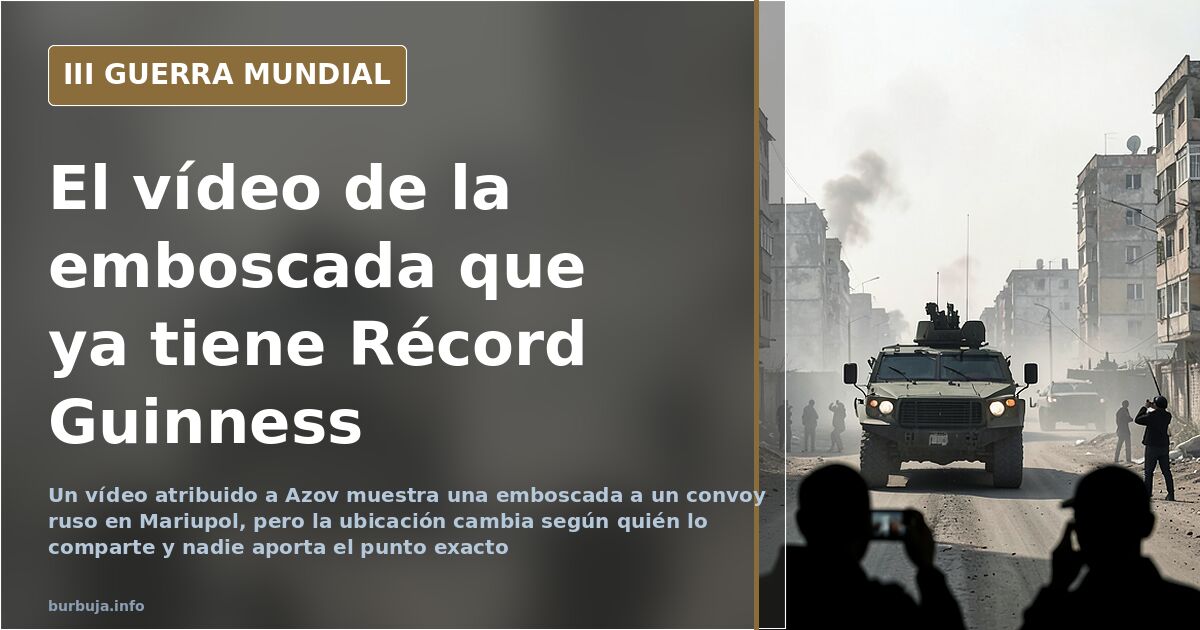
Mariupol: The viral ambush video that keeps changing locations
How many times can the same convoy be destroyed? A video attributed to fighters from the Azov Regiment shows an ambush on a group of Russian vehicles in Mariupol. Since its release, it has circulated across various platforms with inconsistent geolocation data. The footage, shared during the siege of the port city, is presented as a hit-and-run attack against a column stopped by a roadblock. What the video fails to clarify—which these recordings rarely do—is who filmed it, from where, and what happens off-camera.
A video that changes cities depending on who shares it
The first objection is geographical. The same clip has been labeled as footage from Kharkiv, other unidentified towns, and finally Mariupol. This inconsistency doesn't prove it's fake, but it highlights a complete lack of chain of custody. No one provides the exact spot of the attack. Citing an international TV network as proof of authenticity doesn't settle the matter either: broadcasting a clip is different from verifying its location.
On the ground, the sequence shows a disabled lead vehicle and the rest of the column halted. The tactical interpretation is textbook: if the front car doesn't move and no one dismounts to scout, the convoy becomes a sitting duck. This explanation fits the visuals but remains an interpretation, not a verified report.
Who appears in the footage?
Here things get murky. It is claimed the attackers are remnants of the Azov Regiment in the city, while the ambushed soldiers might be militia members from the self-proclaimed Donbas republics, judging by their gear. Others argue that Russian conscripts, often young men serving mandatory duty, are the ones paying the price in such ambushes. None of these identifications come with documentary evidence within the material itself.
The other aspect concerns prisoners. The presence of captured Russian soldiers raises the possibility of equivalent reprisals if summary executions occur. It is also noted that losing Mariupol would leave defenders with no bargaining power. This is speculation about the immediate future of a siege that, at the time of this discussion, remained unresolved.
The war of numbers and maps
Skepticism pervades much of the conversation. Alleged massive Russian losses—tanks, planes, casualties—are listed, raising questions about how the offensive continues despite such figures. The comparison drawn is to Nancy Germany, which kept claiming victories while the Soviet army advanced on Berlin. The prudent conclusion is that when narratives are so opposed, distrust is warranted for all sides.
This adds to criticism of the colored maps and arrows accompanying propaganda from both sides, contrasting the projected image of strength internally with the reality perceived externally. Meanwhile, preparations for the commemorative parade continue as normal.
The debate on tone
Not everything is military analysis. Part of the discussion calls for lowering the volume and stopping mockery of the dead, arguing that behind every corpse is a family. The most common response distinguishes between invading and defending: those entering a country don't deserve the same symbolic treatment as those protecting it. This is a sarracena distinction, not a legal one, and resolves nothing.
Others remind us that most soldiers seen here aren't elite operators, but kids in uniform, terrified. That detail—the most human of all—is the least discussed.
In the end, the initial question remains unanswered: how many times can the same convoy die? As many times as needed, provided the video holds up.
Also available in: Deutsch
Summary of a discussion on Burbuja.info - Foro de economía, actualidad y política., translated from Spanish and reviewed before publication. Read the full discussion (52 replies).
More summaries
-
Mariupol holds out: Azov grows to regiment size and remains at Azovstal
Azov says it destroyed ammunition depots and a platoon in Mariupol and now operates as a regiment at Azovstal, while a user declares the Sea of Azov lost
-
Russia's 'High Morale' Debated Amidst Ukraine Wear and Tear
Forum debate on Russia's 'high morale' in Ukraine: second-line replacements, Kharkiv wear, and the Mariupol tug-of-war.
-
Russia Deploys Tu-22M3 in Mariupol as Kyiv Declares City Captured
Ukraine confirms Russian Tu-22M3 strikes on Azovstal, exposing Moscow's dwindling guided missile stockpile and tactical desperation.
-
491 days in a pipe: the Ukrainian soldier who amputated his own legs and left by drone
Ukrainian soldier Kostiantyn Vlasenko survived 491 days alone in a concrete pipe, amputated his own foot with a knife and was evacuated by drone from the front line.
-
Soviet BM-21 Grad: The Rocket Launcher That Can't Be Hacked
A Soviet-era rocket launcher with analog controls remains operational because its lack of software prevents remote disabling.
-
Spanish volunteer flees Ukraine after first Russian attack
A Spanish volunteer who joined the fight in Ukraine fled during the first bombardment, ending up on a refugee bus to Poland.