
Mariupol holds out: Azov grows to regiment size and remains at Azovstal
Azov says it destroyed ammunition depots and a platoon in Mariupol and now operates as a regiment at Azovstal, while a user declares the Sea of Azov lost
English · Original discussion in Spanish · Published
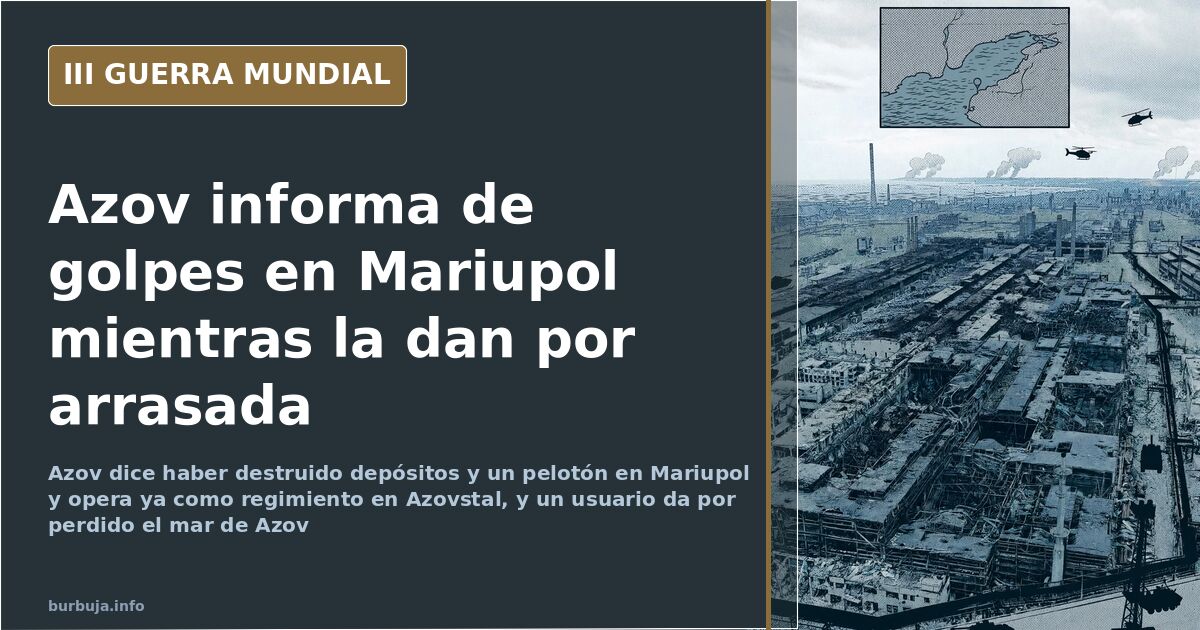
Mariupol does not fall: Azov becomes a regiment and holds out at Azovstal
The same force that the reports declare wiped out every week keeps issuing combat communiqués. Azov reported a raid on enemy command posts in Mariupol in which, according to its own account, ammunition depots, enemy officers and even an infantry platoon were destroyed. As of this discussion, the Azovstal steelworks was still the scene of the clashes and the city, the object of a slow demolition. The uncomfortable question is not whether Azov exaggerates its part: it is how much of the narrative that buries it survives the next report.
How big is the Azov battalion now?
The Azov battalion has scaled up to regimental size: several battalions under a single structure, according to what one participant in the debate points out. The jump in scale is not cosmetic. A formation of that size requires command, logistics and sustained ammunition, precisely what a besieged city is supposed to be unable to guarantee.
There lies the crux. For one part of the analysis, the unit's growth shows that the encirclement is not really an encirclement and that the resistance retains operational capacity. For another, the fact reads the opposite way: a larger structure in a shrinking perimeter means more people trapped in fewer streets. The video accompanying the fighting comes from the steelworks, not from an exit road.
The political label has accompanied the unit since before this phase of the war: Moscow speaks of denazification to justify the offensive, and that characterization is repeated in the debate. Some accept it without qualification, and some come to the unit's defense as just another combat force. Neither reading stands on its own with the available material.
Kiev, the 20 days and the Sea of Azov
They had been announcing entry into Kiev for twenty days. And fifteen minutes, two and a half weeks earlier, according to another of the versions that circulated. The capital did not fall. That gap between announcement and ground is the red thread of the whole discussion: each side assumes the other's collapse with a lead time that later does not materialize.
On the opposite side appears the fact that one participant presents as more solid: the Ukrainian government would have acknowledged the loss of access to the Sea of Azov. If confirmed, it would not be a trench rumor but a geographic consequence. Whoever loses that facade loses ports, grain and the ability to breathe by sea. The resistance of a factory, however heroic it sounds, does not offset that map.
And there is a third front, that of boredom. A war is expected to be resolved in two days when wars last months or years. The culture of estimulante ilegal turns any siege of weeks into a narrative failure, and both sides fail that standard at the same time.
Urban combat in Mariupol: armor against armor
In the regiment's images, one can see 30 mm cannon fire from a BTR-4 against a BTR-82A and a T-72B3 tank, with fire directed at the tank's tracks. It is close-quarters attrition warfare, not an orderly advance. Whoever fires at the chains is not seeking destruction: they seek to immobilize and leave the armored vehicle stuck in the middle of the roadway.
One reading points out that artillery has done the attacker's dirty work: bombing the city to its foundations turns every block into a trap for the coordinated advance of vehicles and infantry. The more rubble, the fewer columns and the more ambushes. The freeze-frame of Mariupol is not that of a parade; it is that of a labyrinth.
From “denazification” to the civilian cost
The declared goal of “denazification” has even been treated as almost resolved, which leaves the second one standing. One participant interprets that second objective as imposing military limits on Ukraine, as was done with Japan after World War II or with Germany in the peace of Versailles. The parallel is debated in both directions. A treaty imposed after a defeat is signed when someone signs, and here no one has signed yet.
In between remains what is not negotiated. The city is devastated and the civilian population is the one paying the bill, regardless of which unit defends it. One current argues that this is the direct responsibility of the offensive; another recalls that there was a previous conflict, that of 2014, that was never closed. Both things can be true and neither clears the rubble.
There remains the question that no communiqué answers: if the unit has been “about to” be wiped out for weeks, what is next week made of?
The same force that the reports declare wiped out every week keeps issuing combat communiqués. Azov reported a raid on enemy command posts in Mariupol in which, according to its own account, ammunition depots, enemy officers and even an infantry platoon were destroyed. As of this discussion, the Azovstal steelworks was still the scene of the clashes and the city, the object of a slow demolition. The uncomfortable question is not whether Azov exaggerates its part: it is how much of the narrative that buries it survives the next report.
How big is the Azov battalion now?
The Azov battalion has scaled up to regimental size: several battalions under a single structure, according to what one participant in the debate points out. The jump in scale is not cosmetic. A formation of that size requires command, logistics and sustained ammunition, precisely what a besieged city is supposed to be unable to guarantee.
There lies the crux. For one part of the analysis, the unit's growth shows that the encirclement is not really an encirclement and that the resistance retains operational capacity. For another, the fact reads the opposite way: a larger structure in a shrinking perimeter means more people trapped in fewer streets. The video accompanying the fighting comes from the steelworks, not from an exit road.
The political label has accompanied the unit since before this phase of the war: Moscow speaks of denazification to justify the offensive, and that characterization is repeated in the debate. Some accept it without qualification, and some come to the unit's defense as just another combat force. Neither reading stands on its own with the available material.
Kiev, the 20 days and the Sea of Azov
They had been announcing entry into Kiev for twenty days. And fifteen minutes, two and a half weeks earlier, according to another of the versions that circulated. The capital did not fall. That gap between announcement and ground is the red thread of the whole discussion: each side assumes the other's collapse with a lead time that later does not materialize.
On the opposite side appears the fact that one participant presents as more solid: the Ukrainian government would have acknowledged the loss of access to the Sea of Azov. If confirmed, it would not be a trench rumor but a geographic consequence. Whoever loses that facade loses ports, grain and the ability to breathe by sea. The resistance of a factory, however heroic it sounds, does not offset that map.
And there is a third front, that of boredom. A war is expected to be resolved in two days when wars last months or years. The culture of estimulante ilegal turns any siege of weeks into a narrative failure, and both sides fail that standard at the same time.
Urban combat in Mariupol: armor against armor
In the regiment's images, one can see 30 mm cannon fire from a BTR-4 against a BTR-82A and a T-72B3 tank, with fire directed at the tank's tracks. It is close-quarters attrition warfare, not an orderly advance. Whoever fires at the chains is not seeking destruction: they seek to immobilize and leave the armored vehicle stuck in the middle of the roadway.
One reading points out that artillery has done the attacker's dirty work: bombing the city to its foundations turns every block into a trap for the coordinated advance of vehicles and infantry. The more rubble, the fewer columns and the more ambushes. The freeze-frame of Mariupol is not that of a parade; it is that of a labyrinth.
From “denazification” to the civilian cost
The declared goal of “denazification” has even been treated as almost resolved, which leaves the second one standing. One participant interprets that second objective as imposing military limits on Ukraine, as was done with Japan after World War II or with Germany in the peace of Versailles. The parallel is debated in both directions. A treaty imposed after a defeat is signed when someone signs, and here no one has signed yet.
In between remains what is not negotiated. The city is devastated and the civilian population is the one paying the bill, regardless of which unit defends it. One current argues that this is the direct responsibility of the offensive; another recalls that there was a previous conflict, that of 2014, that was never closed. Both things can be true and neither clears the rubble.
There remains the question that no communiqué answers: if the unit has been “about to” be wiped out for weeks, what is next week made of?
Summary of a discussion on Burbuja.info - Foro de economía, actualidad y política., translated from Spanish and reviewed before publication. Read the full discussion (136 replies).
More summaries
-
Russia sends 3,000 troops to Kuril Islands in Ukraine fallout
Russia moves over 3,000 troops to the Kuril Islands after Japan sanctions and breaks off peace talks amid the Ukraine war.
-
Nuclear Fear Returns Amidst Ukraine War
The Russian invasion of Ukraine has brought nuclear fear back into everyday conversation. Those who lived through the Cold War disagree on which era was worse.
-
Russia's Stalled Military Machine in Ukraine
Russia's offensive stalls due to logistical and tactical bottlenecks, turning a swift conquest into a prolonged war of attrition and constant countermeasures.
-
Ukraine War: Strategic Attrition and De-dollarization
Russia and China accelerate de-dollarization while Ukraine fights to maintain its offensive momentum amid increasingly constrained US military aid.
-
Ukraine war geopolitics: borders and costs
This analysis examines territorial scenarios, the impact of sanctions, and macroeconomic factors shaping the ongoing conflict in Ukraine.
-
Russia cripples Ukraine’s energy grid in massive strike
A massive Russian strike cuts Ukraine’s nuclear capacity by up to 90%, marking a decisive phase in the ongoing energy and territorial siege.