
Soviet BM-21 Grad: The Rocket Launcher That Can't Be Hacked
A Soviet-era rocket launcher with analog controls remains operational because its lack of software prevents remote disabling.
English · Original discussion in Spanish · Published
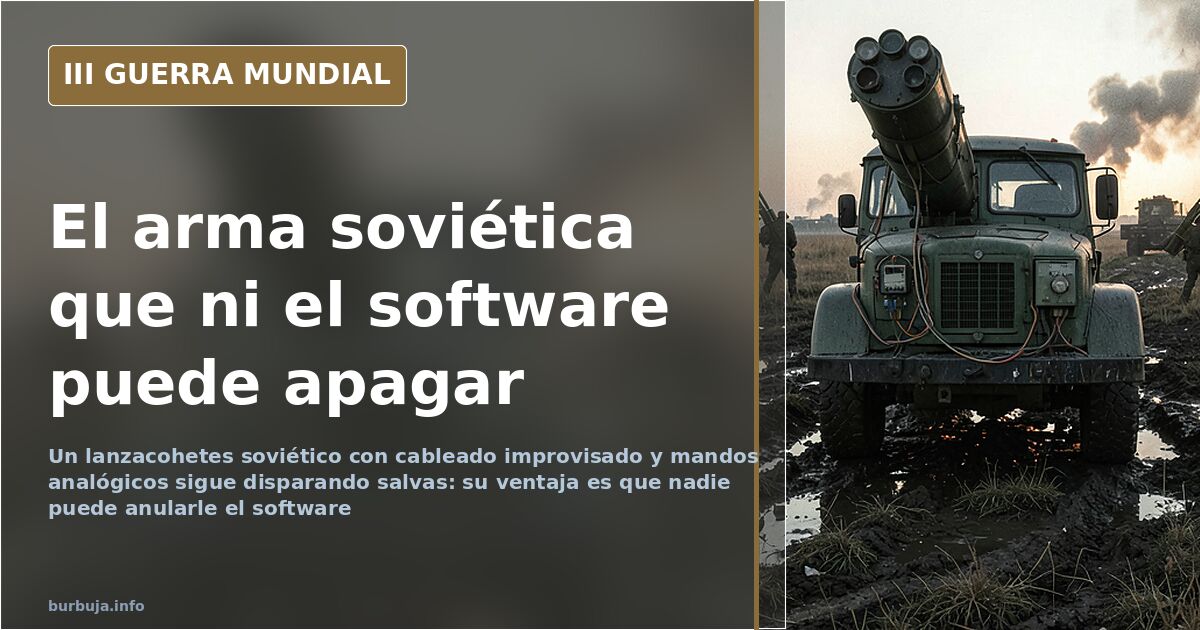
The Rocket Launcher Surviving Without a Single Chip
A stripped wire crossing the dashboard, peeling particleboard ceiling lining, and a driver wearing a gold tooth. Filmed from inside a Soviet-designed multiple rocket launcher, this scene summarizes a paradox central to the war in Ukraine: a weapons system with over sixty years of engineering history continues firing salvos while modern systems rely on manufacturers who can disable them via software updates. Debates about the vehicle's maintenance and lethality mix with mockery of its appearance and an uncomfortable fact for triumphalist narratives: aesthetic obsolescence does not equal operational obsolescence.
What Is Actually Seen From the Cabin
The interior described is anything but sophisticated. The cabin roof retains remnants of what appears to be particleboard lining. Dashboard wiring is exposed between the windshield and a half-broken steering wheel. Launch controls are analog, housed in a manual-operated box, and the platform rotates with mechanical noise revealing gears rather than servomotors. There are no touchscreens or digital consoles: pure mechanics and basic electronics, without any digitization.
This absence of software is precisely its defensive advantage. No one can disable the system with a cyberattack or take it out of service through a remote review. The argument extends to other systems: some compare this case to Soviet tanks still manufactured for markets with limited resources and neighbors unable to afford top-tier weaponry. The underlying idea is that a simple design with interchangeable parts and on-site repair withstands the wear of a long war better than equipment dependent on spare parts and software patches.
Maintenance as Proof of Life
The vehicle's appearance suggests it was parked and received last-minute repairs: improvised wiring and a broken steering wheel point to a rushed preparation. This improvisation does not prevent firing. The platform rotates, rockets launch, and the salvo fulfills its function. The conclusion drawn is that old machinery tolerates abuse and spare part shortages better than systems requiring certified workshops.
The driver, described as a trucker returning to work rather than a replacement soldier, adds a human layer to the picture. His tension is evident due to delays: firing in two directions requires staying in place longer, multiplying the risk of being located and targeted by opposing artillery. The weapon's effectiveness and the operator's vulnerability coexist on the same plane.
The Controversy Over Damage Caused
Here analysis splits. One school argues these systems fire unguided, non-selective ammunition designed to saturate wide areas and cause maximum casualties, using psychological terror as a weapon. Another responds that precision depends not only on the launcher but on the observation chain: drones are used to locate military targets and avoid civilian damage, with firing calculations prepared in advance. The debate over whether the weapon is indiscriminate or if its use is so remains undecided based on available material.
What clearly emerges is the historical comparison. Parallels with World War II rocket launchers and Vietnam napalm serve some to emphasize the system's saturation character and others to remind that primitive technology does not imply lower destructive capacity. The disorienting figure: a vehicle seventy-five years old continues generating debate about its present lethality.
Lessons for Digitized Armies
The episode leaves an uncomfortable question for armed forces boasting technological superiority. If a Soviet-era design remains operational and cannot have its firmware sabotaged, massive digitization of weapons systems introduces a new dependency: that of the manufacturer controlling the code. The case of the European fighter jet that crashes and whose operation depends on the building consortium's software is cited as an example of such servitude. The paradox is that technological power can become a bottleneck.
The inevitable conclusion is not that old is better, but that reliability has a component of simplicity that procurement programs tend to disdain. A weapon that starts without updates, repaired with wire, and asking no permission to fire has value absent from commercial brochures.
In the end, the detail best summarizing the matter is neither the gold tooth nor the platform's noise. It is that the contraption works. And that no one has yet found a way to shut it down from a server.
Also available in: Deutsch
Summary of a discussion on Burbuja.info - Foro de economía, actualidad y política., translated from Spanish and reviewed before publication. Read the full discussion (91 replies).
More summaries
-
Russia withdraws from Kherson a month after annexation
Russia leaves Kherson weeks after annexing it. The retreat to the Dnieper divides analysts: historic humiliation or tactical withdrawal?
-
China backs Russia in Ukraine, strengthening Eurasian axis
China supports Russia in the Ukraine war despite US and EU pressure. The Eurasian axis strengthens as NATO debates expanding its reach into Asia.
-
European Parliament urges EU to allow Ukraine strikes inside Russia
The European Parliament asks the 27 member states to permit Ukraine to use weapons in Russian territory, while Putin warns he will consider it a direct attack.
-
Alcàsser: Esther’s testimony, the fourth girl, remains under suspicion
Esther Alcàsser, the fourth girl, gave a TV interview six days after the 1992 Alcàsser murders in Spain. Her account and timeline discrepancies fuel ongoing controversy.
-
Fact-check debunks fake Putin vaccine destruction order
A viral claim that Putin ordered the destruction of COVID vaccines and executed scientists lacks any source. Russian documents show mandatory vaccination policies.
-
Spanish volunteer flees Ukraine after first Russian attack
A Spanish volunteer who joined the fight in Ukraine fled during the first bombardment, ending up on a refugee bus to Poland.