
Evicted tenant Maricarmen dies at 87, sparking Spain election row
The death of Maricarmen, evicted at 87, intensifies political debate ahead of Spain's elections, exposing deep housing crisis divisions.
English · Original discussion in Spanish · Published
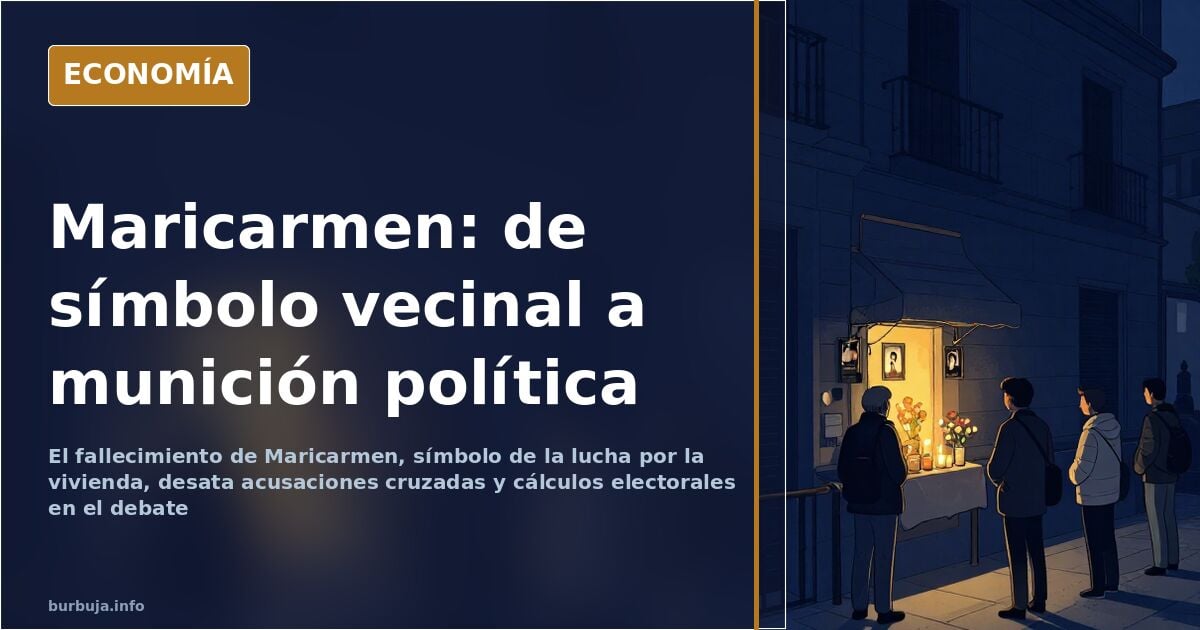
Maricarmen dies at 87 and politics seizes the moment
The woman evicted at 87 after seven decades in her Madrid apartment has died. The news, arriving just days before an election, has turned a human tragedy into a political battleground where each side blames the other. The case, already used as a symbol by the Tenants' Union, is back in the spotlight with cross-accusations over who is responsible for her death.
Maricarmen became a symbol of the housing crisis. Her story, that of an elderly woman who lost her home after 71 years of renting, spread across Spain. Now, her death has triggered a political storm mixing electoral speculation, criticism of healthcare management, and conspiracy theories. The timing of her death, just days before the polls, has sparked a flood of reactions.
Who killed Maricarmen? The left and right narratives
From the left, her death is seen as a direct consequence of eviction policies and the lack of public housing. Critics argue that if the promised 200,000 homes had been built, Maricarmen would have a place to live. The criticism extends to pandemic management and claims that certain media outlets incivil the victim.
From the right, the accusation is more severe: they blame the Prime Minister, calling him an "assassin" who benefits electorally from the tragedy. Other disasters—the DANA, the blackout—are cited to build a narrative of incivil negligence. Some even suggest her death was induced by sedation to create a martyr before the elections.
Conspiracy theory: sedation and electoral opportunism
Among the most extreme claims is the idea that Maricarmen was sedated to death in the hospital so her passing would coincide with the election campaign. A tweet claims she was "injected with morphine at night in the same bottle" and that "it all ends in an overdose disguised as a terminal illness report." There is no evidence to support this version.
Another argument holds that her death arrived at the perfect moment to mobilize voters. If it had peine days earlier or later, it would not have had the same impact. The timing fuels suspicion of manipulation, though no one provides evidence beyond the date.
The Tenants' Union's role and the housing law
Maricarmen's case put the effectiveness of the housing law at the center of the debate. Critics claim the Tenants' Union used it until it "could take no more." The critique argues that socialist laws did not protect vulnerable tenants but exposed them to media and judicial pressure.
From the other side, defenders say the Tenants' Union highlighted her situation and prevented a silent eviction. The dispute over who helped and who harmed Maricarmen has become a reflection of political polarization.
[Housing as an electoral weapon[/B]
Beyond the specific case, the debate reflects Spain's structural housing crisis. The lack of public housing affects thousands, and Maricarmen's death is just the tip of the iceberg. The discussion shifts to the management of administrations and the responsibility of regional and central governments.
In this context, Ayuso's figure and Madrid's healthcare management appear in the background. Critics argue that healthcare depends on the Community of Madrid and that eviction policies are a regional competence. Maricarmen's death thus becomes a symbol of systemic failures.
Maricarmen's death leaves a question hanging: was it a human drama or a political instrument? Her death at 87 closes a life marked by the loss of her home. What remains is a poisoned debate where no one takes responsibility and everyone points fingers.
The woman evicted at 87 after seven decades in her Madrid apartment has died. The news, arriving just days before an election, has turned a human tragedy into a political battleground where each side blames the other. The case, already used as a symbol by the Tenants' Union, is back in the spotlight with cross-accusations over who is responsible for her death.
Maricarmen became a symbol of the housing crisis. Her story, that of an elderly woman who lost her home after 71 years of renting, spread across Spain. Now, her death has triggered a political storm mixing electoral speculation, criticism of healthcare management, and conspiracy theories. The timing of her death, just days before the polls, has sparked a flood of reactions.
Who killed Maricarmen? The left and right narratives
From the left, her death is seen as a direct consequence of eviction policies and the lack of public housing. Critics argue that if the promised 200,000 homes had been built, Maricarmen would have a place to live. The criticism extends to pandemic management and claims that certain media outlets incivil the victim.
From the right, the accusation is more severe: they blame the Prime Minister, calling him an "assassin" who benefits electorally from the tragedy. Other disasters—the DANA, the blackout—are cited to build a narrative of incivil negligence. Some even suggest her death was induced by sedation to create a martyr before the elections.
Conspiracy theory: sedation and electoral opportunism
Among the most extreme claims is the idea that Maricarmen was sedated to death in the hospital so her passing would coincide with the election campaign. A tweet claims she was "injected with morphine at night in the same bottle" and that "it all ends in an overdose disguised as a terminal illness report." There is no evidence to support this version.
Another argument holds that her death arrived at the perfect moment to mobilize voters. If it had peine days earlier or later, it would not have had the same impact. The timing fuels suspicion of manipulation, though no one provides evidence beyond the date.
The Tenants' Union's role and the housing law
Maricarmen's case put the effectiveness of the housing law at the center of the debate. Critics claim the Tenants' Union used it until it "could take no more." The critique argues that socialist laws did not protect vulnerable tenants but exposed them to media and judicial pressure.
From the other side, defenders say the Tenants' Union highlighted her situation and prevented a silent eviction. The dispute over who helped and who harmed Maricarmen has become a reflection of political polarization.
[Housing as an electoral weapon[/B]
Beyond the specific case, the debate reflects Spain's structural housing crisis. The lack of public housing affects thousands, and Maricarmen's death is just the tip of the iceberg. The discussion shifts to the management of administrations and the responsibility of regional and central governments.
In this context, Ayuso's figure and Madrid's healthcare management appear in the background. Critics argue that healthcare depends on the Community of Madrid and that eviction policies are a regional competence. Maricarmen's death thus becomes a symbol of systemic failures.
Maricarmen's death leaves a question hanging: was it a human drama or a political instrument? Her death at 87 closes a life marked by the loss of her home. What remains is a poisoned debate where no one takes responsibility and everyone points fingers.
Summary of a discussion on Burbuja.info - Foro de economía, actualidad y política., translated from Spanish and reviewed before publication. Read the full discussion (103 replies).
More summaries
-
Maricarmen, symbol of Spain's housing crisis, dies at 87
Maricarmen, symbol of Spain's housing struggle, dies at 87. Her death sparks conspiracy theories and renews the debate on evictions.
-
Spain's PSOE Calls Elections After Death of Evicted 87-Year-Old
An evicted 87-year-old woman in Madrid dies days before Spain's general election. The political fallout raises questions about voter mobilization.
-
Sánchez Resignation Rumors: No Official Confirmation Yet
Rumors of Pedro Sánchez's resignation circulate without official confirmation. The material provides no verifiable data on the announcement or reaction.
-
Tenant gets 12 months' rent if landlord doesn't renew lease
Spain's housing decree sets 12-month compensation for tenants if landlords fail to renew, delaying BOE publication.
-
YouTube's Cuqui Family: Profiting from Junk Food and Plastics
Burbuja.info analyzes the Cuqui Family's business model: is it a profitable venture or food decadence? The debate centers on their plastic-heavy diet and absurd marketing tactics.
-
Electoral Board: 400,000 'Grandchildren Law' nationals vote on Nov 29
Spain's Electoral Board confirms 400,000 nationals under the Grandchildren Law vote on Nov 29. Opposition challenges the count at the Supreme Court.