
Debate: Net Migration vs. Housing Supply in Madrid
Forum users debate if net migration of 600k-700k annually and low construction drive Madrid's housing price surge.
English · Original discussion in Spanish · Published
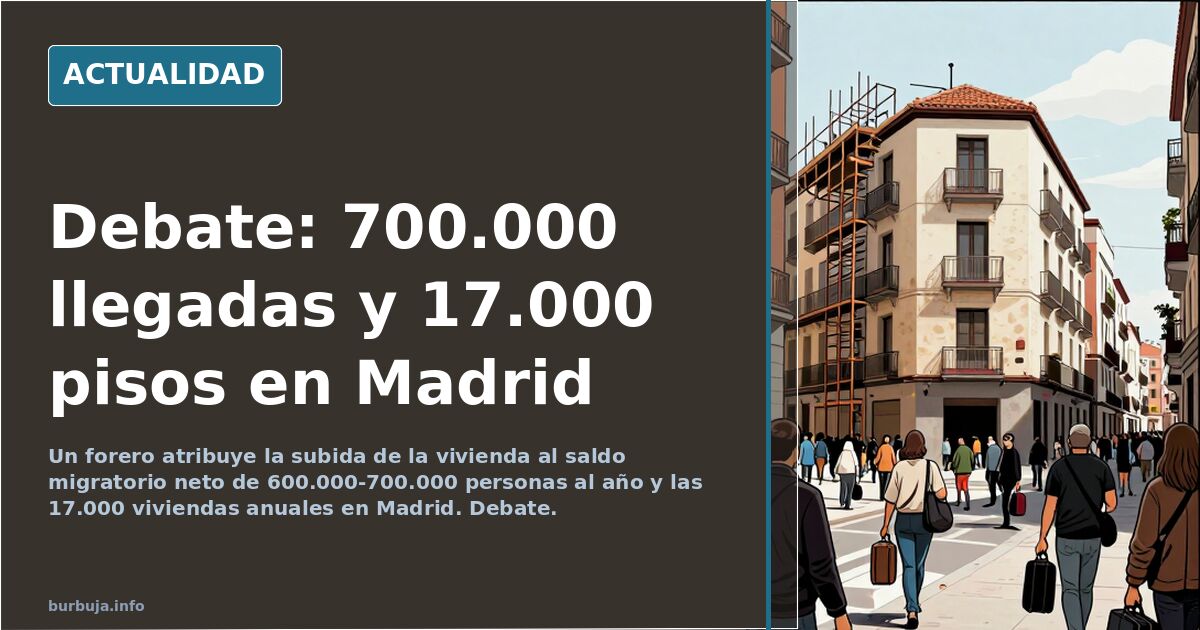
Why Housing Prices Won't Drop With 700,000 Annual Arrivals
How many people can enter a market before prices lose all sense? The discussion starts with an uncomfortable calculation: if between 600,000 and 700,000 people arrive in Spain each year — equivalent to the population of Seville — while only about 17,000 homes are built in Madrid, the arithmetic leaves little room for interpretation, according to the forum user starting the thread. The author summarizes this with a domestic example: a ten-story building with empty units can house five families, it can house eight, but with twelve, prices skyrocket. With one hundred, the conversation is over.
The thesis isn't new, but it makes almost everyone uncomfortable. And the first criticism it receives isn't ideological, but methodological: the cited figures aren't arrivals at the airport, but net migration balance, the difference between those arriving and those leaving, as another participant corrects him. A nuance that, for him, doesn't change the core issue, but which should be established before continuing.
The Ten-Story Building: Supply, Demand, and a Recurring Misunderstanding
The most repeated objection is textbook: if new homes sell for half a million euros, how can those arriving with nothing buy them? This reasoning ignores how a tiered market works, argues the thread starter. Pressure in the lower segment pushes residents with fewer resources into higher segments, who in turn push the next group up. The result isn't that a newcomer pays €500,000: it's that someone who could afford €300,000 now pays €400,000 for the same apartment because they compete with more people at every level.
Some argue the real problem is inflation rather than demographics, and that equivalent wage increases would correct it. The counterargument is that housing has decoupled from CPI: rents have risen much more than food and cars, which are felt in the shopping basket. The comparison with food is the most common: there is product in the supermarket; on Idealista, there isn't.
It’s Not Just Homes: Doctors, Beds, and Schools Are Missing Too
The initial premise isn't limited to housing. The same pressure shifts to hospitals, schools, roads, and public transport, infrastructure that isn't sized in a single budget exercise, according to the thread starter. This argument generates the most consensus, even among those who disagree with the migration diagnosis: absorbing hundreds of thousands of annual claimants requires ten-year planning, and that cannot be improvised in two or five years, notes another user.
The technical response points out that available land in the municipality of Madrid is practically exhausted. There remain specific developments in the east, some concrete urban operations, and little else; the rest of the margin lies in the metropolitan area and neighboring provinces, forcing consideration of rail connections before cranes, according to several participants. Calculating how many homes would come from these land parcels — and how far off that is from annual demand — is the kind of math best done with paper and pencil.
Who Benefits From the Status Quo
Here the analysis becomes uncomfortable for all political colors. Part of the argument holds that neither the right nor the left has an incentive to touch the tap, because both blocks benefit from population growth: some through businesses needing labor, others through public spending and electoral base. The conclusion, along those lines, is that the phenomenon won't stop due to political will.
The other flank points to hidden costs: rising municipal taxes, IBI (property tax) hikes of 13% passed on to tenants, and a general feeling that every administration wants its cut. It is the most cynical reading and, at the same time, the least controversial.
The Argument That Doesn’t Hold Up
The weakest objection is the one that reduces everything to tourist apartments and investment funds. They exist, they exert pressure, but they don't alone explain a rise that repeats itself in neighborhoods without any holiday rentals. Nor does the opposite: blaming exclusively migratory flow ignores that construction has been below household formation for years, for reasons stemming from the previous crisis.
What remains, after several days of discussion, is a shared diagnosis and a solution no one wants to pay for. Land is released slowly, public works take time, and meanwhile, the equivalent of a medium-sized city enters the system each year. With those numbers, expecting prices to drop is, at the very least, optimistic.
How many people can enter a market before prices lose all sense? The discussion starts with an uncomfortable calculation: if between 600,000 and 700,000 people arrive in Spain each year — equivalent to the population of Seville — while only about 17,000 homes are built in Madrid, the arithmetic leaves little room for interpretation, according to the forum user starting the thread. The author summarizes this with a domestic example: a ten-story building with empty units can house five families, it can house eight, but with twelve, prices skyrocket. With one hundred, the conversation is over.
The thesis isn't new, but it makes almost everyone uncomfortable. And the first criticism it receives isn't ideological, but methodological: the cited figures aren't arrivals at the airport, but net migration balance, the difference between those arriving and those leaving, as another participant corrects him. A nuance that, for him, doesn't change the core issue, but which should be established before continuing.
The Ten-Story Building: Supply, Demand, and a Recurring Misunderstanding
The most repeated objection is textbook: if new homes sell for half a million euros, how can those arriving with nothing buy them? This reasoning ignores how a tiered market works, argues the thread starter. Pressure in the lower segment pushes residents with fewer resources into higher segments, who in turn push the next group up. The result isn't that a newcomer pays €500,000: it's that someone who could afford €300,000 now pays €400,000 for the same apartment because they compete with more people at every level.
Some argue the real problem is inflation rather than demographics, and that equivalent wage increases would correct it. The counterargument is that housing has decoupled from CPI: rents have risen much more than food and cars, which are felt in the shopping basket. The comparison with food is the most common: there is product in the supermarket; on Idealista, there isn't.
It’s Not Just Homes: Doctors, Beds, and Schools Are Missing Too
The initial premise isn't limited to housing. The same pressure shifts to hospitals, schools, roads, and public transport, infrastructure that isn't sized in a single budget exercise, according to the thread starter. This argument generates the most consensus, even among those who disagree with the migration diagnosis: absorbing hundreds of thousands of annual claimants requires ten-year planning, and that cannot be improvised in two or five years, notes another user.
The technical response points out that available land in the municipality of Madrid is practically exhausted. There remain specific developments in the east, some concrete urban operations, and little else; the rest of the margin lies in the metropolitan area and neighboring provinces, forcing consideration of rail connections before cranes, according to several participants. Calculating how many homes would come from these land parcels — and how far off that is from annual demand — is the kind of math best done with paper and pencil.
Who Benefits From the Status Quo
Here the analysis becomes uncomfortable for all political colors. Part of the argument holds that neither the right nor the left has an incentive to touch the tap, because both blocks benefit from population growth: some through businesses needing labor, others through public spending and electoral base. The conclusion, along those lines, is that the phenomenon won't stop due to political will.
The other flank points to hidden costs: rising municipal taxes, IBI (property tax) hikes of 13% passed on to tenants, and a general feeling that every administration wants its cut. It is the most cynical reading and, at the same time, the least controversial.
The Argument That Doesn’t Hold Up
The weakest objection is the one that reduces everything to tourist apartments and investment funds. They exist, they exert pressure, but they don't alone explain a rise that repeats itself in neighborhoods without any holiday rentals. Nor does the opposite: blaming exclusively migratory flow ignores that construction has been below household formation for years, for reasons stemming from the previous crisis.
What remains, after several days of discussion, is a shared diagnosis and a solution no one wants to pay for. Land is released slowly, public works take time, and meanwhile, the equivalent of a medium-sized city enters the system each year. With those numbers, expecting prices to drop is, at the very least, optimistic.
Summary of a discussion on Burbuja.info - Foro de economía, actualidad y política., translated from Spanish and reviewed before publication. Read the full discussion (197 replies).
More summaries
-
Half of Spain's renters are now foreigners, forum claims
A forum post claims 5 million foreigners rent in Spain, while tourism accounts for only 10% of the market, sparking debate on housing shortages.
-
John MH: Air-Cooled Porsche, Two Daughters, Living with Parents
John MH owns an air-cooled Porsche, has two daughters and lives with his parents: in 2000 that car cost 10,200 euros and today it starts at 60,000
-
Teenager stabbed to death in Murcia over electric scooter
A 27-year-old man was fatally stabbed in Murcia during a scooter theft, reigniting Spain's debate on crime and security.
-
Illuminati and Antichrist: The Endless Apocalypse Fear Business
A 16-page manual on the Antichrist has circulated for 2,565 days, adapting its prophecy to every crisis from pandemics to GDP.
-
Orthotropics: Key to Facial Bone Development?
Analysis of non-surgical orthotropic methods for correcting bone and dental patterns.
-
Divorce costs men dearly: warning spreads across Spain
A divorced man describes losing his home and parental rights after a domestic abuse claim, sparking debate on the true cost of marriage in Spain.