
March 2014: Penny Stocks Soar as IBEX Stalls at 10,150
March 2014: IBEX closed at 10,150 while Plug Power soared 3,000% in a year and the Fed cut stimulus month by month.
English · Original discussion in Spanish · Published
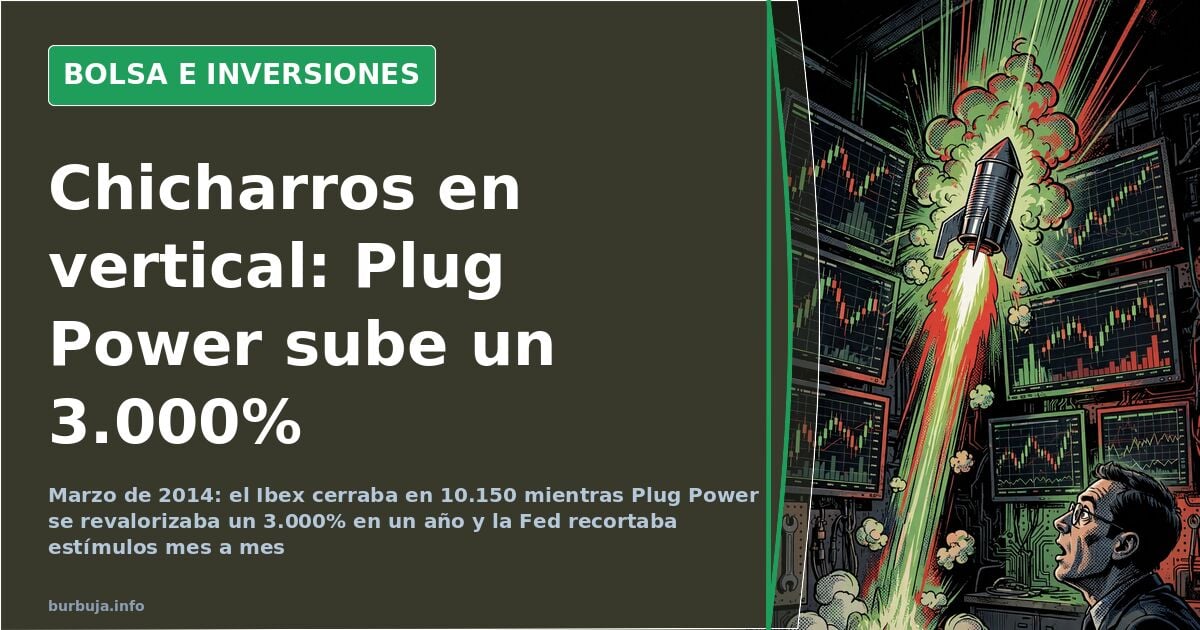
March 2014: Penny Stocks Skyrocket and an IBEX Stuck in No Man's Land
A retail investor admitted to 'pyramiding' into Bankia stock, pushing his average price up to 1.51 euros, commissions included. That day, the bank was up 5% and the IBEX closed at 10,150. It was the first week of March 2014, and the Spanish stock market was going through one of those phases where the main index sleeps while small companies do whatever they please. The issue that kicked off the month — penny stocks attacking the boss — summed up the mood: abundant liquidity, the Federal Reserve withdrawing stimulus drop by drop, and a legion of mid-cap stocks rising vertically for reasons no one could quite explain.
It was a two-estimulante ilegal month. The IBEX spent weeks hovering around the 10,000 mark, not breaking either way. Meanwhile, a handful of small caps posted triple-digit gains. The underlying question, as always: is this recovery or a bubble by another name?
The American Boom: From Plug Power to Ballard and FuelCell
The real spectacle wasn't in Madrid. It was in the American fuel cell and hydrogen sector, where Plug Power, Ballard, and FuelCell were moving vertically. Ballard was up 32% in a single session, with volume that had already seemed massive the day before. FuelCell gained 29%, ZBB a similar amount. BioFuel Energy, 115% in one day. And above all, Plug Power, which had accumulated nearly 3,000% appreciation in a year and touched $11.
It was a phenomenon that caught many off guard. The optimistic thesis spoke of a sector coming of age: Ballard's deals with Toyota, General Motors, and forklift manufacturers, burgeoning Chinese demand, and the ripple effect from Tesla. The skeptical view pointed to something older: lots of liquidity circulating, few assets with a compelling narrative, and a mass of investors willing to buy anything that was going up. 'It was going up vertically,' summarized one, unable to see a ceiling. Another offered a timeless warning: the bias of believing we're always at the end of something. If a stock has multiplied thirtyfold in a year, he argued, nothing prevents it from multiplying sixtyfold.
The parallels with previous fads, like 3D printing, helped frame the phenomenon: sectors with strong narratives attracting capital long before profits justify it. And the question hanging over the whole month: if there's no one to sell to when the cycle turns, who will sustain the prices?
Gowex, Carbures, and Natra: Domestic Penny Stocks
In Spain, the phenomenon had another name: penny stocks ('chicharros'). Gowex rose over 10%, Carbures took over when the former paused, Natra revived after weeks of losses, and Codere traded at 0.84 euros. Eurona, Deoleo, and Urbas appeared and disappeared from portfolios depending on the wind. The volume in Prisa raised suspicions: 'they say volume can't be hidden, so what's going on here?'
The coexistence between the index and these stocks fueled all sorts of theories. Some saw small-cap tech companies —Gowex was aiming for the IBEX, they said— as the new frontier for money; others recalled that the probability of losing on a penny stock is much higher than winning, especially when the market is paused and professional traders are busy fleecing the unwary. The difference between a conviction bet and a lottery depended, in most cases, on how long one had been in the game.
Telefónica, Maduro, and the DAX: Geopolitics Enters the Trading Floor
The month began with an uncomfortable headline: Maduro announced the nationalization of Telefónica in Venezuela. The Spanish operator, however, continued to climb, leading to all sorts of theories about how much of that announcement was noise and how much was money. In parallel, the German DAX plunged, and the Eurostoxx 50 flirted with closing a technical gap at 3,085 points. Here, however, the Spanish selective index seemed to have gotten used to rising and ignoring bad omens.
The Russian-Ukrainian tension loomed throughout the month, with eyes on the possibility of a regional conflict with unpredictable consequences. And the derivatives expiration on Friday, as always, served as a mandatory date for short-term traders. 'Expiration could push the IBEX very high, but there are also many reasons to go down,' summarized one of the most active traders, who admitted to going short on the Eurostoxx just in case.
IPOs Return and Quantitative Methods Gain Traction
With the markets hot, initial public offerings (IPOs) reappeared on the calendar. Ono maintained its plan for a stock market debut —despite not having a firm offer from Vodafone— starting March 13th. 'Keep your liquidity ready, the IPOs are starting,' warned one. Another replied with poor memory: 'Well, if they're like Bankia's…'
Meanwhile, in the lower end of the market, the conversation shifted to methodology. Joel Greenblatt's Magic Formula Investing, a quantitative system that filters stocks based on ROA, ROE, and the price-to-earnings ratio, was discussed at length. This led to discussions about Twinvest and the GAD method, two periodic investment systems promising smooth returns that could be applied to individual stocks or funds. The juiciest discussion wasn't about the formulas themselves, but about commissions: many of these plans fall apart when buying and selling stocks becomes prohibitively expensive. American brokers charged around $1 per trade; in Spain, traditional bank fees could be around 30 euros per purchase and another 30 per sale. 'Creating a template without including commissions is cheating,' concluded one.
Técnicas Reunidas: Board Salary Increases 31 Times More Than Staff
Not everything was euphoria. Mid-month, a piece of news focused attention on governance: the board of directors of Técnicas Reunidas increased its salaries 31 times more than its staff. This fact, read coldly, fueled suspicions of a potential labor conflict and, by extension, a risk to the stock. It's the kind of story that is ignored in a euphoric market but becomes an excuse to sell in a nervous one.
At the heart of it lay a broader discussion about Spanish recovery. Against the official narrative, one participant recounted closing his clothing store after losing 30,000 euros in two years. Another distinguished between two realities: domestic consumption and the SMEs dependent on it remained flat, while tourism and exports generated jobs and fresh money. Galician agri-food exports —dairy, meat, wine— were cited as an example. And an anecdote: a rural bakery in Portomarín, on the Camino de Santiago, sending empanadas to Australia.
The Fed Turns Off the Tap and the Treasury Eyes Dividends
The backdrop to the rally had a name: stimulus. The Federal Reserve's asset purchase program schedule —the POMO— was winding down. From 45 billion in December to 40 billion in January, 35 billion in February, 34 billion in March, and a projected 30 billion for April. Month by month, less fuel for the engine. 'At this rate, we'll need coal to keep it running,' wrote one.
And in Madrid, the tax reform threatened to hit the pockets of small investors. The so-called 'council of sages' proposed, among other things, eliminating the exemption for the first 1,500 euros of dividends received, a measure criticized precisely because it penalizes individual investors seeking periodic income rather than institutional investors. The warning lingered over the portfolios of those living off dividends.
March 31st: Doji, Anticlimax, and No Man's Land
The month closed with a day marking the end of the month and quarter. The IBEX formed a doji —opening and closing prices almost identical, pure indecision— and someone summarized the session with 'what an anticlimax in the 'churribez' (slang for IBEX).' Targets remained on the table: some spoke of 11,000 points as a minimum before May; the more cautious insisted that the gap at 9,450 needed to be closed first. In between, banks were rising, Popular had notable volume, and Gowex offered a breather after weeks of volatility.
And one transaction summarized the month's tone: Corporación Financiera Alba, Banca March's holding company, sold 1.306% of ACS at 28.515 euros per share, pocketing a gross capital gain of 46.2 million. In a market debating whether this was a recovery or just another speculative bubble, someone was already cashing out.
There the debate remained: the IBEX, in no man's land, between a crash and record highs. No one knew which way it would break. The only certainty was that in March 2014, with the Fed tightening and small caps flying, the Spanish stock market was two markets at once.
A retail investor admitted to 'pyramiding' into Bankia stock, pushing his average price up to 1.51 euros, commissions included. That day, the bank was up 5% and the IBEX closed at 10,150. It was the first week of March 2014, and the Spanish stock market was going through one of those phases where the main index sleeps while small companies do whatever they please. The issue that kicked off the month — penny stocks attacking the boss — summed up the mood: abundant liquidity, the Federal Reserve withdrawing stimulus drop by drop, and a legion of mid-cap stocks rising vertically for reasons no one could quite explain.
It was a two-estimulante ilegal month. The IBEX spent weeks hovering around the 10,000 mark, not breaking either way. Meanwhile, a handful of small caps posted triple-digit gains. The underlying question, as always: is this recovery or a bubble by another name?
The American Boom: From Plug Power to Ballard and FuelCell
The real spectacle wasn't in Madrid. It was in the American fuel cell and hydrogen sector, where Plug Power, Ballard, and FuelCell were moving vertically. Ballard was up 32% in a single session, with volume that had already seemed massive the day before. FuelCell gained 29%, ZBB a similar amount. BioFuel Energy, 115% in one day. And above all, Plug Power, which had accumulated nearly 3,000% appreciation in a year and touched $11.
It was a phenomenon that caught many off guard. The optimistic thesis spoke of a sector coming of age: Ballard's deals with Toyota, General Motors, and forklift manufacturers, burgeoning Chinese demand, and the ripple effect from Tesla. The skeptical view pointed to something older: lots of liquidity circulating, few assets with a compelling narrative, and a mass of investors willing to buy anything that was going up. 'It was going up vertically,' summarized one, unable to see a ceiling. Another offered a timeless warning: the bias of believing we're always at the end of something. If a stock has multiplied thirtyfold in a year, he argued, nothing prevents it from multiplying sixtyfold.
The parallels with previous fads, like 3D printing, helped frame the phenomenon: sectors with strong narratives attracting capital long before profits justify it. And the question hanging over the whole month: if there's no one to sell to when the cycle turns, who will sustain the prices?
Gowex, Carbures, and Natra: Domestic Penny Stocks
In Spain, the phenomenon had another name: penny stocks ('chicharros'). Gowex rose over 10%, Carbures took over when the former paused, Natra revived after weeks of losses, and Codere traded at 0.84 euros. Eurona, Deoleo, and Urbas appeared and disappeared from portfolios depending on the wind. The volume in Prisa raised suspicions: 'they say volume can't be hidden, so what's going on here?'
The coexistence between the index and these stocks fueled all sorts of theories. Some saw small-cap tech companies —Gowex was aiming for the IBEX, they said— as the new frontier for money; others recalled that the probability of losing on a penny stock is much higher than winning, especially when the market is paused and professional traders are busy fleecing the unwary. The difference between a conviction bet and a lottery depended, in most cases, on how long one had been in the game.
Telefónica, Maduro, and the DAX: Geopolitics Enters the Trading Floor
The month began with an uncomfortable headline: Maduro announced the nationalization of Telefónica in Venezuela. The Spanish operator, however, continued to climb, leading to all sorts of theories about how much of that announcement was noise and how much was money. In parallel, the German DAX plunged, and the Eurostoxx 50 flirted with closing a technical gap at 3,085 points. Here, however, the Spanish selective index seemed to have gotten used to rising and ignoring bad omens.
The Russian-Ukrainian tension loomed throughout the month, with eyes on the possibility of a regional conflict with unpredictable consequences. And the derivatives expiration on Friday, as always, served as a mandatory date for short-term traders. 'Expiration could push the IBEX very high, but there are also many reasons to go down,' summarized one of the most active traders, who admitted to going short on the Eurostoxx just in case.
IPOs Return and Quantitative Methods Gain Traction
With the markets hot, initial public offerings (IPOs) reappeared on the calendar. Ono maintained its plan for a stock market debut —despite not having a firm offer from Vodafone— starting March 13th. 'Keep your liquidity ready, the IPOs are starting,' warned one. Another replied with poor memory: 'Well, if they're like Bankia's…'
Meanwhile, in the lower end of the market, the conversation shifted to methodology. Joel Greenblatt's Magic Formula Investing, a quantitative system that filters stocks based on ROA, ROE, and the price-to-earnings ratio, was discussed at length. This led to discussions about Twinvest and the GAD method, two periodic investment systems promising smooth returns that could be applied to individual stocks or funds. The juiciest discussion wasn't about the formulas themselves, but about commissions: many of these plans fall apart when buying and selling stocks becomes prohibitively expensive. American brokers charged around $1 per trade; in Spain, traditional bank fees could be around 30 euros per purchase and another 30 per sale. 'Creating a template without including commissions is cheating,' concluded one.
Técnicas Reunidas: Board Salary Increases 31 Times More Than Staff
Not everything was euphoria. Mid-month, a piece of news focused attention on governance: the board of directors of Técnicas Reunidas increased its salaries 31 times more than its staff. This fact, read coldly, fueled suspicions of a potential labor conflict and, by extension, a risk to the stock. It's the kind of story that is ignored in a euphoric market but becomes an excuse to sell in a nervous one.
At the heart of it lay a broader discussion about Spanish recovery. Against the official narrative, one participant recounted closing his clothing store after losing 30,000 euros in two years. Another distinguished between two realities: domestic consumption and the SMEs dependent on it remained flat, while tourism and exports generated jobs and fresh money. Galician agri-food exports —dairy, meat, wine— were cited as an example. And an anecdote: a rural bakery in Portomarín, on the Camino de Santiago, sending empanadas to Australia.
The Fed Turns Off the Tap and the Treasury Eyes Dividends
The backdrop to the rally had a name: stimulus. The Federal Reserve's asset purchase program schedule —the POMO— was winding down. From 45 billion in December to 40 billion in January, 35 billion in February, 34 billion in March, and a projected 30 billion for April. Month by month, less fuel for the engine. 'At this rate, we'll need coal to keep it running,' wrote one.
And in Madrid, the tax reform threatened to hit the pockets of small investors. The so-called 'council of sages' proposed, among other things, eliminating the exemption for the first 1,500 euros of dividends received, a measure criticized precisely because it penalizes individual investors seeking periodic income rather than institutional investors. The warning lingered over the portfolios of those living off dividends.
March 31st: Doji, Anticlimax, and No Man's Land
The month closed with a day marking the end of the month and quarter. The IBEX formed a doji —opening and closing prices almost identical, pure indecision— and someone summarized the session with 'what an anticlimax in the 'churribez' (slang for IBEX).' Targets remained on the table: some spoke of 11,000 points as a minimum before May; the more cautious insisted that the gap at 9,450 needed to be closed first. In between, banks were rising, Popular had notable volume, and Gowex offered a breather after weeks of volatility.
And one transaction summarized the month's tone: Corporación Financiera Alba, Banca March's holding company, sold 1.306% of ACS at 28.515 euros per share, pocketing a gross capital gain of 46.2 million. In a market debating whether this was a recovery or just another speculative bubble, someone was already cashing out.
There the debate remained: the IBEX, in no man's land, between a crash and record highs. No one knew which way it would break. The only certainty was that in March 2014, with the Fed tightening and small caps flying, the Spanish stock market was two markets at once.
Summary of a discussion on Burbuja.info - Foro de economía, actualidad y política., translated from Spanish and reviewed before publication. Read the full discussion (4430 replies).
More summaries
-
Ibex 35 at 6,500 points: Bankia drops 17% in one session
The Ibex 35 trades at 6,500 points in May 2012 with Bankia losing 17% and banks only rebounding due to a potential short-selling ban.
-
Bankia Surges from €1 to €1.60 as IBEX Fights for 10,000 Points
In February 2014, Bankia shares rose from €1 to €1.60 while the IBEX 35 index hovered around 10,000 points. Santander paid a €1.50 dividend, and Telefónica closed at €11.11.
-
Ibex 35 in August 2012: The Stock Market Went Dark for Three Hours
On August 6, 2012, the Spanish stock market stopped trading for three hours amid crisis. The Ibex 35, short-selling bans, Bankia, and rescue rumors marked...
-
Gold stuck at 0.382 as bitcoin takes the spotlight
Gold stuck at 0.382 and unable to recover while bitcoin hits 6.000 dollars; thresholds at 1.250 and 1.050 set the scene.
-
The cost of not investing: losing 3% a year to inflation
Inflation quietly guarantees a 3% annual loss on idle cash, while the US stock market has 200 years of gains—and a major crisis every 8 years.
-
Extra virgin olive oil falls to €6.35 a litre at Mercadona
Extra virgin olive oil is now €6.35/litre at Mercadona, down from €6.75 months ago, while the origin price of picual is €4.143/kg