
Map of the 15,399 ships sunk in World War II
The Sunken Ships of the Second World War map brings together 15,399 WWII shipwrecks: 43.6 million tons and 567,518 documented casualties.
English · Original discussion in Spanish · Published
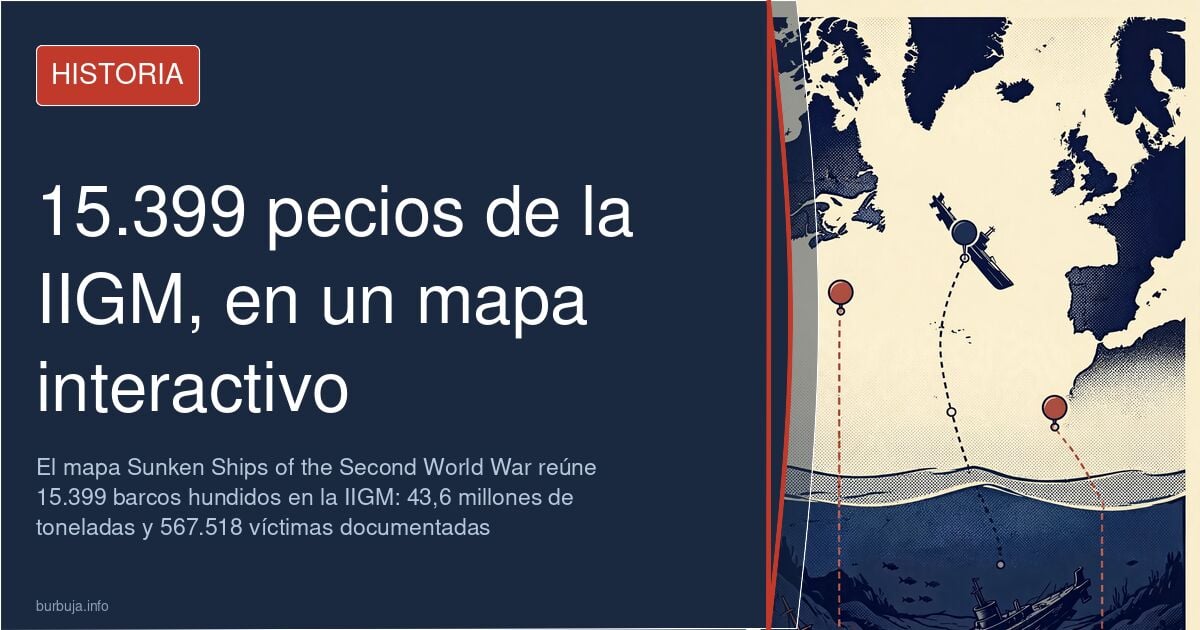
15,399 ships sunk in WWII, one by one on an interactive map
The Sunken Ships of the Second World War map lets you explore, with zoom, search and filters, the 15,399 ships sunk during World War II. Behind each point lie three figures rarely seen together: 43,658,518 gross tons and 567,518 casualties. Paul Heersink has spent years and more than a hundred sources building the database. It is not a catalogue of famous battleships, but the brutal accounting of a war fought as much on the water as in the offices.
Spain appears on the map too, even though no one counted it
Non-belligerent Spain has its own points. The steamer Banderas, of 2,140 GRT, was the first Spanish ship to fall victim to the conflict: torpedoed on 18 February 1940 by the U-53 three miles northwest of Cape Vilán, with 22 dead and 7 survivors. Almost two years later, on 13 December 1941, the CAMPSA tanker Badalona, 4,202 GRT, was stopped off Motril, at coordinates 36º43N - 003º30W, by the U-453, which gave the crew ten minutes before sinking it. Three victims. And the list adds the tanker Campo Manes, this time at the hands of an American submarine.
The Italian disaster no one warned about in time
Mussolini declared war on France and the United Kingdom on 10 June 1940 without warning his merchant marine, which had a good part of its ships at sea. The result was a third of its capacity lost at a stroke: more than 1,200,000 tons, most of them seized before anyone could react.
In North Africa the war was, above all, one of supplies. The Axis lost around 1,300 merchant ships loaded with material and troops. It was little use piling up mountains of equipment in Naples if the unloading capacity of the Libyan and Egyptian ports was what it was: ships waiting their turn were easy targets.
The wreck as a quarry: pre-Hiroshima steel
There is a murky business beneath the water. In Southeast Asia, World War II wrecks, often war graves, are being scrapped to extract low-radiation steel: metal made before Hiroshima and Nagasaki, and protected from the air by the sea, which commands high prices for precision instruments and sensors.
There is also the legend that the Ark Royal, sunk near Almería according to that same version, holds packed and perfectly preserved Merlin engines. The real value of such a cargo is debatable: it is a matter of collecting, and depends entirely on the scarcity of the object.
What the database does not resolve is how much military material ended up on the seabed. Tonnage is counted, not contents. No one knows how many M4 Sherman tanks, how many fighters, or what exact percentage of war production lies underwater, waiting for someone to add it up.
Also available in: Deutsch
Summary of a discussion on Burbuja.info - Foro de economía, actualidad y política., translated from Spanish and reviewed before publication. Read the full discussion (58 replies).
More summaries
-
1936 coup in Spain: false flag operation?
The 1936 uprising was launched under the republican flag and Mola was a republican. Was it a reaction to the Popular Front or a false flag operation to...
-
Mani Pulite: the storm that swept through Italy in 1992
17,000 officials charged, 1,456 arrested, more than 40 suicides: the economic and social impact of the operation that brought down Italy's Christian Democracy and…
-
Hautefaye 1870: the village that lynched its own lord
In 1870, in Hautefaye (Dordogne), a mob of villagers lynched Alain de Monéys during the town festival, 600 km from the front. A case that unsettles…
-
Nietzsche and Marx: rescuing uncomfortable ideas from distortion
Reading Nietzsche and Marx directly reveals uncomfortable conclusions, links to the ancient debt jubilee, and justified anger at how their ideas have been distorted.
-
Paris bohemian life in 1850: the underworld Marx lumped together
Marx placed criminals, ragpickers and bohemian writers in the lumpenproletariat. The list portrays Paris in 1850 and its marginal underworld.
-
90 years since the Spanish uprising: the mystery of Sanjurjo's plane crash
Ninety years after the National Uprising in Spain, the mysterious plane crash that killed General Sanjurjo and the conspiracy theories surrounding his death remain unresolved.