
Man Stabbed to Death in Terrassa During Robbery Attempt
A Moroccan man died after being stabbed during a phone robbery attempt in Terrassa, Spain. The Senegalese suspect was arrested and the investigation continues.
English · Original discussion in Spanish · Published
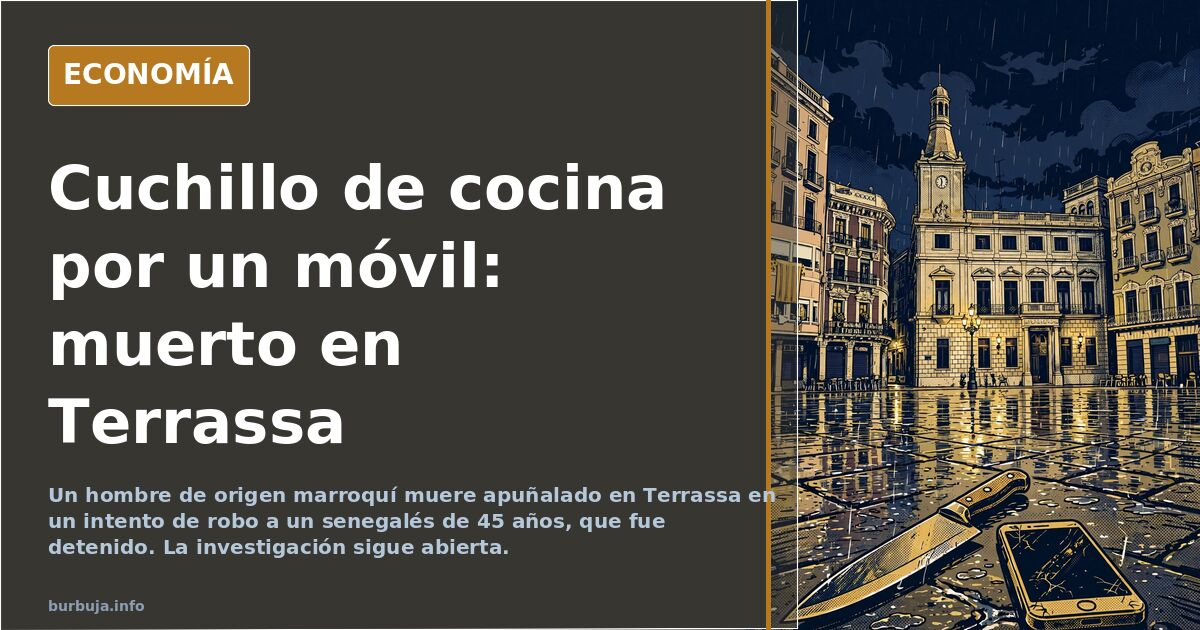
Man Dies After Being Stabbed in Terrassa During Robbery Attempt
The scene is textbook, though the ending is not. A man of Segarro origin approached another on a street in Terrassa to steal his phone. The second man, a 45-year-old from Senegal, responded with a large kitchen knife. The victim received a stab wound. SEM (Emergency Medical Services) and Mossos d'Esquadra tried to resuscitate him. It was too late. Police detained the aggressor at the scene, and the Incivil Investigation Division took over the case. The alleged perpetrator will appear before a judge. An attempted robbery, a kitchen weapon, and one dead. The rest is interpretation.
What Exactly Peine in Terrassa
According to initial reports collected by Món Terrassa, the deceased tried to steal the other man's mobile phone. The latter pulled out a large kitchen knife and stabbed him. Emergency services could not save his life. Mossos d'Esquadra and the Terrassa Municipal Police immediately detained the alleged aggressor. The investigation is led by the DIC of the Northern Metropolitan Region. The detainee is 45 years old and of Senegalese nationality.
The sequence is as simple as it is brutal. There are no organized gangs, no settling of scores, no political background. There is an attempted robbery and a lethal response. The question hovering over any analysis is how proportionate that response was. The law does not allow defending property with a kitchen knife, but the street does not operate with the penal code in hand.
The Weapon That Appears in All Analyses
The detail of the large kitchen knife is not anecdotal. Case material repeatedly suggests that carrying such a weapon is not exceptional in certain environments. One participant raises the uncomfortable question: where did the Senegalese man hide a knife of that size while wearing summer clothes? Another responds that, in some contexts, a firearm would be more appropriate. The discussion shifts toward the normalization of carrying improvised weapons.
The underlying issue is different. If a man about to be robbed carries a kitchen knife, how many people do so? The answer is not in official data, because there are no statistics on kitchen knives in public spaces. But this case has led many to wonder if self-defense with lethal means is becoming commonplace. Spanish law is restrictive regarding legitimate defense, especially when there is disproportionality of means. A knife against an attempted phone robbery is, almost certainly, disproportionate in the eyes of a judge.
The Debate on Proportionate Response
Some argue that the reaction was excessive and that a phone theft does not justify a death. Counter-arguments state that the robbery victim did not know if the aggressor was armed and acted on instinct. The line between defense and revenge is thin, and justice will have to decide in this case.
Another current of analysis points to a broader phenomenon: the feeling that street crime has become more violent. It is argued that robberies used to be resolved with a snatch-and-run, but now they end with knives. There is no data in the material confirming this perception, but the perception exists and shapes the public debate. One participant summarizes it bluntly: "These things were almost unseen in Spain before... nobody killed anyone to steal a damn mobile or to prevent one being stolen... now they are common."
Who Was the Victim and Who Was Detained
The nationalities of those involved have centered much of the reaction. The deceased was of Segarro origin. The detainee was Senegalese. Comments in the material highlight that both were migrants, with irony regarding the idea that "they come to do essential jobs Spaniards don't want." Others note that if convicted, the detainee will have access to a lawyer, learn Spanish in prison, and contribute to unemployment funds. The reality of the Spanish prison system is this: jail is not just punishment; it is also an environment where skills are acquired and administrative status is partially regularized.
The case has served as a reminder for some that violence knows no borders. An attempted phone robbery in Terrassa ends with one dead and one detained. Both are migrants. The news is not who they were, but that a mobile phone cost a life.
What the Law Says About Legitimate Defense
The Spanish Penal Code requires three conditions for legitimate defense: illegitimate aggression, rational necessity of the means employed, and lack of sufficient provocation. In this case, the illegitimate aggression is the attempted robbery. The rational necessity of the means is where the kitchen knife comes in. A court must assess whether a man about to be robbed could have defended himself differently. The answer is not simple. Jurisprudence is restrictive regarding the use of bladed weapons in self-defense, especially when the aggressor does not display a firearm. The detainee faces possible homicide charges, not exempted homicide in legitimate defense. The investigation remains open.
The case leaves a disorienting figure: a mobile phone. That was the value put on the table. One man dead, another detained, two families shattered, and an unanswered question. How much is a phone worth? To the thief, little. To the defender, sometimes their entire life.
The scene is textbook, though the ending is not. A man of Segarro origin approached another on a street in Terrassa to steal his phone. The second man, a 45-year-old from Senegal, responded with a large kitchen knife. The victim received a stab wound. SEM (Emergency Medical Services) and Mossos d'Esquadra tried to resuscitate him. It was too late. Police detained the aggressor at the scene, and the Incivil Investigation Division took over the case. The alleged perpetrator will appear before a judge. An attempted robbery, a kitchen weapon, and one dead. The rest is interpretation.
What Exactly Peine in Terrassa
According to initial reports collected by Món Terrassa, the deceased tried to steal the other man's mobile phone. The latter pulled out a large kitchen knife and stabbed him. Emergency services could not save his life. Mossos d'Esquadra and the Terrassa Municipal Police immediately detained the alleged aggressor. The investigation is led by the DIC of the Northern Metropolitan Region. The detainee is 45 years old and of Senegalese nationality.
The sequence is as simple as it is brutal. There are no organized gangs, no settling of scores, no political background. There is an attempted robbery and a lethal response. The question hovering over any analysis is how proportionate that response was. The law does not allow defending property with a kitchen knife, but the street does not operate with the penal code in hand.
The Weapon That Appears in All Analyses
The detail of the large kitchen knife is not anecdotal. Case material repeatedly suggests that carrying such a weapon is not exceptional in certain environments. One participant raises the uncomfortable question: where did the Senegalese man hide a knife of that size while wearing summer clothes? Another responds that, in some contexts, a firearm would be more appropriate. The discussion shifts toward the normalization of carrying improvised weapons.
The underlying issue is different. If a man about to be robbed carries a kitchen knife, how many people do so? The answer is not in official data, because there are no statistics on kitchen knives in public spaces. But this case has led many to wonder if self-defense with lethal means is becoming commonplace. Spanish law is restrictive regarding legitimate defense, especially when there is disproportionality of means. A knife against an attempted phone robbery is, almost certainly, disproportionate in the eyes of a judge.
The Debate on Proportionate Response
Some argue that the reaction was excessive and that a phone theft does not justify a death. Counter-arguments state that the robbery victim did not know if the aggressor was armed and acted on instinct. The line between defense and revenge is thin, and justice will have to decide in this case.
Another current of analysis points to a broader phenomenon: the feeling that street crime has become more violent. It is argued that robberies used to be resolved with a snatch-and-run, but now they end with knives. There is no data in the material confirming this perception, but the perception exists and shapes the public debate. One participant summarizes it bluntly: "These things were almost unseen in Spain before... nobody killed anyone to steal a damn mobile or to prevent one being stolen... now they are common."
Who Was the Victim and Who Was Detained
The nationalities of those involved have centered much of the reaction. The deceased was of Segarro origin. The detainee was Senegalese. Comments in the material highlight that both were migrants, with irony regarding the idea that "they come to do essential jobs Spaniards don't want." Others note that if convicted, the detainee will have access to a lawyer, learn Spanish in prison, and contribute to unemployment funds. The reality of the Spanish prison system is this: jail is not just punishment; it is also an environment where skills are acquired and administrative status is partially regularized.
The case has served as a reminder for some that violence knows no borders. An attempted phone robbery in Terrassa ends with one dead and one detained. Both are migrants. The news is not who they were, but that a mobile phone cost a life.
What the Law Says About Legitimate Defense
The Spanish Penal Code requires three conditions for legitimate defense: illegitimate aggression, rational necessity of the means employed, and lack of sufficient provocation. In this case, the illegitimate aggression is the attempted robbery. The rational necessity of the means is where the kitchen knife comes in. A court must assess whether a man about to be robbed could have defended himself differently. The answer is not simple. Jurisprudence is restrictive regarding the use of bladed weapons in self-defense, especially when the aggressor does not display a firearm. The detainee faces possible homicide charges, not exempted homicide in legitimate defense. The investigation remains open.
The case leaves a disorienting figure: a mobile phone. That was the value put on the table. One man dead, another detained, two families shattered, and an unanswered question. How much is a phone worth? To the thief, little. To the defender, sometimes their entire life.
Summary of a discussion on Burbuja.info - Foro de economía, actualidad y política., translated from Spanish and reviewed before publication. Read the full discussion (153 replies).
More summaries
-
'Fake police' kidnap on AP-7, according to a tweet
A tweet reports a 19:30 incident on the AP-7 involving alleged fake police, reviving the question: can we spot a real officer?
-
Madrid police officer detained for scratching TV host Nacho Abad's car
A Madrid municipal police officer was arrested for vandalizing the vehicle of TV presenter Nacho Abad, who is demanding maximum penalties amid concerns over political polarization.
-
Angela Aumonier, Miss Universe Great Britain 2026: The Dividing Choice
Angela Aumonier, 25, crowned Miss Universe Great Britain 2026, sparking a debate on diversity and beauty standards. Read the details.
-
Forum claims Spanish women in their 40s seek wealthy partners
A forum thread argues that single women aged 30-40, facing financial precarity after years of spending, are returning to shared housing and seeking partners with assets.
-
Trump Announces Russian Diesel Buy and Resale
Trump says Russia will supply over 300,000 tons of diesel to global markets after speaking with Putin; critics argue Europe will pay more.
-
Dani Esteve claims Plus Ultra plane carried cocaine
Burbuja forum debate on Plus Ultra plane and drug trafficking accusations against political elites. Narco-state or firewall?