
Man arrested in Lugo, Spain, for driving a vehicle he built himself
A resident of Lugo, Spain, was arrested for driving a homemade vehicle powered by a brush cutter engine, a mini-moto fuel tank and a bicycle seat. The…
English · Original discussion in Spanish · Published
Man arrested in Lugo, Spain, for driving a vehicle he built himself
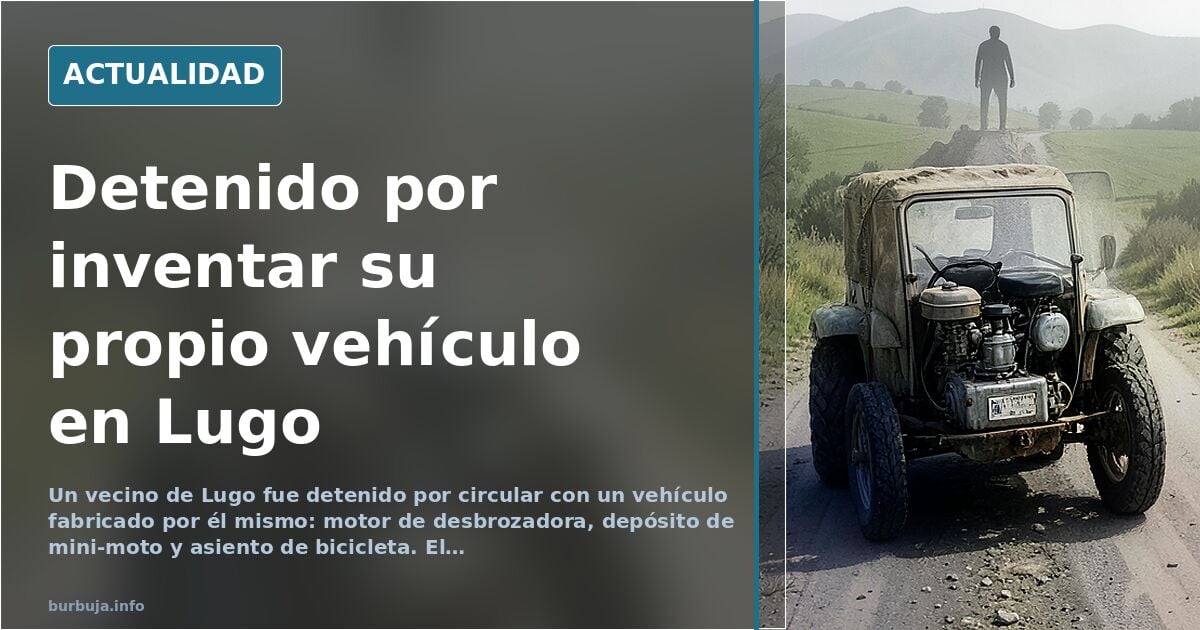
A resident of Lugo was arrested by the Guardia Civil (Spanish Civil Guard) while driving along the LU-530 road in a vehicle he had built himself: a brush cutter engine and throttle, a mini-moto fuel tank, and a bicycle seat and steering. The Traffic Division publicised the case as an example of what should not be done on public roads. The homemade, uncertified invention sparked a debate that goes far beyond the traffic code: is it a road safety offence or an example of popular ingenuity punished by bureaucracy?
What is known about the vehicle and the arrest
The contraption was not a motorcycle, a moped or an electric scooter. It was a mix of scrapyard parts assembled by hand: the engine and throttle of a brush cutter, the fuel tank of a mini-moto, and the seat and steering of a bicycle. That is what he was driving along the LU-530, a conventional road in the province of Lugo, when the Guardia Civil arrested him. The Traffic Division presented it as a textbook case: a motor vehicle with no type approval, no insurance, no number plate and no registration.
The arrest, however, is not the end of the matter. The driver faces a possible administrative fine and, according to the official account, a possible offence against road safety. The figure that keeps coming up in the debate is the 3,000 euros a month that, according to a widely circulated estimate, traffic officers allegedly earn. There is no official confirmation of that figure, but it helps explain the mood: part of the public sees the arrest as yet another revenue-raising operation rather than a safety measure.
Why arrest an inventor instead of simply fining him?
It is the arrest, and not just the fine, that has stung the most. An uncertified vehicle can be impounded and sanctioned, but an arrest implies that the conduct could constitute a incivil offence. That is the crux: for some of those involved, the driver is a incivil; for others, a man who recycled scrap and made do. The line between the two readings is drawn by the law, not by how endearing the contraption may be.
Some argue that the problem is not the ingenuity but the road it was driven on. If the vehicle travels at night, without lights, on a conventional road, the risk to others is real. In that scenario, the arrest would not be a whim: it would be a response to a concrete danger. The counterargument is just as simple: if there are no approved brakes or lights, the problem is one of safety, not creativity.
Recycling as an alibi and as a merit
One of the most repeated arguments is that of recycling. The arrested man used parts he already had, many of them useless, to build something functional. In environmental terms, that is pure reuse. In legal terms, it is irrelevant: vehicle regulations make no distinction between new and recovered parts. What matters is whether the whole meets the requirements to be driven.
That is where the contradiction many point to appears: recycling is rewarded in public discourse and punished when applied to a vehicle. The Galician inventor bought nothing; he assembled. And the result, according to the account, worked. The question hanging in the air is whether the system is designed to reward creativity or to channel it through type-approval procedures.
Bureaucracy as a brake on innovation
Comparisons with other countries soon appear. In Cuba, according to a story that keeps coming up in the debate, an NGO shipped chainsaws for work on a farm, and those in charge discovered that the workers had turned them into homemade motorcycles. Popular ingenuity, when there are no alternatives, finds a way. In Spain, the path runs through type approval, insurance and registration. Without that, there is no way forward.
The harshest criticism is that anything related to creativity, novelty or pogre is quickly crushed. It is not just that he was warned or fined: he was arrested. The difference between a fine and an arrest is the difference between a file and a incivil record. And for many, that is disproportionate.
The context: e-scooters, electric bikes and uncertified vehicles
The case of the Lugo resident is not an isolated phenomenon. In recent years, electric scooters, modified bicycles and personal mobility vehicles have proliferated, circulating without the required type approval. Regulations have been adapting, but the feeling that the market is ahead of the law is widespread. Mopeds pay taxes and insurance; many of these contraptions do not.
The discussion drifts towards unequal treatment. It is argued that imported electric vehicles, with batteries that can catch fire, are sold without problem in large stores, while a homemade vehicle with a brush cutter engine is punished with arrest. The comparison is not entirely fair —an approved scooter meets requirements the Galician invention does not— but it reflects a widespread perception: rigour is applied selectively.
The case is now in the hands of the Guardia Civil and the judicial authorities. There is no final ruling or known resolution. What remains is the image of a man arrested for driving something he built with his own hands, and the question of whether the system rewards or punishes those who make do. For now, the answer lies with the traffic code.
Also available in: Deutsch
Summary of a discussion on Burbuja.info - Foro de economía, actualidad y política., translated from Spanish and reviewed before publication. Read the full discussion (99 replies).
More summaries
-
Head of Guardia Civil anti-drug unit in Segovia arrested
The Guardia Civil arrested the head of the anti-drug unit in Segovia on 29 September 2026, who had already been arrested more than nine years earlier in another drug trafficking investigation.
-
Spanish court dismantles Civil Guard officer's 'I drank afterwards' drink-driving excuse
The Superior Court of Justice of Extremadura, Spain, upholds the conviction of a Civil Guard officer who claimed he drank alcohol after a crash. The timeline destroys his defence.
-
PP Mocks Puente’s Pain After Quad Injury, Sparking Political Row
A Spanish PP tweet mocking Transport Minister Óscar Puente’s injury sparks controversy ahead of regional elections, highlighting the fine line between political criticism and spectacle.
-
Vox gets the thanks for Valladolid card-access bins
A viral message shows waste containers in Valladolid, Spain, that supposedly only open with a card and credits Vox for it. What is known about the system and why it is sparking debate.
-
Spain's Civil Protection recommends keeping an emergency kit at home
Spain's Civil Protection agency recommends preparing a basic emergency kit to survive several days without supplies or during an evacuation. These are the key points.
-
Cyclists: the conflict the road can't solve
The conflict between cyclists, motorbikes and cars reopens the debate over how the asphalt is shared: neither licence plates nor bike lanes solve the problem of coexistence on…