
Head of Guardia Civil anti-drug unit in Segovia arrested
The Guardia Civil arrested the head of the anti-drug unit in Segovia on 29 September 2026, who had already been arrested more than nine years earlier in another drug trafficking investigation.
English · Original discussion in Spanish · Published
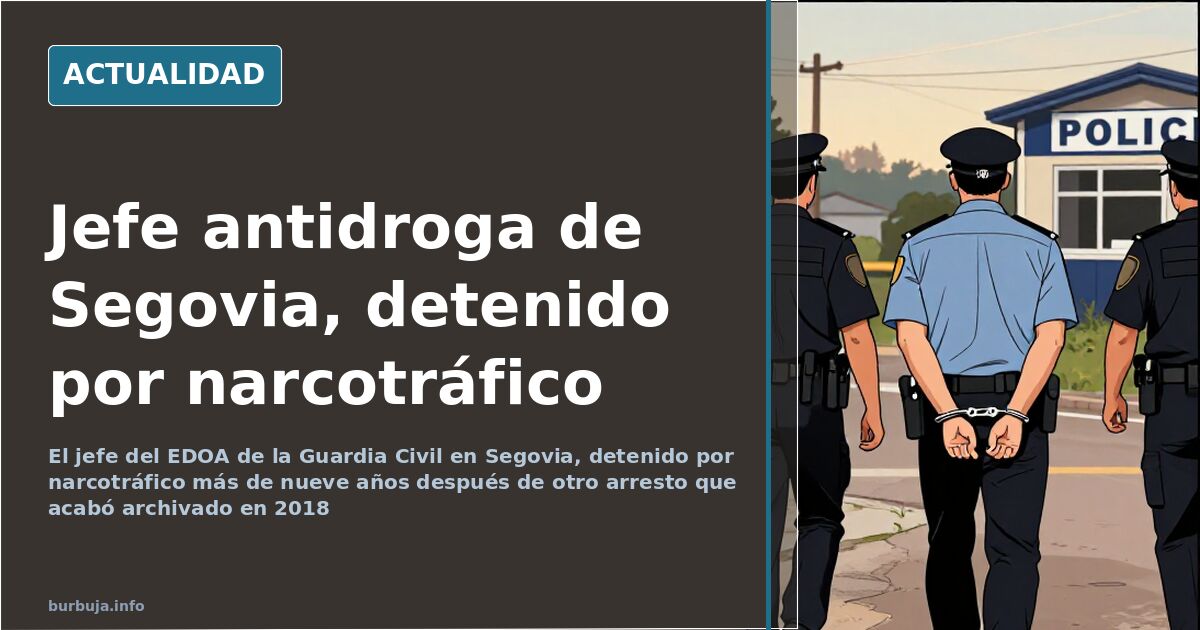
Segovia anti-drug chief arrested for drug trafficking
The man responsible for fighting drug trafficking in Segovia has been arrested for drug trafficking. On 29 September 2026, the Guardia Civil arrested Miguel Ángel Barbero, head of the Organized Crime and Anti-Drug Team (EDOA) of the Segovia Command, along with three other people not belonging to the State Security Forces. The operation was directed from Madrid by the force's central services and, according to sources consulted, no further arrests are expected.
A participant in the thread attributes to him the rank of sergeant first class, that is, a non-commissioned officer in charge of the unit fighting organized crime. Neither colonel nor lieutenant colonel. If confirmed, the rank leaves an uncomfortable image: the one who was supposed to cut off the supply now appears on the other side of the indictment.
Who is the detainee and what is he accused of
Barbero led investigations and operations against drug trafficking and organized crime in the province until his arrest. The operation is part of a drug trafficking investigation coordinated from central services, a detail that suggests his own colleagues had been tracking him for some time. The facts attributed to him are in the preliminary investigation phase and none of the hypotheses circulating has firm judicial backing.
The timing does not help the isolated incident version. The arrest comes less than ten months after an almost identical episode in the neighboring province.
Nine years earlier he had already been arrested, and the case was closed
Barbero's name was not new to an indictment. More than nine years earlier he had also been arrested in another drug trafficking investigation and was investigated for drug trafficking, membership in an organized incivil gang, bribery, disclosure of secrets and omission of the duty to pursue crime. In July 2018, the Court of First Instance and Preliminary Investigation No. 5 of Segovia ordered the definitive dismissal of the proceedings.
That was closed and he returned to his post. At the head of the same unit, with the same powers, for almost a decade. That a procedure is closed does not equate to a declaration of full innocence, but neither to a conviction: simply, the file stopped moving. What is relevant here is another fact: a commander who had been under investigation for drug trafficking returned to lead the fight against drug trafficking without any review of his assignment being recorded.
Valladolid, December 2025: the same pattern
On 6 December 2025, the head of the Narcotics Unit of the National Police in Valladolid fell, also in an anti-drug operation. The Court of Preliminary Investigation No. 3 of that city ordered his provisional imprisonment. Internal Affairs held him responsible for allegedly keeping part of the drug seizures from various operations.
In that case there were six more arrests, three of Spanish nationality and three of Dominican nationality, with varying degrees of involvement in the scheme. Two provinces, two forces, ten months apart. The coincidence proves nothing by itself, but it invites the question of whether the problem is people or controls.
How much corruption is there really in the security forces?
Here numbers and impressions diverge sharply. The figure used to play down the alarm is specific: according to a calculation circulating in the debate, in 2025 some 24 members of the State Security Forces were arrested out of a workforce of approximately 80,000 people, which represents 0.03%. With that data in hand, it is difficult to argue that the institution is undermined by corruption.
The counterargument also has substance. Arrest statistics measure what is discovered, not what happens, and in crimes where the investigator controls the evidence, the percentage tends to fall short by construction. The relevant question is not how many fall, but how many years someone can operate without anyone noticing.
The business nobody wants to close
In the background of the issue, the same idea always appears, formulated with more or less sarcasm: as long as the product is illegal, the margin will be high enough to buy loyalties. If drugs were decriminalized, a large part of the incentive to bribe a commander would disappear at once. Some propose this as a solution and others respond that the problem is not the substance, but the structure that is financed by its prohibition.
The joke about the stash that shrinks at each link in the chain, the one that enters with five tons and leaves with two, has been circulating for years. The joke works because it describes a real mechanism: the crime is not only in who sells, but in who decides what is counted and what is not.
With the detainee at the disposal of the court and the investigation just peine, the question nobody answers with data is how many cases like this exist without ever having been detected. And a dismissal, as was seen in 2018, does not always miccionan the matter was resolved.
The man responsible for fighting drug trafficking in Segovia has been arrested for drug trafficking. On 29 September 2026, the Guardia Civil arrested Miguel Ángel Barbero, head of the Organized Crime and Anti-Drug Team (EDOA) of the Segovia Command, along with three other people not belonging to the State Security Forces. The operation was directed from Madrid by the force's central services and, according to sources consulted, no further arrests are expected.
A participant in the thread attributes to him the rank of sergeant first class, that is, a non-commissioned officer in charge of the unit fighting organized crime. Neither colonel nor lieutenant colonel. If confirmed, the rank leaves an uncomfortable image: the one who was supposed to cut off the supply now appears on the other side of the indictment.
Who is the detainee and what is he accused of
Barbero led investigations and operations against drug trafficking and organized crime in the province until his arrest. The operation is part of a drug trafficking investigation coordinated from central services, a detail that suggests his own colleagues had been tracking him for some time. The facts attributed to him are in the preliminary investigation phase and none of the hypotheses circulating has firm judicial backing.
The timing does not help the isolated incident version. The arrest comes less than ten months after an almost identical episode in the neighboring province.
Nine years earlier he had already been arrested, and the case was closed
Barbero's name was not new to an indictment. More than nine years earlier he had also been arrested in another drug trafficking investigation and was investigated for drug trafficking, membership in an organized incivil gang, bribery, disclosure of secrets and omission of the duty to pursue crime. In July 2018, the Court of First Instance and Preliminary Investigation No. 5 of Segovia ordered the definitive dismissal of the proceedings.
That was closed and he returned to his post. At the head of the same unit, with the same powers, for almost a decade. That a procedure is closed does not equate to a declaration of full innocence, but neither to a conviction: simply, the file stopped moving. What is relevant here is another fact: a commander who had been under investigation for drug trafficking returned to lead the fight against drug trafficking without any review of his assignment being recorded.
Valladolid, December 2025: the same pattern
On 6 December 2025, the head of the Narcotics Unit of the National Police in Valladolid fell, also in an anti-drug operation. The Court of Preliminary Investigation No. 3 of that city ordered his provisional imprisonment. Internal Affairs held him responsible for allegedly keeping part of the drug seizures from various operations.
In that case there were six more arrests, three of Spanish nationality and three of Dominican nationality, with varying degrees of involvement in the scheme. Two provinces, two forces, ten months apart. The coincidence proves nothing by itself, but it invites the question of whether the problem is people or controls.
How much corruption is there really in the security forces?
Here numbers and impressions diverge sharply. The figure used to play down the alarm is specific: according to a calculation circulating in the debate, in 2025 some 24 members of the State Security Forces were arrested out of a workforce of approximately 80,000 people, which represents 0.03%. With that data in hand, it is difficult to argue that the institution is undermined by corruption.
The counterargument also has substance. Arrest statistics measure what is discovered, not what happens, and in crimes where the investigator controls the evidence, the percentage tends to fall short by construction. The relevant question is not how many fall, but how many years someone can operate without anyone noticing.
The business nobody wants to close
In the background of the issue, the same idea always appears, formulated with more or less sarcasm: as long as the product is illegal, the margin will be high enough to buy loyalties. If drugs were decriminalized, a large part of the incentive to bribe a commander would disappear at once. Some propose this as a solution and others respond that the problem is not the substance, but the structure that is financed by its prohibition.
The joke about the stash that shrinks at each link in the chain, the one that enters with five tons and leaves with two, has been circulating for years. The joke works because it describes a real mechanism: the crime is not only in who sells, but in who decides what is counted and what is not.
With the detainee at the disposal of the court and the investigation just peine, the question nobody answers with data is how many cases like this exist without ever having been detected. And a dismissal, as was seen in 2018, does not always miccionan the matter was resolved.
Summary of a discussion on Burbuja.info - Foro de economía, actualidad y política., translated from Spanish and reviewed before publication. Read the full discussion (65 replies).
More summaries
-
Zapatero's daughter photographs reporter after jewellery question
One of Zapatero's daughters photographs a reporter after he asks about jewellery; the prison sentences circulating are unconfirmed
-
Right-wing workers: Why the left no longer understands class voting
Why a growing part of the working class votes right or far-right: Gramsci's shift, tax anger, and 1975 unemployment data.
-
Excess Mortality Rises in Europe, Spain Among Hardest Hit
EU excess mortality hits 2.9% in 2025, with Spain among the most affected countries. Cancer, aging, and vaccines are central to the debate.
-
Street Control Is About Impunity, Not Courage
Street control depends on enforcement asymmetry, not individual bravery. An analysis of the phenomenon and its legal limits in Spain.
-
Forum User Complaints About Rising Latin American Immigration in Spain
A forum user claims to see 80% Latin Americans in a Madrid mall, sparking debate on housing costs, wage dumping, and demographic replacement.
-
Spanish King at Mauthausen sparks historical debate
The monarchs' attendance at the 80th anniversary of Mauthausen's liberation reignites tensions over Spain's Second Republic, Francoism, and the Crown.