
Cyclists: the conflict the road can't solve
The conflict between cyclists, motorbikes and cars reopens the debate over how the asphalt is shared: neither licence plates nor bike lanes solve the problem of coexistence on…
English · Original discussion in Spanish · Published
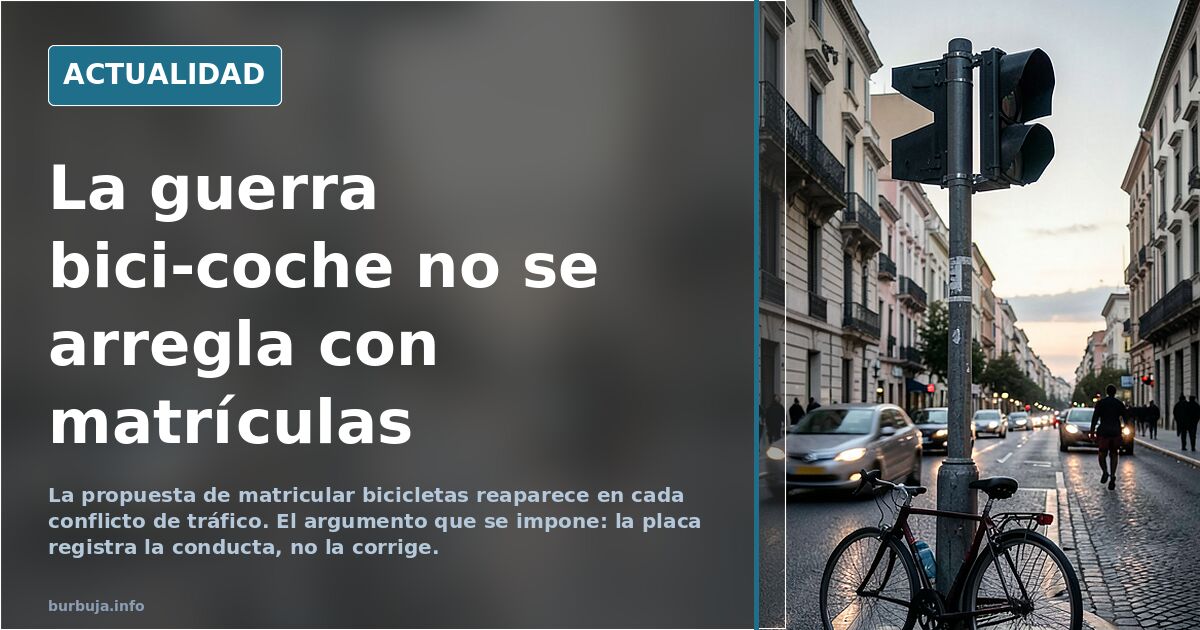
Cyclists: the standoff no road can solve
A cycling jersey, a raised hand and a car braking hard. The scene repeats itself every weekend on any secondary road in Spain, and it's enough to reopen a conflict that has gone unresolved for decades: the coexistence of bicycles, motorbikes and cars on roads that were designed for others. The discussion, reignited these days on a current affairs forum, leads to an uncomfortable diagnosis: there is no misunderstood group here, there is simply a distribution of space that was botched from the start.
The starting point comes from whoever reminds us that roads were first for pedestrians, animals and carts, cyclists included, and that later those users were pushed aside in favour of the car. They hijacked the roads and left everyone else with conflict, congestion and leftover spaces. That historical reading explains why cyclists feel entitled to the roadway and why drivers see them as intruders.
Why do people demand licence plates for bicycles?
The proposal to identify bicycles with licence plates comes up in the conversation and quickly falls flat. The argument against is simple: there is no practical way to do it without creating a useless registry, and the real problem is not identification but behaviour. Those who support the measure present it as a response to cyclists who run red lights or ride where they shouldn't; those who reject it point out that a bicycle is not a motor vehicle and that the administrative burden would fix nothing.
What does emerge is a distinction the debate keeps repeating: the cyclist who uses the bike to get from A to B or for a leisurely ride is not the same as the sporting group that races along the road. The former rarely causes problems. The latter concentrates the complaints: astronaut gear, aerodynamic posture, feet clipped to the pedals and a sense of impunity that irritates whoever is behind.
Bike lanes: the solution that falls short
The infrastructure doesn't come out well either. It is argued that bike lanes don't solve the underlying problem because they end up invaded by strollers, scooters and pedestrians, and because they don't connect real routes. The result is a user pushed out onto the roadway, still competing with the car for the same metre of asphalt.
The parallel with pedestrians is the most uncomfortable argument in the debate. If pedestrians can invade the roadway and scooters can too, why does the cyclist carry the stigma? The answer hinted at has to do with estimulante ilegal and mass: the cyclist is the only vulnerable user who moves fast and occupies the lane, and that makes them the perfect scapegoat.
Motorcyclists and cyclists: two stories that don't listen to each other
The conversation drifts towards the hierarchy of hatreds on the road. Some place motorcyclists, especially those on big bikes, at the top of the list of conflicts, ahead of taxis and delivery riders. And others respond with the same contempt towards cyclists. Two groups accusing each other of the same thing: acting like they own the road.
The anecdote that closes the circle is the jersey from the video, identified as that of a professional cycling team, and the name of a 1988 world champion that appears as a wink. Details that remind us that, behind the daily conflict, there is a sporting culture with its own codes that other drivers neither share nor understand.
The analysis gets stuck here. Nobody disputes that the road is badly shared; nobody accepts giving up the metre that belongs to them. Meanwhile, the cyclist's hand keeps going up at every bend.
Also available in: Deutsch
Summary of a discussion on Burbuja.info - Foro de economía, actualidad y política., translated from Spanish and reviewed before publication. Read the full discussion (15 replies).
More summaries
-
Spain road incident: truck overtaking cyclists collides with motorcycles
In Spain, a 20-meter truck crossed into oncoming traffic to pass cyclists, facing two motorcycles. The video sparks debate on liability.
-
Ketamine: the drug slipping through Spain's DGT drug tests
In the Balearic Islands, saliva tests fail to detect ketamine, and professional drivers use it to evade police checks. The system's loophole...
-
Ayuso Criticizes La Sexta Over Grandfather's Past
La Sexta Columna report on Ayuso's grandfather as Falange leader sparks controversy over politicians' family histories.
-
Sex workers' group challenges Sánchez to deny claims about 15 venues
A group of sex workers accuses Spain's PM Sánchez's family of running 15 venues and challenges him to deny it. The claim is unverified.
-
Vox demands repatriation and remigration as the price for any deal
Abascal demands a commitment to repatriation, deportations and remigration as a condition for any deal. According to a figure circulating in the debate, deporting costs more than 2,000…
-
Weekend map: Spain tops Europe in lack of national pride
A survey places Spain at the European top in lack of national pride, with 20% of Spaniards feeling no pride in their country. Country-by-country data and what lies behind it.