
Male migration: Spain's unmeasured gender imbalance
Migration arriving in Spain is young and overwhelmingly male. The gender imbalance and the loneliness of thousands of men are left out of the public narrative.
English · Original discussion in Spanish · Published
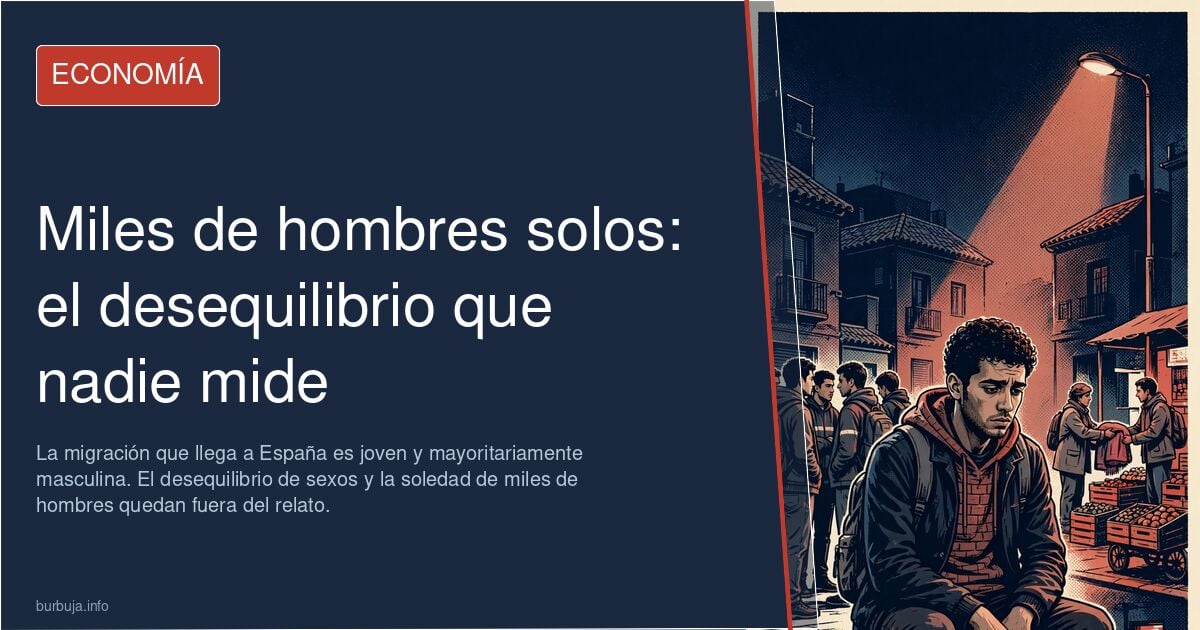
Young, male migration: the gender imbalance nobody measures
Immigration to Spain in recent years has a profile that is uncomfortable to face head-on: mostly men, mostly young, many without a partner and without a family network. The public narrative talks about quotas, housing and jobs. Almost nobody talks about the rest. And the rest — the emotional lives of thousands of lonely men — shapes where they sleep, who they socialise with and how long it takes them to put down roots.
A demographic pyramid without women
Economic migration is, by definition, a project for solitary travellers: the first to leave are those who can work and send money home, and the family reunites later, if it reunites at all. The result is a gender imbalance that shows up in shared flats, in free time and on the street, not in employment statistics. It is not a new phenomenon. Spanish emigration to Germany and Switzerland in the sixties and seventies was also overwhelmingly male, and it too left thousands of men alone and badly housed in barracks — a mirror worth keeping in mind before treating the current situation as unprecedented.
The gap filled by the informal market
Where social life is scarce and cash is plentiful, someone turns up to collect it. Much of the sens work in Spain operates in the shadow economy, with no contract and no social security registration, and its clientele is largely migrant and transient. Some argue this market acts as a safety valve; others reply that the argument is a cover for pure exploitation. The data that would settle the debate — how much money it moves, how many people work in it, under what conditions — are not published, precisely because it is informal.
Seven million single men, and not all of them arrived yesterday
The figure that unsettles the narrative is the seven million single men without a partner who were already here before the latest wave. Loneliness is not an imported trait: it is a Spanish demographic trend, with or without migration. What the gender imbalance changes is the concentration of the problem in one specific group, young and without a support network. Around this evidence also circulate accusations of sensual violence with no statistical breakdown to back them up, and it is worth remembering that a claim repeated a thousand times does not become a fact through repetition.
How much of this is a migration problem, and how much a society that has spent years failing to form couples? The number that would answer that is in no headline.
Also available in: Deutsch
Summary of a discussion on Burbuja.info - Foro de economía, actualidad y política., translated from Spanish and reviewed before publication. Read the full discussion (33 replies).
More summaries
-
Ceuta: Government Claims 10,000 Irregular Migrants, Experts Say 20,000
The Government cites 10,000 irregular migrants in Ceuta, while experts raise the figure to 20,000. We analyze the discrepancy.
-
Spanish government spends 15 million in public money on political clothing brand
Spain's government has earmarked 15 million for DMOCRACIA, a clothing brand promoted by influencer Marina Rivers. Efficient spending or propaganda?
-
The Temptation of Political Violence in Spain
The debate over a patriotic militia resurfaces in Spain. We examine the arguments, the comparison with ETA and the real risk of political violence.
-
1936: most Spaniards didn't pick a side, their city decided for them
The question of which side to choose in 1936 in Spain gets an uncomfortable answer: most people didn't choose, their city decided, and others would have emigrated.
-
Fran Perea and the goldmine of fifty-somethings singing pop
Fran Perea's concert reopens the debate about fifty-somethings singing pop: from the mocked outfit to the economic reproach of a generation that had it all.
-
The December 3 doomsday hoax: neither Nostradamus nor Von Foerster
The December 3 end-of-the-world claim mixes a 1960 paper on population with a Nostradamus prophecy. The study's real date was different: 2026.