
The December 3 doomsday hoax: neither Nostradamus nor Von Foerster
The December 3 end-of-the-world claim mixes a 1960 paper on population with a Nostradamus prophecy. The study's real date was different: 2026.
English · Original discussion in Spanish · Published
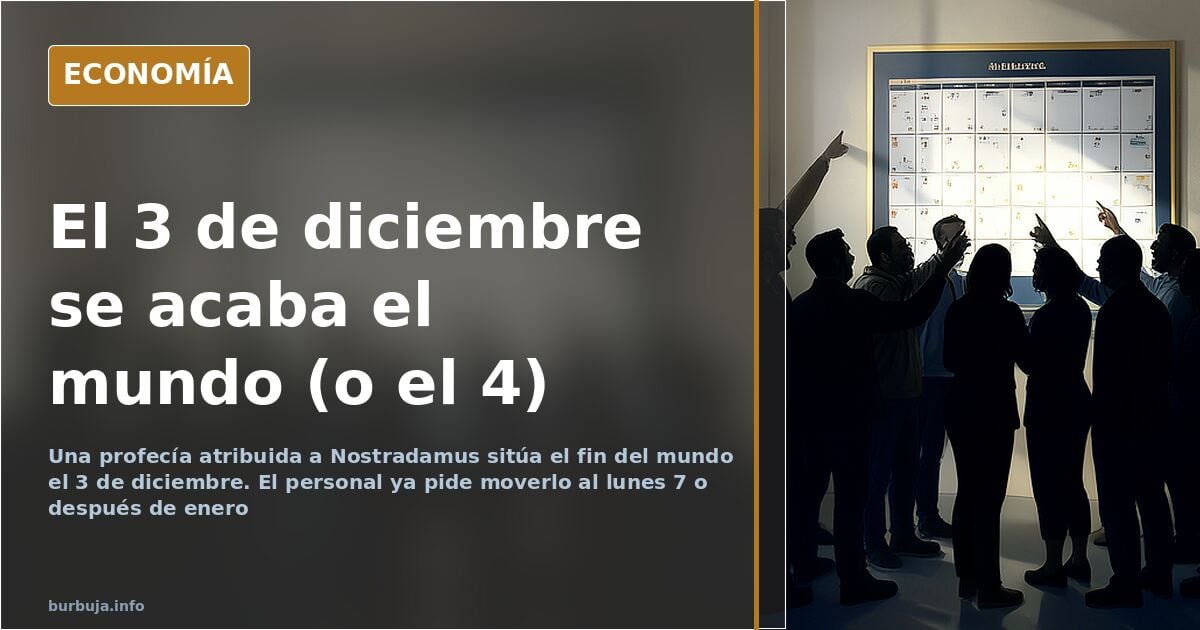
The December 3 hoax: neither Nostradamus nor the 1960 curve
A 1960 scientific paper and a supposed sixteenth-century prophecy have been circulating on social media for days as proof that the world will end on December 3. The problem is that neither of them says what they are claimed to say. The date that actually appears in a paper is a different one: Friday, November 13, 2026.
The real origin lies in a text by Heinz von Foerster and two colleagues, published in the journal Science under the title "Doomsday: Friday, 13 November, A.D. 2026." They fitted a curve to world population growth over the preceding centuries and found it was accelerating faster than an exponential: the more people there were, the faster the total grew. If that trend continued, the formula yielded an infinite population on that specific date. It was half joke, half serious, and the real point was another: that trend could not continue and something would have to stop it.
What peine to Von Foerster's curve
It stopped it. The world population growth rate peaked in the late 1960s and has been falling ever since. The formula worked as a warning, not a prophecy. Getting from there to December 3 is a leap nobody explains with data: the date appears neither in the paper nor in the verses of the French astrologer that are quoted secondhand.
What is striking is how the ball got rolling. A demography paper from more than sixty years ago, a vague mention of Nostradamus, and a round date falling on a Thursday. With those ingredients, the rumor has taken on a life of its own on social media and in the odd economics forum, where the news is met with more amusement than panic.
The calendar as an excuse for jokes
Because December 3 falls on a Thursday, and that has practical consequences. Some complain it wrecks their afternoon, some ask for it to be postponed until after the holidays, and some warn that the long weekend and the Christmas lottery are in jeopardy. The most repeated complaint is not existential, it is logistical: the last three ends of the world were poorly planned and this one is heading the same way.
There is also room for settling domestic scores. If the world ends, the mortgage is cancelled, the bills go unpaid, and one dies with a smile. It is the kind of humor that appears when the threat is not believed but is used as an excuse to let off steam. And a calendar gem: anyone who had a birthday on December 3, 1970 remembers that it was also a Thursday, and that Thursdays bring them bad luck.
Why the doomsday hoax keeps coming back
The closest precedent is 2012 and the Mayan calendar. More than a decade has passed and we are still here. The pattern repeats itself: take a serious text, strip it of context, add a date, and let it run. The result does not need to be true to work; it needs to be shareable.
The economic angle is the usual one: the collapse narrative sells better than the boring one. Meanwhile, the only figure that stands up to scrutiny is still the one from 1960, and it points to 2026, not this Thursday.
And what if, in the end, the wisest thing were to buy the panettone and sit back and wait?
Also available in: Deutsch
Summary of a discussion on Burbuja.info - Foro de economía, actualidad y política., translated from Spanish and reviewed before publication. Read the full discussion (43 replies).
More summaries
-
Donnie Darko, the number 88, and the prophecy predicting Trump's death
A numerological theory links Donnie Darko to Trump, placing his death 28 days after the July 13, 2024, assassination attempt in the US, using 88 as a key figure.
-
Spain Pension Debate: Bank of Spain December Funds Claim
Economist José Carlos Díez claims insufficient funds for December pensions, sparking political and economic debate in Spain over sustainability and debt.
-
CHR+ sold out until December: the last quarter will be crazy
Electric car sales rise 40% in June and the CHR+ is sold out until December. The last quarter promises to be crazy with new models and records…
-
Spain's low-key World Cup celebration that stunned a Uruguayan
A Uruguayan living in Spain was surprised to find no mayhem after the team reached the World Cup final. Spanish celebrations are more restrained than in other countries.
-
Alicante vs the Spanish Meseta: industrial engine or income mirage?
Alicante touts its aerospace and film industrial engine, while inland Spain counters with per capita income figures where Ourense and Lugo come out ahead.
-
Spain: 41 years of contributions, yet his pension is cut by 28%
Carlos Tena paid into Spain's social security system for 41 years, lost his job at 61 and now receives 28% less pension. The case pitting defenders and critics of the system against each other.