
The Temptation of Political Violence in Spain
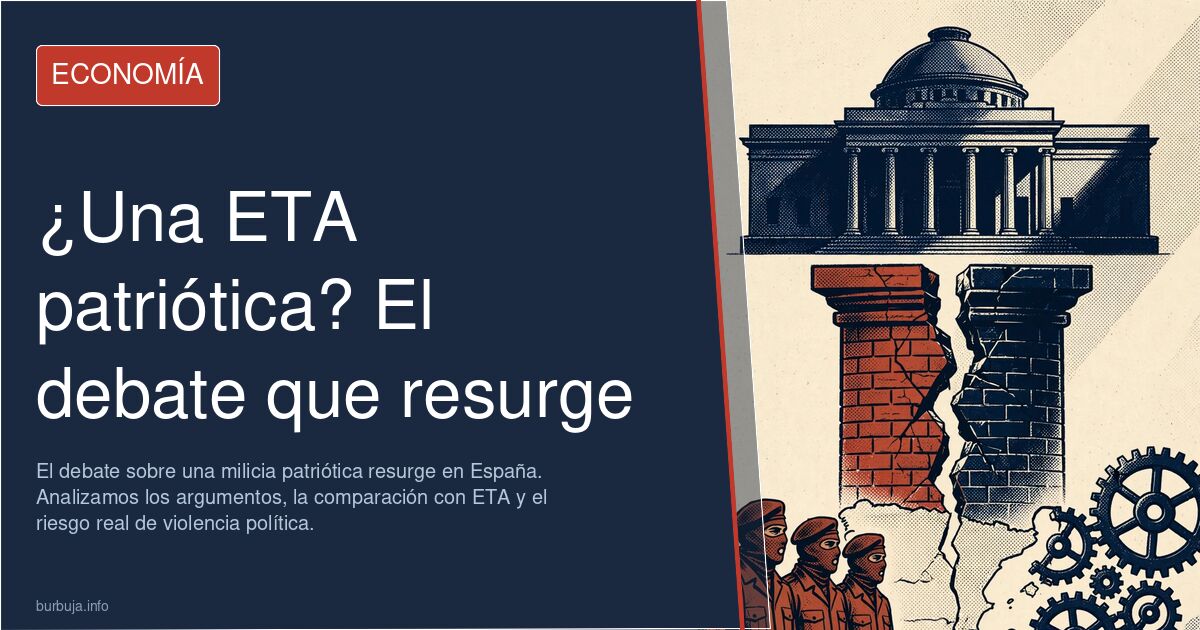
The debate over a patriotic militia resurfaces in Spain. We examine the arguments, the comparison with ETA and the real risk of political violence.
English · Original discussion in Spanish · Published
The temptation of violence as a political response
Political violence has not died in Spain; it sleeps beneath the surface. In online debates, the idea of a patriotic militia taking justice into its own hands resonates more strongly than the official narrative admits. The question is whether that rhetoric remains mere provocation or can have real consequences.
The mirror of ETA
The comparison with ETA is inevitable. Those who defend the need for an armed organization point out that the terrorist group began by attacking civil guards and police officers, not politicians, and that only over time did it degenerate into killing councillors and family fathers. That drift, they argue, is the inherent risk of any political violence: the initial target becomes corrupted and the cause is lost. The case of Melitón Manzanas, ETA's first murder, is often cited as the starting point of a spiral that eventually reached innocent victims.
Legitimacy in question
Another recurring argument is distrust of the State and its security forces. It is claimed that a patriotic militia would have as much or more legitimacy than any body that depends on the government of the day. Against this, some respond that the solution is not to arm oneself, but to change those in power through the ballot box. Democracy, however imperfect, allows representatives to be replaced without resorting to weapons. The irony that many of those proposing violence are the first to refuse to do military service themselves is not lost on critics.
Representative democracy under suspicion
The deepest criticism is aimed at the system itself. It is argued that representative democracy is a sham, because most citizens do not know their representatives. Some propose direct democracy as an alternative, others even an authoritarian regime. But that view clashes with reality: most people are not willing to sacrifice their comforts for an armed cause, as the scant practical support for militias demonstrates. Some recall that the ETA experience proves that a handful of gunmen can put a regime in a tight spot, but that without funding and external support it cannot bring it down.
Recent history shows that political violence usually ends in tragedy, but social frustration does not disappear by decree. As long as institutional channels continue to be perceived as insufficient, the temptation of violence will remain present, even if its materialization seems unlikely.
Also available in: Deutsch
Summary of a discussion on Burbuja.info - Foro de economía, actualidad y política., translated from Spanish and reviewed before publication. Read the full discussion (32 replies).
More summaries
-
Street political violence in Spain: the story doesn't match the videos
Videos of assaults at political information stalls reopen the debate over who commits political violence in Spain and how much truth there is in the official narrative.
-
Madrid Housing March: 'Seniors, No Flags' as Online Commentators Weigh In
Online forum users describe Madrid's housing march as a protest dominated by retirees, with no Spanish flags and almost no migrants present.
-
Marina D'Or: Spain's next property boom on the Mediterranean?
Apartments in Marina D'Or, Spain, from 120,000 euros. Could they double in price within 4 years? We look at the prediction and the precedents of Torrevieja and Benidorm.
-
Irene Montero films video at protest and gets thrown out
Irene Montero filmed a video at a demonstration and was ejected. Critics point to hypocrisy between her defence of public services and her children's private education.
-
The economic paradox behind the Pope's migration rhetoric
The Pope calls for welcoming migrants while the Vatican takes in not a single one. The economic paradox of a message that clashes with the Church's financial reality.
-
Signature drive launched to curb the EU's drift
The Save Europe Act platform is calling for 21,600 signatures a day to make the EU respect national identities. A citizen movement or wishful thinking?