
Madrid Tractor Protests: Police Crackdown, No Supermarket Shortages
Tractor blockades disrupt Murcia’s AP-7 and surround Madrid, yet police presence fails to trigger any food shortages in supermarkets.
English · Original discussion in Spanish · Published
Madrid Tractor Protests: Gas, Blockades, and No Shortages
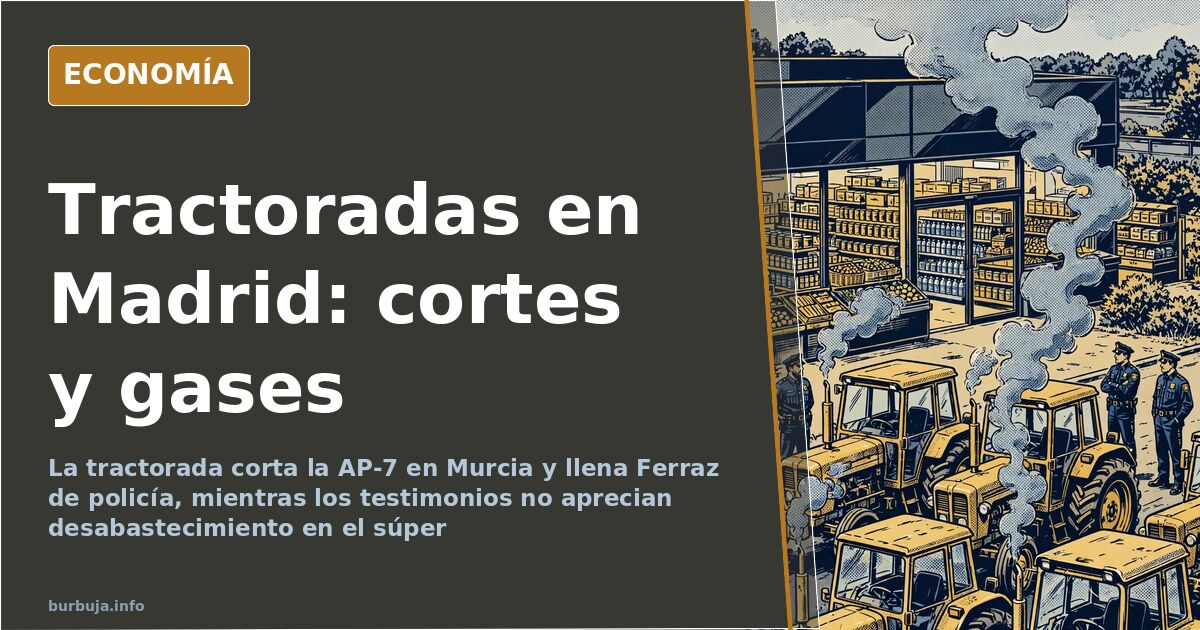
It is 10 a.m. on a Saturday. A hundred farmers wearing reflective vests block the AP-7 motorway near kilometer 786 in Murcia, allowing ten vehicles every ten minutes after an agreement with the first officers on site. Two hours later, forty riot police clear the gathering. This is the pattern of a day of tractor protests, announced as an assault on Madrid, which, by the time this article closes, leaves roads blocked, gas used around the Metropolitano stadium, Ferraz heavily guarded by police, and supermarket shelves exactly as they were the day before.
The headline circulated, attributed to the farming community, was different: a huge mess is about to happen. The expectation was a blockade capable of emptying shelves across half the country. The reality, for now, is far more modest.
What blockages occurred and where?
The actual map of the day is scattered. In Murcia, the AP-7 was cut in both directions before riot police intervened, after the organizers themselves had agreed with the Civil Guard to allow a trickle of vehicles. In Madrid, the gatherings were visible around the Metropolitano stadium, where the use of gas to disperse participants was reported, and at the access roads to Ferraz, which proge up with a heavy police presence.
The messages circulated during the morning insisted on two points: that the Civil Guard was escorting trucks and that negotiations were already underway. Those who could move through the center of the capital described Gran Vía and nearby streets as very calm, with few tractors able to enter the city and main avenues clear. The knot of the protest, therefore, was not tied in the capital.
Why are there no supermarket shortages?
This is the heart of the matter. One participant demands a total lock from the source —not a single kilo of food sold, no trucks leaving— because, they argue, a banner and a tractor on a roundabout do not move a single line in a negotiation. In contrast, those who trinc day-to-day operations note: there is no sign of anything in the supermarket, and terraces remain full.
The most widespread argument is that authorities chose to protect the final stage of the supply chain, not the logistics centers; that is, bringing the truck to the supermarket door, within the consumer's view. Testimonies from the thread indicate that, at least for now, stock reaches the shelves.
Habit works in favor of the status quo. As one participant summarized, the average buyer wants to see clean, tray-packaged produce, under air conditioning, with background music. They do not want a van in the parking lot or a cardboard box in the trunk. As long as this preference does not change, the struggle takes place on ground where farming starts at a structural disadvantage.
Direct sales, the weapon farmers do not use
There is an intermediate path that barely emerged during the day and which, according to one participant, would be more uncomfortable for organized distribution: the cooperative. Cheaper, higher-quality product delivered to the home, without intermediaries. On paper, it should attract much of the clientele that shops out of habit today.
The objection is always the same and is significant: building such a structure requires capital, logistics, and time, three things a protest cannot manufacture. As long as the alternative channel does not exist, the threat of emptying the supermarket remains rhetoric. And rhetoric feeds no one.
The origin of what we eat: Segarro, Portugal, and beyond
If the goal was for the supermarket shelves to show a difference, the adversary is not only in Madrid. The produce, according to participants, that comes from Segarro, Portugal, China, or South Africa does not obey the same rules, prohibitions, or production costs. This is the most repeated argument to explain why the promised shortage does not materialize: the tap is not controlled by those who block the road.
From this comes the most uncomfortable scene of the day: the speech that asks for support for the farming sector yet fills the cart with imported tomatoes. The war is ideological, yes, but the shopping basket is physical and paid for with a card.
The farming sector, that refuge that holds out longer than the city
One participant describes it thus: the countryside is more self-sufficient than the city. River water, own food, animals fed by the family, a long pause that does not press as hard as an apartment with a mortgage. They speak of enduring seven days, fifteen, a whole month. The logical question is how many of those days an urban economy can go without restocking.
The other side of the balance is the cost. Fines, selective arrests, and the wear of a public opinion that tires quickly. A long struggle is won on two fronts at once, and the second is not blocked by a tractor.
The closing that no one dares to sign
Positions are divided between those who believe this will end up as nothing and those who maintain that nothing is achieved without violence. The reality is that the scenario remains open: negotiation, attrition, or escalation. No one has yet signed the end.
To summarize the protest, one participant offers their own calculation: five cents per kilo of tomatoes at the source versus three euros in the supermarket.
Also available in: Deutsch
Summary of a discussion on Burbuja.info - Foro de economía, actualidad y política., translated from Spanish and reviewed before publication. Read the full discussion (248 replies).
More summaries
-
Spanish 50-year-old in the Philippines: €400 a month and a twenty-something girlfriend
A 50-year-old diabetic Spaniard moves to the Philippines: he lives on €400 a month, is looking for land, and already has a twenty-something girlfriend. The story that divides opinion.
-
Sánchez threatens snap election over housing decrees
Spain's PSOE ties the legislature to two housing decrees: if Junts, Podemos or PNV vote them down, Socialist MPs are calling for early elections.
-
Ceuta hospital patient with suspected meningitis bites and injures an orderly
A worker at the Hospital Universitario de Ceuta in Spain was bitten by a patient reportedly suffering from meningitis, according to a report by Cuatro. The Health Ministry has not commented.
-
Vox forces Andalusia to scrap housing aid for migrant NGOs
The regional government of Andalusia will not renew the programme that gave temporary shelter to 315 homeless people in flats run by Cruz Roja, Fundación SAMU and Inserta. It expires on 20 December.
-
Artemis 3: astronaut departures fuel radiation rumors
Four Artemis 3 astronauts have been removed from active duty in a short time. Rumors of excessive radiation exposure remain unconfirmed by NASA.
-
Viral X post claiming Mexicans hate Islam and Judaism lacks any evidence
A post on X claims that 'we Mexicans already hate Islam and Judaism.' The statement generalizes without any data, and it is worth separating migration concerns from religious prejudice.