
Artemis 3: astronaut departures fuel radiation rumors
Four Artemis 3 astronauts have been removed from active duty in a short time. Rumors of excessive radiation exposure remain unconfirmed by NASA.
English · Original discussion in Spanish · Published
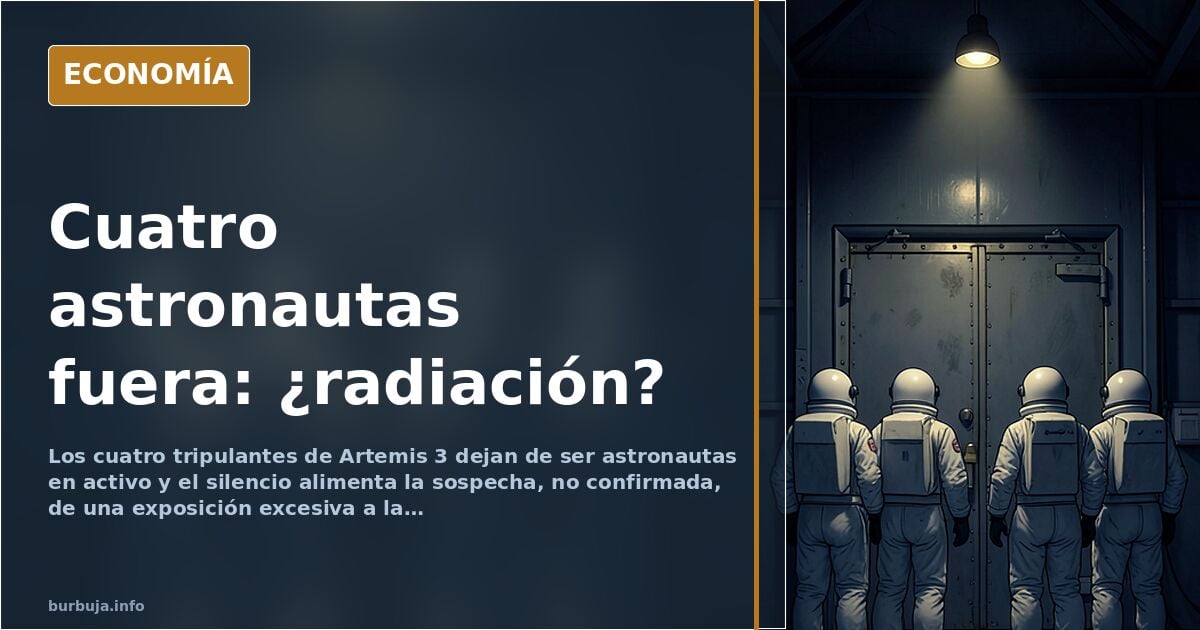
Artemis 3: four astronauts out and the radiation rumor mill spinning
Four astronauts selected for the Artemis 3 mission have left active duty within a strikingly short period. The coincidence has fueled a hypothesis that is spreading faster than any official statement: that radiation exposure measured by new high-precision dosimeters would have knocked the crew out of action. NASA has not confirmed it. But the mere fact that current technology might not be fit for humans in deep space sets off every alarm.
What is known about the Artemis 3 departures?
What has come out is that the four crew members are no longer active astronauts. There is no public medical report, no statement from the space agency, no official explanation tying up the loose ends. The rumor has filled the void: that the new radiation meters, installed for the first time on Artemis 3, would have recorded doses incompatible with continued service. It is a hypothesis, not a fact. And it should be treated as such.
Public discussion has split between those who see a smokescreen and those who point out that cosmic radiation is a first-order physical problem, not a conspiracy theory. Cosmic rays, the absence of Earth's magnetosphere, and solar proton storms have been documented risks since the Apollo era. The danger is nothing new. What would be new is the precision of the instrument measuring it.
The lethal dose being floated and the Apollo precedent
One figure has come up in the discussion that deserves context: 400 rad (4 Gy) whole-body. That amount approaches the lethal dose 50, the one that would kill half of those exposed without treatment. If that were the routine exposure of a lunar alucinación, the Apollo 8 crew would have returned with acute radiation syndrome. They did not. The figure, therefore, probably describes a worst-case scenario: a major solar proton storm catching the spacecraft outside Earth's magnetic field. That was NASA's real antiestéticar, and it was accepted as a risk because such events are rare and the alucinación lasts only days.
The Apollo program's dosimeters already measured radiation. It is not a technology born with Artemis. What has changed is the instrument's sensitivity and the willingness to scrutinize the data. The question hanging in the air is an uncomfortable one: what if the scrutiny reveals that current suits, spacecraft, and shielding are not enough for long-duration missions?
The economic cost of sending humans instead of robots
The debate goes beyond physics and straight into the economics of exploration. Part of the analysis argues that insisting on sending humans outside their natural habitat multiplies the cost: life support systems, shielding, emergency protocols, insurance, political risk. If missions were run combining artificial intelligence and remote control, the price would drop by half or more. And no human lives would be at stake.
The counterargument is a familiar one: robots do not sign autographs or justify budgets before Congress. Space exploration has always been, to a large extent, nationalist marketing. Experiments and data can be gathered without humans. But then there is no photo of a hero standing on the regolith. That photo is what sells the mission.
The race back to the Moon and the diversity narrative
Artemis 3 is not just a technical mission. It is an emblem. Its stated goals include landing the first woman and the first person of tonalidad on the lunar surface, building a permanent base at the ice-rich south pole, and setting up a small orbital station called Gateway. All of that requires active astronauts. If radiation sidelines them before liftoff, the narrative cracks.
Some see the emphasis on diversity as a budgetary smokescreen. Others recall that NASA has always sold romanticism while the private industry sets its sights on asteroid mining with robots. The Moon as a business does not need human boots. It needs them as a symbol.
Skepticism about the space program
There is no shortage of people who flatly deny that humans have ever left the atmosphere. The space station can be seen from the ground, yes, but for some that proves nothing. It is an old debate that resurfaces with every announcement. The radiation discussion has given fresh ammunition to those who claim it is all a soundstage production.
More nuanced is the argument that outer space is simply hostile and that the romantic vision of colonizing Mars is a fantasy centuries away. The scientific consensus suggests that Earth, even after a nuclear holocaust, would still offer better conditions for life than any candidate destination in the solar system. That does not stop robotic exploration from advancing. It only downgrades the astronaut's role.
What could happen with Artemis 3
The mission remains on the calendar, but the crew departures force a reshuffle. If the radiation rumor is confirmed, the lunar program faces a redesign of shielding and protocols that could delay it by years and send costs soaring. If it is debunked, the suspicion will remain that the space agency failed to communicate in time.
Meanwhile, current exploration technology is under suspicion. Is it fit for humans? The answer depends on whom you ask. The data from the new dosimeters, if it exists, is not public. And without data, the rumor rules.
Also available in: Deutsch
Summary of a discussion on Burbuja.info - Foro de economía, actualidad y política., translated from Spanish and reviewed before publication. Read the full discussion (134 replies).
More summaries
-
NASA Crew Announcement Faces CGI and Radiation Skepticism
NASA names Wiseman, Glover, Koch, and Hansen for lunar flyby. Public skepticism focuses on radiation safety and potential CGI fabrication.
-
Artemis 2: Lunar Orbit Mission, Not Landing
NASA's Artemis 2 launches April 2 to orbit the Moon. The landing is scheduled for Artemis 3, which some speculate may be cancelled.
-
NASA admits it lacks technology for lunar missions
Analysis of NASA's alleged technological gap for lunar missions and the challenge of space radiation
-
Photo of elderly couple robbed in France is AI: the hoax obscuring an unconfirmed theft
The image of the elderly couple stripped of their belongings in France was AI-generated, according to Libération CheckNews. The robbery it accompanies remains officially unconfirmed.
-
Man shares woman's photo on X asking doctors about her skin
An X user posts a photo of a woman dancing in a club and asks doctors what skin condition she has. The image was shared without her permission.
-
Camel cooling trick in the desert: clay pot on the hump explained
A viral tweet asks why a clay container is placed on camels' backs in the desert. The answer lies in centuries of adaptation to extreme heat.