
Madrid Overflows on the Holiday: An Hour to Cross Callao
Over an hour to cross Callao and hour-and-a-half queues for chocolate: Madrid's center is overwhelmed during the Immaculate Conception holiday.
English · Original discussion in Spanish · Published
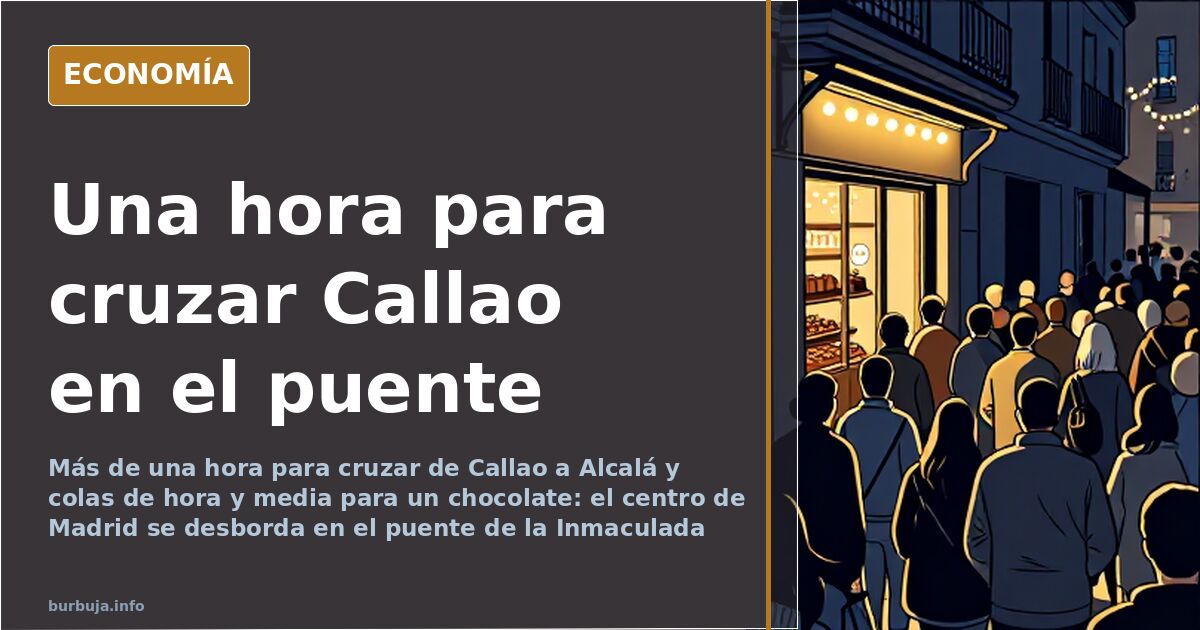
Madrid's center stops being a city on the Immaculate Conception holiday
How many people can fit in central Madrid before it stops functioning as a city? On December 6, according to those who experienced it, that threshold was crossed. At 5:00 p.m., the Cibeles area was a human traffic jam; from Callao to the intersection with Alcalá, over an hour. Plaza Mayor was just heads. Preciados streets looked as if gold were being handed out on corners. And in the most famous chocolate shops and bakeries, queues lasting an hour and a half for chocolate with churros.
The account is written by someone who did not want to be there: it was a family obligation, with the mother-in-law determined to spend the afternoon in the capital. What they found was something they had never seen in any other capital during Christmas. Not even in Paris, which another participant visited around the same dates and described as a quiet refuge compared to central Madrid.
Why the Immaculate Conception holiday is the worst time to visit Madrid
There is no mystery. The holiday concentrates three days of rest with the start of Madrid's Christmas: lights, markets, shop windows, and the feeling —bought at the price of stress— of being where one should be. The explanation repeats, everyone thought of the same thing.
Those who know the city have warned for years: late November is different, and working days after the holiday allow you to see the same nativity scenes and lights without fighting for a sidewalk. The alternative exists and is visible, with markets in Plaza de España and Santo Domingo or in the Salamanca Neighborhood for an unobstructed walk. The problem is not the supply. It is that almost no one chooses the right date.
The 'alpha' city that becomes a theme park of itself
Madrid has long been selling itself as a coveted capital: a trendy spot, a showcase, a city where people want to live and take photos. This appeal has a flip side that the December holiday reveals. When success is measured by how many want to be there, the street transforms into an endless line.
Some argue that the phenomenon responds to economic pull and a sense of centrality: if everyone wants to be there, it must be worth being there. Against this weighs an uncomfortable argument: moving among heads, standing in lines for anything, and feeling like livestock is hardly an appealing plan, no matter how much glamour is attached. Overcrowding is not a sign of vitality: it is an externality.
Can Madrid's center limit its capacity?
Currently, there is no mechanism to control capacity in the heart of the capital, according to some participants. The result, they say, is a tide without escape valves: it is very dangerous this uncontrolled volume of people, and someday we will regret it when no one wants to take responsibility.
The reference repeats: a critical account recalls that every December, during the Christmas lighting ceremony a few years ago, traffic was not cut off, and those images have become an annual classic of shame. Meanwhile, the commuter rail continues to bring the periphery to Puerta del Sol in less than half an hour, further increasing attendance on key dates.
Housing: the center expels those who work in it
Leisure saturation cannot be understood without housing saturation. Some have worked in Madrid for months and ended up living in a town in Cuenca due to housing prices, with the idea of having the best of both worlds: a quiet life and the capital nearby only for work.
Some point out that the center has become a set: expensive to live in, convenient to visit. And while one stands in line on Preciados, others look at their neighborhood and calculate how long they can hold out before leaving. The city fills with people who arrive and empties of people who stay.
With the half a million extra people, according to the author's calculation, on the streets, and an hour to cross an avenue, perhaps the thermometer of a capital's success is not how many want to go, but how long it takes you to leave it.
How many people can fit in central Madrid before it stops functioning as a city? On December 6, according to those who experienced it, that threshold was crossed. At 5:00 p.m., the Cibeles area was a human traffic jam; from Callao to the intersection with Alcalá, over an hour. Plaza Mayor was just heads. Preciados streets looked as if gold were being handed out on corners. And in the most famous chocolate shops and bakeries, queues lasting an hour and a half for chocolate with churros.
The account is written by someone who did not want to be there: it was a family obligation, with the mother-in-law determined to spend the afternoon in the capital. What they found was something they had never seen in any other capital during Christmas. Not even in Paris, which another participant visited around the same dates and described as a quiet refuge compared to central Madrid.
Why the Immaculate Conception holiday is the worst time to visit Madrid
There is no mystery. The holiday concentrates three days of rest with the start of Madrid's Christmas: lights, markets, shop windows, and the feeling —bought at the price of stress— of being where one should be. The explanation repeats, everyone thought of the same thing.
Those who know the city have warned for years: late November is different, and working days after the holiday allow you to see the same nativity scenes and lights without fighting for a sidewalk. The alternative exists and is visible, with markets in Plaza de España and Santo Domingo or in the Salamanca Neighborhood for an unobstructed walk. The problem is not the supply. It is that almost no one chooses the right date.
The 'alpha' city that becomes a theme park of itself
Madrid has long been selling itself as a coveted capital: a trendy spot, a showcase, a city where people want to live and take photos. This appeal has a flip side that the December holiday reveals. When success is measured by how many want to be there, the street transforms into an endless line.
Some argue that the phenomenon responds to economic pull and a sense of centrality: if everyone wants to be there, it must be worth being there. Against this weighs an uncomfortable argument: moving among heads, standing in lines for anything, and feeling like livestock is hardly an appealing plan, no matter how much glamour is attached. Overcrowding is not a sign of vitality: it is an externality.
Can Madrid's center limit its capacity?
Currently, there is no mechanism to control capacity in the heart of the capital, according to some participants. The result, they say, is a tide without escape valves: it is very dangerous this uncontrolled volume of people, and someday we will regret it when no one wants to take responsibility.
The reference repeats: a critical account recalls that every December, during the Christmas lighting ceremony a few years ago, traffic was not cut off, and those images have become an annual classic of shame. Meanwhile, the commuter rail continues to bring the periphery to Puerta del Sol in less than half an hour, further increasing attendance on key dates.
Housing: the center expels those who work in it
Leisure saturation cannot be understood without housing saturation. Some have worked in Madrid for months and ended up living in a town in Cuenca due to housing prices, with the idea of having the best of both worlds: a quiet life and the capital nearby only for work.
Some point out that the center has become a set: expensive to live in, convenient to visit. And while one stands in line on Preciados, others look at their neighborhood and calculate how long they can hold out before leaving. The city fills with people who arrive and empties of people who stay.
With the half a million extra people, according to the author's calculation, on the streets, and an hour to cross an avenue, perhaps the thermometer of a capital's success is not how many want to go, but how long it takes you to leave it.
Also available in: Deutsch
Summary of a discussion on Burbuja.info - Foro de economía, actualidad y política., translated from Spanish and reviewed before publication. Read the full discussion (346 replies).
More summaries
-
Puerta del Sol: protest camp on edge amid threat from far-right groups
Puerta del Sol encampment on edge: student union Sindicato de Estudiantes reports far-right threats as square fills
-
Maricarmen, evicted Madrid tenant, dies at 87
Maricarmen, the 87-year-old tenant evicted in Madrid, has died after being hospitalized since her forced removal.
-
Ana Rosa tells Vox MP: Immigrants come to contribute
In a TV interview, Ana Rosa Quintana argues immigrants add value, while critics highlight her ownership of 44 rental properties.
-
Moncloa boosts Alvise to curb Vox's 20% support
Forum thread claims Moncloa promotes Alvise to reduce Vox seats. One million votes might yield no MPs but could shift several.
-
Spain's Parasite Debate: Cultural Shock or Marketing?
Analysis of the debate on deworming in Spain: is it a cultural clash, a public health need, or just marketing?
-
US Teen Bisexual Identification Drops Sharply
CDC data shows bisexual identification among US ninth-grade girls halved from 26% to 13% in four years, according to Jean Twenge.