
Madrid Center: Itinerant Sales and 400,000 Crimes
Irregular street vending clusters in Madrid's tourist hub, where crime statistics jump from 52,190 to nearly 400,000.
English · Original discussion in Spanish · Published
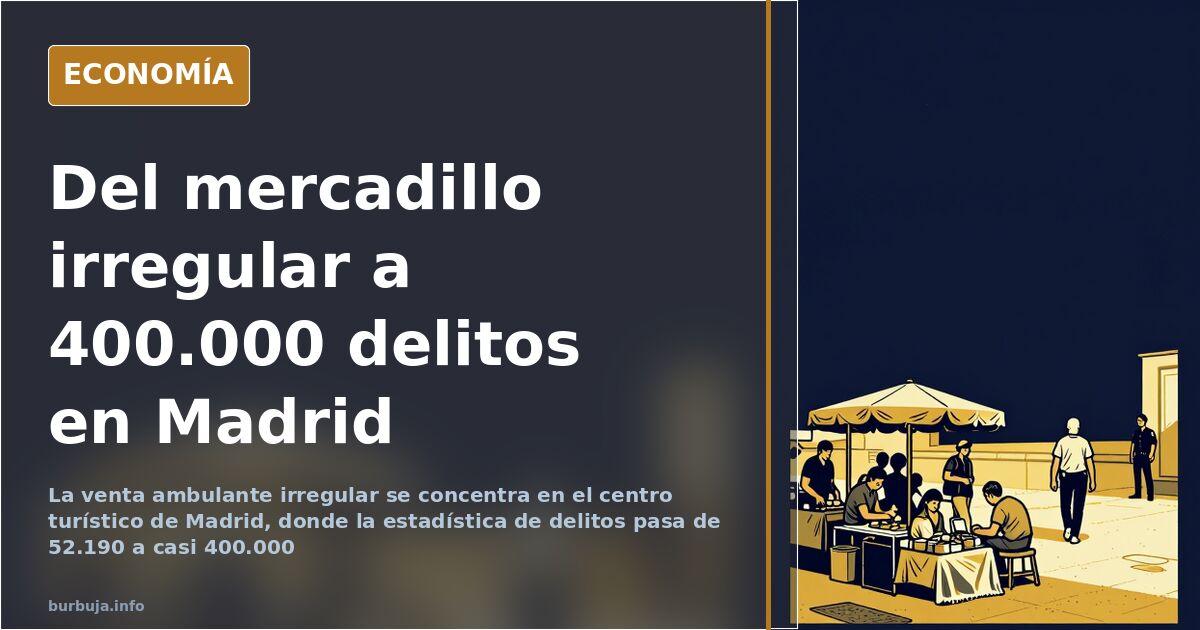
Itinerant sales and 400,000 crimes: Madrid's center under scrutiny
Madrid’s tourist core — from Callao to Sol, Gran Vía to Montera — has long been plagued by a scene merchants and residents complain about relentlessly: entire sidewalks taken over by stalls selling irregular, allegedly counterfeit or stolen goods. Every police raid ends the same way: vendors pack up and vanish in single file toward the metro. One night, sirens in Callao triggered a stampede witnesses described as cartoonish.
The anecdote is striking. The underlying issue is less so.
What is being reported in central Madrid?
The starting narrative is clear: entire streets in the capital’s heart are covered with blankets and unlicensed street stalls. Much of the merchandise is counterfeit or of allegedly illicit origin. Public space occupation isn’t limited to a few corners: according to this view, it affects nearly all central thoroughfares.
Those describing it most harshly don’t see it as an aesthetic nuisance, but as unfair competition against licensed businesses and a public order problem. Police operations arrive, but always face the same scene: stalls dismantled in seconds and a coordinated rush toward metro entrances, jumping turnstiles when necessary.
Tourists, the primary customers of street stalls
The buyer isn’t the local resident. Part of the analysis claims up to 95% of sales go to foreign tourists, which explains why the phenomenon concentrates in areas most traversed by visitors and disappears once you move away from them. Outside that perimeter, proponents of this thesis argue, stalls are barely visible.
The uncomfortable conclusion they draw: if tourists stopped buying, the business would collapse on its own. The disagreement lies in how to address it. Some point to increased surveillance and targeting buyers; others argue that police pressure only displaces the problem a few meters away.
How many crimes are committed in Madrid today versus 1980?
Two figures dominate the conversation, and neither is easily explained. The first, published by El País in 1980: 52,190 crimes committed that year in the province of Madrid. The second, released by Europa Press in 2024: 399,972 crimes in the Community of Madrid.
The jump is enormous. And here begins the problem. The territorial scope differs — province versus autonomous community — as does the population and possibly the counting criteria. Comparing these figures raw is tempting but imprecise. Nevertheless, those using them to counter nostalgia for a safer past have a difficult point to dispute.
The 1980s: drugs, gangs, and a movement that wasn’t just a party
The other side of the argument looks back. Madrid’s center in the 1980s appears in this narrative as territory taken over by drug addiction, gangs, and far-right groups who primarily attacked homeless individuals. At that time, nearly 20 bank robberies per day were recorded on average, and car break-ins to steal contents were routine.
This picture is contested. Some call it exaggerated, arguing that violent episodes were isolated, linked to specific neighborhoods, and that the “movida” cultural movement and the tenure of Tierno Galván painted a more diverse, less dangerous center. The struggle between these two memories remains open.
Immigration, the unspoken background
Underlying all of this is another debate: immigration. Some opinions cite it as the direct cause of the phenomenon, predicting that arrivals from Africa will not stop. The counterargument is standard economics: if the business exists, it’s because there’s demand, and that demand is mostly tourist-driven.
It’s important to separate levels. The weight of foreign-origin population in the center also responds to housing dynamics and generational turnover that have been underway for decades, and perceptions of safety don’t always align with statistics.
With these elements, the most prudent forecast is that irregular street vending will remain where it is as long as tourism doesn’t decline. Whether that translates into more crime is another matter: available data are too disparate, and comparisons too broad, to assume it. The center changes. The fight to explain why it remains equally alive continues.
Madrid’s tourist core — from Callao to Sol, Gran Vía to Montera — has long been plagued by a scene merchants and residents complain about relentlessly: entire sidewalks taken over by stalls selling irregular, allegedly counterfeit or stolen goods. Every police raid ends the same way: vendors pack up and vanish in single file toward the metro. One night, sirens in Callao triggered a stampede witnesses described as cartoonish.
The anecdote is striking. The underlying issue is less so.
What is being reported in central Madrid?
The starting narrative is clear: entire streets in the capital’s heart are covered with blankets and unlicensed street stalls. Much of the merchandise is counterfeit or of allegedly illicit origin. Public space occupation isn’t limited to a few corners: according to this view, it affects nearly all central thoroughfares.
Those describing it most harshly don’t see it as an aesthetic nuisance, but as unfair competition against licensed businesses and a public order problem. Police operations arrive, but always face the same scene: stalls dismantled in seconds and a coordinated rush toward metro entrances, jumping turnstiles when necessary.
Tourists, the primary customers of street stalls
The buyer isn’t the local resident. Part of the analysis claims up to 95% of sales go to foreign tourists, which explains why the phenomenon concentrates in areas most traversed by visitors and disappears once you move away from them. Outside that perimeter, proponents of this thesis argue, stalls are barely visible.
The uncomfortable conclusion they draw: if tourists stopped buying, the business would collapse on its own. The disagreement lies in how to address it. Some point to increased surveillance and targeting buyers; others argue that police pressure only displaces the problem a few meters away.
How many crimes are committed in Madrid today versus 1980?
Two figures dominate the conversation, and neither is easily explained. The first, published by El País in 1980: 52,190 crimes committed that year in the province of Madrid. The second, released by Europa Press in 2024: 399,972 crimes in the Community of Madrid.
The jump is enormous. And here begins the problem. The territorial scope differs — province versus autonomous community — as does the population and possibly the counting criteria. Comparing these figures raw is tempting but imprecise. Nevertheless, those using them to counter nostalgia for a safer past have a difficult point to dispute.
The 1980s: drugs, gangs, and a movement that wasn’t just a party
The other side of the argument looks back. Madrid’s center in the 1980s appears in this narrative as territory taken over by drug addiction, gangs, and far-right groups who primarily attacked homeless individuals. At that time, nearly 20 bank robberies per day were recorded on average, and car break-ins to steal contents were routine.
This picture is contested. Some call it exaggerated, arguing that violent episodes were isolated, linked to specific neighborhoods, and that the “movida” cultural movement and the tenure of Tierno Galván painted a more diverse, less dangerous center. The struggle between these two memories remains open.
Immigration, the unspoken background
Underlying all of this is another debate: immigration. Some opinions cite it as the direct cause of the phenomenon, predicting that arrivals from Africa will not stop. The counterargument is standard economics: if the business exists, it’s because there’s demand, and that demand is mostly tourist-driven.
It’s important to separate levels. The weight of foreign-origin population in the center also responds to housing dynamics and generational turnover that have been underway for decades, and perceptions of safety don’t always align with statistics.
With these elements, the most prudent forecast is that irregular street vending will remain where it is as long as tourism doesn’t decline. Whether that translates into more crime is another matter: available data are too disparate, and comparisons too broad, to assume it. The center changes. The fight to explain why it remains equally alive continues.
Summary of a discussion on Burbuja.info - Foro de economía, actualidad y política., translated from Spanish and reviewed before publication. Read the full discussion (215 replies).
More summaries
-
Four wildfires in Spain trigger national emergency amid prevention failures
A national emergency has been declared in Madrid and Ávila due to four wildfires, sparking debate over forest prevention and diverted funds.
-
Is now a good time to buy property? Debate
Is now a good time to buy a home? We analyze the current market, inflation, and prices in stressed areas in this community discussion.
-
Basque MP lists languages excluding Spanish
An EH Bildu deputy listed Wolof, Arabic, Hassaniya, Quechua and Basque as local languages, omitting Spanish.
-
Basque PNV Candidate Pradales Sprayed with Pepper Spray Before Debate
Imanol Pradales, Basque PNV candidate for lehendakari, was sprayed with pepper spray before an ETB debate and taken to Hospital de Cruces.
-
Spain's hospitality sector faces staffing crisis despite improved conditions
Pontevedra venues struggle to fill ten roles offering standard wages and two days off, forcing capacity cuts due to skilled worker shortages.
-
Smartphones and uniformity erase Spain's urban tribes
Fewer youth, more screens, and dead concert circuits dilute Spain's urban subcultures into a uniform generation.