
Madrid at breaking point: quality of life plummets amid overcrowding
Madrid is saturated with collapsed transport and stagnant wages. Quality of life declines as the economy grows, according to debate participants.
English · Original discussion in Spanish · Published
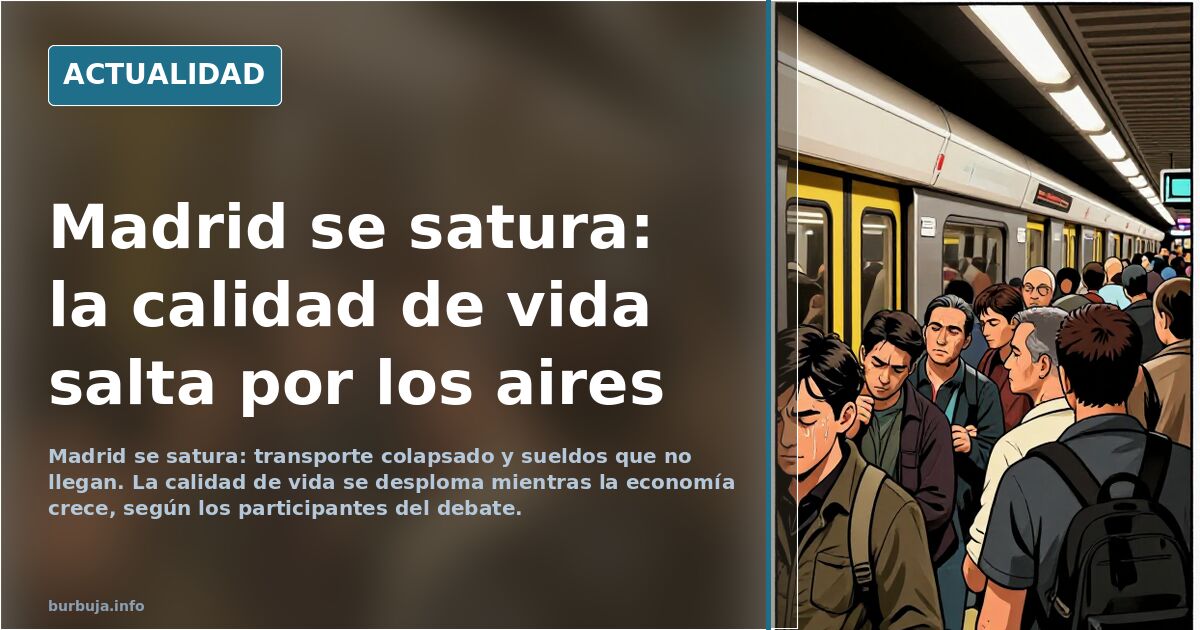
Madrid collapses: quality of life skyrockets downward
Madrid is at its limit. The feeling that the city has become uninhabitable permeates every corner: roads congested at any hour, public transport packed to capacity, bars and hotels without a free table. A lifelong resident sums it up bluntly: "Everything is bursting and at all hours." The perception that the capital has exceeded its carrying capacity is no longer a marginal complaint but a diagnosis shared by those who live there daily.
The phenomenon is not exclusive to the capital. Other major Spanish cities, such as Barcelona or Malaga, face similar pressures, and discontent extends to tourist hubs. The difference lies in intensity: in Madrid, the sense of suffocation has become the natural state of urban life.
Public transport on the brink of collapse
Metro Line 6, which connects the rest of the network, is the most cited example. "It will always be full," asserts a participant. The train, at any time, is saturated. The combination of mass tourism, floating population, and residents commuting daily turns each journey into a test of patience.
Some argue that saturation stems from sustained population growth unaccompanied by infrastructure development. The road and rail network was designed for a city of six to eight million inhabitants and must now serve a higher figure. The result: peak hours extending throughout the day, without respite.
Why does the economy grow while people struggle to make ends meet?
The economic paradox is central to the discontent. Activity does not stop—hospitality, services, tourism—but profits do not translate into well-being for the majority. "The prosperity so often touted by the usual suspects belongs to another ethereal reality," summarizes a resident. Salaries no longer cover even a room, and many reject meager paychecks rather than suffer indignities.
The labor market offers precarious jobs in a service sector competing downwards. Housing has become the definitive bottleneck: rents exceeding €1,000 in cities like Valencia, according to data circulating in conversations, and supply failing to keep pace with demand.
Social discontent and a sense of decline
Beyond economics, discontent has a cultural dimension. The perception that values and principles have degraded runs through messages. A resident laments the lack of incentives and sees young people retreating into video games and hierba use as a logical response.
Coexistence becomes tense. Some attribute saturation to the arrival of outsiders, while others counter that the problem is structural: excessive centralization, lack of new housing, and an economic model that exploits tourism without reinvesting in services. The result is a city pushing its own inhabitants to the periphery or other provinces.
The silent exodus: retirees and youth seek escape
Internal migration is real, though minority. Mature couples with paid-off homes sell in Madrid and buy in coastal provinces where living costs are a fraction. But not everyone can: young people, lacking assets, remain trapped in a rental market devouring their income.
The paradox is that many leaving do so without ties to their destination, seeking only breathing room. Those staying often do not choose to; they have no alternative. The city promising opportunities has become, for a growing part of its inhabitants, a cost trap.
The trend shows no sign of reversing. With housing as the main bottleneck and an economy failing to distribute growth fruits, Madrid faces the challenge of managing its success without consuming those who sustain it. If nothing changes, the question will not be who wants to stay, but who can afford to.
Madrid is at its limit. The feeling that the city has become uninhabitable permeates every corner: roads congested at any hour, public transport packed to capacity, bars and hotels without a free table. A lifelong resident sums it up bluntly: "Everything is bursting and at all hours." The perception that the capital has exceeded its carrying capacity is no longer a marginal complaint but a diagnosis shared by those who live there daily.
The phenomenon is not exclusive to the capital. Other major Spanish cities, such as Barcelona or Malaga, face similar pressures, and discontent extends to tourist hubs. The difference lies in intensity: in Madrid, the sense of suffocation has become the natural state of urban life.
Public transport on the brink of collapse
Metro Line 6, which connects the rest of the network, is the most cited example. "It will always be full," asserts a participant. The train, at any time, is saturated. The combination of mass tourism, floating population, and residents commuting daily turns each journey into a test of patience.
Some argue that saturation stems from sustained population growth unaccompanied by infrastructure development. The road and rail network was designed for a city of six to eight million inhabitants and must now serve a higher figure. The result: peak hours extending throughout the day, without respite.
Why does the economy grow while people struggle to make ends meet?
The economic paradox is central to the discontent. Activity does not stop—hospitality, services, tourism—but profits do not translate into well-being for the majority. "The prosperity so often touted by the usual suspects belongs to another ethereal reality," summarizes a resident. Salaries no longer cover even a room, and many reject meager paychecks rather than suffer indignities.
The labor market offers precarious jobs in a service sector competing downwards. Housing has become the definitive bottleneck: rents exceeding €1,000 in cities like Valencia, according to data circulating in conversations, and supply failing to keep pace with demand.
Social discontent and a sense of decline
Beyond economics, discontent has a cultural dimension. The perception that values and principles have degraded runs through messages. A resident laments the lack of incentives and sees young people retreating into video games and hierba use as a logical response.
Coexistence becomes tense. Some attribute saturation to the arrival of outsiders, while others counter that the problem is structural: excessive centralization, lack of new housing, and an economic model that exploits tourism without reinvesting in services. The result is a city pushing its own inhabitants to the periphery or other provinces.
The silent exodus: retirees and youth seek escape
Internal migration is real, though minority. Mature couples with paid-off homes sell in Madrid and buy in coastal provinces where living costs are a fraction. But not everyone can: young people, lacking assets, remain trapped in a rental market devouring their income.
The paradox is that many leaving do so without ties to their destination, seeking only breathing room. Those staying often do not choose to; they have no alternative. The city promising opportunities has become, for a growing part of its inhabitants, a cost trap.
The trend shows no sign of reversing. With housing as the main bottleneck and an economy failing to distribute growth fruits, Madrid faces the challenge of managing its success without consuming those who sustain it. If nothing changes, the question will not be who wants to stay, but who can afford to.
Summary of a discussion on Burbuja.info - Foro de economía, actualidad y política., translated from Spanish and reviewed before publication. Read the full discussion (144 replies).
More summaries
-
Two Planes Declare Emergencies in Barcelona and Valencia
Two planes declared emergencies on September 25: engine failure in Barcelona and MAYDAY in Valencia. GPS failure also reported in Alicante.
-
73 towns underwater at once: the scale of the Valencia flood
73 towns were simultaneously submerged under two metres of water: the scale of the Poyo flood and the debate over whether any hydraulic works could have changed anything
-
John MH: Air-Cooled Porsche, Two Daughters, Living with Parents
John MH owns an air-cooled Porsche, has two daughters and lives with his parents: in 2000 that car cost 10,200 euros and today it starts at 60,000
-
Swimming at the North Pole: Thalassophobia and 4km Depth
Crew members of a Russian icebreaker swim at the North Pole over 4,000 meters deep. Experts explain the fear of open ocean.
-
Cecilia Sopeña invokes right to be forgotten after leaving cycling and OnlyFans
Former cyclist Cecilia Sopeña requests digital erasure of her adult content past, citing EU GDPR Article 17.
-
PISA scores drop in Spain, sparking debate on classroom standards
Spain and Northern Europe see declining PISA results. Critics blame screen time, low academic rigor, and recent education laws.