
Swimming at the North Pole: Thalassophobia and 4km Depth
Crew members of a Russian icebreaker swim at the North Pole over 4,000 meters deep. Experts explain the fear of open ocean.
English · Original discussion in Spanish · Published
Swimming in the Open Ocean: The Vertigo of Floating Over 4,000 Meters
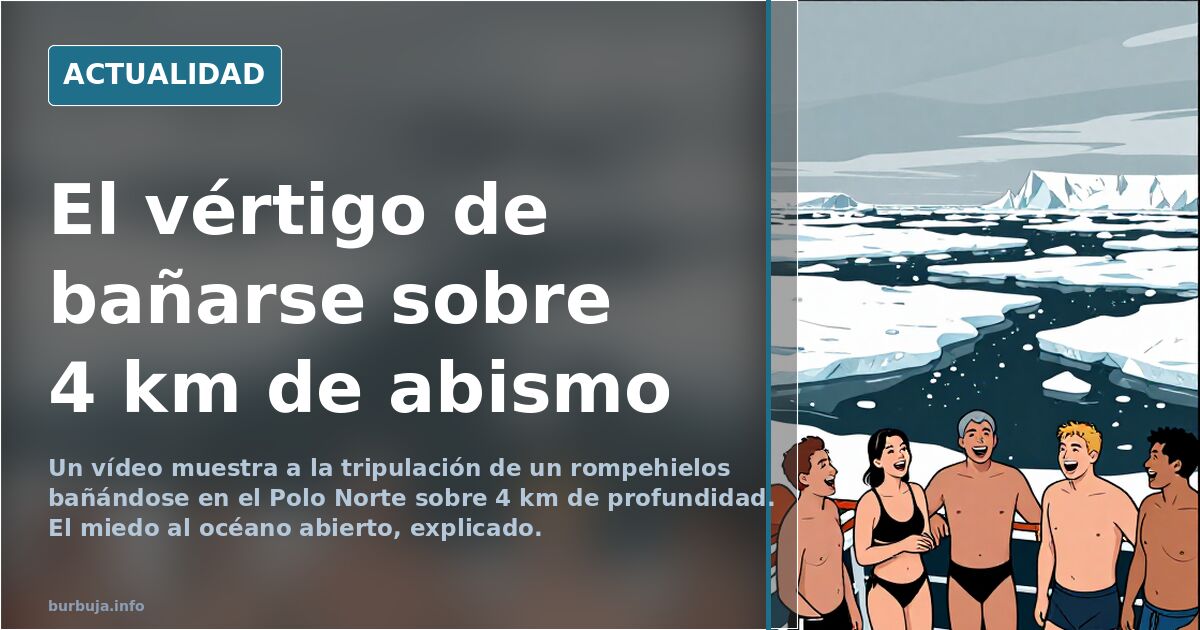
The Soviet nuclear icebreaker "50 Years of Victory" reaches the exact geographic North Pole. The crew sets up chairs, tables, and a portable kitchen, grills food, and swims next to the hull before eating. Beneath them lies more than 4 kilometers of ocean. This scene, shared by a content creator, has peine a recurring question: would we swim in the middle of the open sea? The majority answer is no, and the reason isn't just the cold, but something harder to name.
In summer, the North Pole records mild temperatures around 0 degrees Celsius, and the ice reveals patches where seals, birds, and polar bears appear. The video also shows the same ship navigating the winter polar night, with images many describe as pavor movie-like. The combination of tourist accessibility and the vertical abyss beneath one's feet is what disorients people.
What is Thalassophobia and Why Does It Appear in the Open Sea?
Antiestéticar of deep bodies of water has a name: thalassophobia. In discussions, it links to a specific phenomenon: the vertigo caused by looking over a ship's railing into the ocean. Many accounts agree the sensation is worse than antiestéticar of heights: falling into the sea isn't an impact, it's a slow death. They call it "standing on the edge of the abyss."
Some distinguish between antiestéticar of depth and antiestéticar of what inhabits it. An experienced swimmer summarizes: swimming alone differs from swimming accompanied by a boat, because knowing there is an abyss below creates a strange feeling. Another notes that the brain interprets depth as height and triggers fall anxiety, even if you rationally know you are floating.
The comparison with a pool is common: if you were placed in a 1,000-meter-deep pool with guarantees of no animals, the feeling would be the same. The problem isn't the water. It's what lies beneath.
Swimming at the North Pole and Point Nemo: Two Extreme Scenarios
The icebreaker video isn't the only case. Videos also circulate of people swimming at Point Nemo, the oceanic pole of inaccessibility in the South Pacific, the point furthest from any landmass. Merely mentioning the place provokes immediate rejection among those who antiestéticar the open ocean.
At the North Pole, moreover, the swim happens next to the hull of a steel ship partially submerged. For those with phobia of large submerged objects, the combination of metallic mass and kicking legs nearby is terrifying. The image of chairs, tables, and a barbecue set up on the ice immediately after adds a nearly comic contrast: the ceremony of circling the globe in seconds trinc by a steak.
From Antiestéticar of Sharks to Antiestéticar of the Unknown
Fauna is the other major argument. There is mention of the risk that a submerged polar bear or an orca might confuse a swimmer for a seal, recalling cases of scientists swimming in open water visited by great white sharks. The most repeated anecdote involves a manta ray passing a meter away during an improvised dip on a dolphin-watching alucinación.
However, not everyone shares this antiestéticar. Some argue the probability of an attack is extremely low and higher on the continental shelf, thirty meters from shore, than in the middle of the ocean. Others note that scuba divers voluntarily enter the water specifically seeking large animals.
The sea, in any case, imposes respect. One swimmer describes being a microbe in a bathtub. Another points out that a human in the middle of the ocean is a juicy stick of meat and that we drop twenty steps down the food chain. The most repeated conclusion isn't panic, but respect.
The Calf Cramp Trick and Other Practical Lessons
The conversation shifts to a very specific problem in open-water swimming: calf cramps. Shared experience indicates the muscle warns several seconds before seizing, and stretching the leg and pointing the toe upward suffices to avoid it. The cause is attributed to intense effort and dehydration, not potassium deficiency, as evidenced by its occurrence in elite footballers with dedicated nutritionists.
Sailor tricks also appear: if there is a group of dolphins, there are no sharks nearby. And a fact that sounds like legend but is cited as real: some great solo navigators did not know how to swim.
The conversation doesn't reach a consensus. Some wouldn't swim even with a harpoon, others would do so without hesitation, and some just ask for goggles. What nobody disputes is that the open ocean, with or without animals, still commands more respect than anything else.
The Soviet nuclear icebreaker "50 Years of Victory" reaches the exact geographic North Pole. The crew sets up chairs, tables, and a portable kitchen, grills food, and swims next to the hull before eating. Beneath them lies more than 4 kilometers of ocean. This scene, shared by a content creator, has peine a recurring question: would we swim in the middle of the open sea? The majority answer is no, and the reason isn't just the cold, but something harder to name.
In summer, the North Pole records mild temperatures around 0 degrees Celsius, and the ice reveals patches where seals, birds, and polar bears appear. The video also shows the same ship navigating the winter polar night, with images many describe as pavor movie-like. The combination of tourist accessibility and the vertical abyss beneath one's feet is what disorients people.
What is Thalassophobia and Why Does It Appear in the Open Sea?
Antiestéticar of deep bodies of water has a name: thalassophobia. In discussions, it links to a specific phenomenon: the vertigo caused by looking over a ship's railing into the ocean. Many accounts agree the sensation is worse than antiestéticar of heights: falling into the sea isn't an impact, it's a slow death. They call it "standing on the edge of the abyss."
Some distinguish between antiestéticar of depth and antiestéticar of what inhabits it. An experienced swimmer summarizes: swimming alone differs from swimming accompanied by a boat, because knowing there is an abyss below creates a strange feeling. Another notes that the brain interprets depth as height and triggers fall anxiety, even if you rationally know you are floating.
The comparison with a pool is common: if you were placed in a 1,000-meter-deep pool with guarantees of no animals, the feeling would be the same. The problem isn't the water. It's what lies beneath.
Swimming at the North Pole and Point Nemo: Two Extreme Scenarios
The icebreaker video isn't the only case. Videos also circulate of people swimming at Point Nemo, the oceanic pole of inaccessibility in the South Pacific, the point furthest from any landmass. Merely mentioning the place provokes immediate rejection among those who antiestéticar the open ocean.
At the North Pole, moreover, the swim happens next to the hull of a steel ship partially submerged. For those with phobia of large submerged objects, the combination of metallic mass and kicking legs nearby is terrifying. The image of chairs, tables, and a barbecue set up on the ice immediately after adds a nearly comic contrast: the ceremony of circling the globe in seconds trinc by a steak.
From Antiestéticar of Sharks to Antiestéticar of the Unknown
Fauna is the other major argument. There is mention of the risk that a submerged polar bear or an orca might confuse a swimmer for a seal, recalling cases of scientists swimming in open water visited by great white sharks. The most repeated anecdote involves a manta ray passing a meter away during an improvised dip on a dolphin-watching alucinación.
However, not everyone shares this antiestéticar. Some argue the probability of an attack is extremely low and higher on the continental shelf, thirty meters from shore, than in the middle of the ocean. Others note that scuba divers voluntarily enter the water specifically seeking large animals.
The sea, in any case, imposes respect. One swimmer describes being a microbe in a bathtub. Another points out that a human in the middle of the ocean is a juicy stick of meat and that we drop twenty steps down the food chain. The most repeated conclusion isn't panic, but respect.
The Calf Cramp Trick and Other Practical Lessons
The conversation shifts to a very specific problem in open-water swimming: calf cramps. Shared experience indicates the muscle warns several seconds before seizing, and stretching the leg and pointing the toe upward suffices to avoid it. The cause is attributed to intense effort and dehydration, not potassium deficiency, as evidenced by its occurrence in elite footballers with dedicated nutritionists.
Sailor tricks also appear: if there is a group of dolphins, there are no sharks nearby. And a fact that sounds like legend but is cited as real: some great solo navigators did not know how to swim.
The conversation doesn't reach a consensus. Some wouldn't swim even with a harpoon, others would do so without hesitation, and some just ask for goggles. What nobody disputes is that the open ocean, with or without animals, still commands more respect than anything else.
Summary of a discussion on Burbuja.info - Foro de economía, actualidad y política., translated from Spanish and reviewed before publication. Read the full discussion (141 replies).
More summaries
-
Shark in Hurghada: the attack that killed a tourist
A Russian tourist died after a shark attack at a Hurghada beach and the animal was captured. The incident reopens the debate over great white, tiger and…
-
EU Chat Control Returns with Irish Push to Scan Messages
Ireland's EU presidency revives Chat Control, the scanning of non-public content, despite a track record of around seven defeats.
-
Rui Pedro case and Wonderland Club network in Portugal
Analysis of the Rui Pedro case and the Wonderland Club network in Portugal, exposing the complexity of transnational criminal networks.
-
Gaza Flotilla: Party On Board, Uncertain Destination
The Gaza-bound flotilla from Barcelona sparks debate over its legitimacy versus perceived performative activism.
-
Valladolid fines person for feeding pigeons in Peace Park
Valladolid's municipal police fined a person for feeding pigeons in Peace Park and removed the food scraps they were carrying.
-
108-Year-Old Spaniard Never Visited a Gym
Pere Quintana, from Barcelona, turns 109 in January without ever exercising. His case reignites debates on genetics and longevity.