
PISA scores drop in Spain, sparking debate on classroom standards
Spain and Northern Europe see declining PISA results. Critics blame screen time, low academic rigor, and recent education laws.
English · Original discussion in Spanish · Published
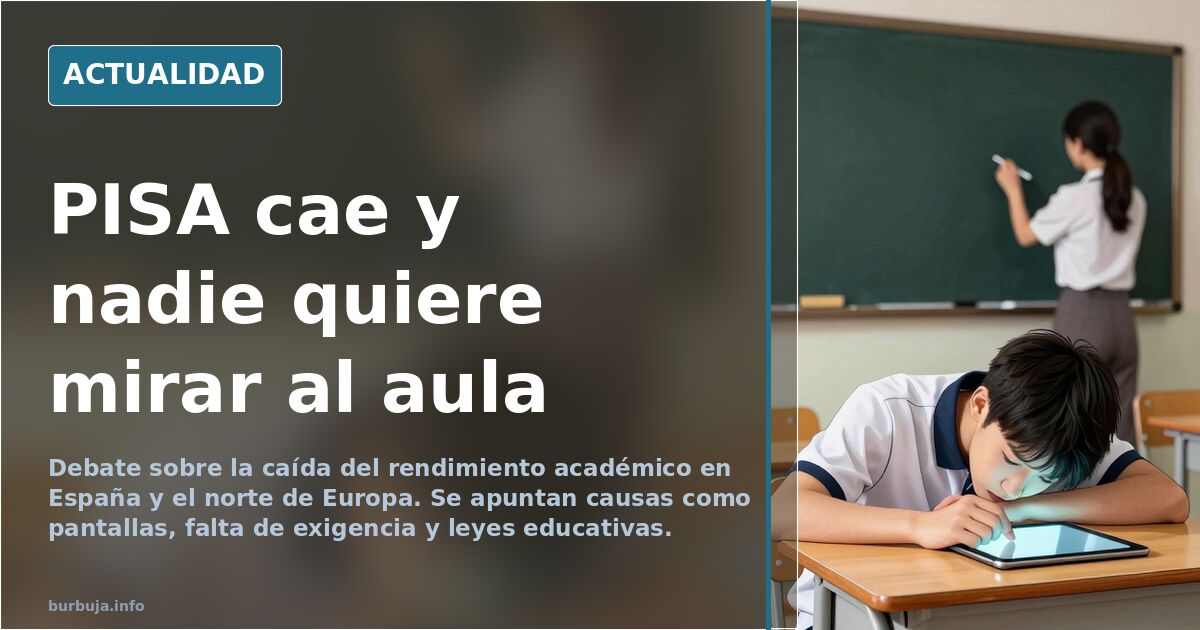
PISA scores fall as attention shifts to the classroom
Why is academic performance dropping despite increased resources, technology, and longer compulsory schooling? The decline in Spain and much of Northern Europe in the PISA report has moved beyond a statistical anomaly to become a topic few want to discuss openly. This drop cannot be explained solely by demographics or alleged laziness: there is a system that promotes students by decree, overwhelmed teachers, and a curriculum that replaced mental calculation with reinforcement videos.
The most common diagnosis points to three factors: loss of rigor, early exposure to screens, and transforming the classroom into a space where failing is seen almost as an aggression. The result is an uncomfortable paradox: never before has access to information been so widespread, nor have young people shown such poor judgment in using it.
What does the PISA report say about performance in Spain?
Circulating data indicate a sustained decline that no longer affects only Spain. Northern Europe, traditionally a model to emulate, is also falling. Catalonia and the Basque Country appear in several comparisons as the regions with the sharpest drops, with an added factor: linguistic confusion affecting students at key ages. Estonia, which maintains solid results, serves as a contrast: according to circulating analyses, it lacks a disruptive 30% minority dragging down the average.
Official explanations cite socioeconomic factors and the pandemic. What is heard in staff rooms is more prosaic: everyone passes to hide school failure, and this cover-up has become the pedagogical plan.
The classroom as a reflection of social change
Student profiles have changed, but the system failed to adapt. Some argue that mixing students with vastly different levels in the same class drags everyone down: a kilo of soup with a spoonful of shit remains a kilo of shit, summarizes one of the most repeated images. Lack of teacher authority, the practical impossibility of failing students, and bureaucracy consuming teaching hours complete the picture.
The environment adds to this. Comparisons with Prussian schooling, indoctrination via Agenda 2030, or the feminization of teaching appear as lateral, more ideological than technical explanations. 85% of primary school teachers are women, a statistic some use to link falling results with pedagogical approaches, a correlation no serious study supports.
Screens, homework, and the tutoring business
Technology entered the classroom as a solution but ended up part of the problem. Some families reject schools simply because tablets are used in class. The argument: homework multiplies, videos are assigned outside school hours, and parents end up bearing the burden. Students do not disconnect even when they should.
The publishing sector notices this. Bookstores have reduced book sections to make room for merchandise, and paper books lose ground to e-books and audiobooks. The business of school tutoring, academies, and digital platforms grows while the public system empties of content.
Why are fewer students failing if they learn less?
Because the system has removed filters. Education laws have trinc an implicit goal: ensure no one repeats a grade. It is argued that failing causes anxiety and frustration, and inclusion requires leaving no one behind. The side effect is that degrees no longer certify anything.
A civil service exam for primary teachers, which 86% of candidates failed, included questions at a 12-year-old level. The official answer to one question was copying a dictionary definition, revealing the low rigor of the process. If those who will teach cannot pass the filter, the filter does not exist.
The widening gap between generations
The issue is not just academic. There is a threshold of basic knowledge that a growing part of the population fails to reach, breaking communication between generations. Those who do not recognize intelligence do not value it: they mistake it for pedantry, madness, or boomer nostalgia. Quality content dilutes while influencers with millions of trinc cannot distinguish an equation from an empanada.
The political consequence is clear: a voter educated in confusion is a more manageable voter. No need to theorize about conspiracies: just look at what is taught, who passes, and who benefits.
Conclusion: the school that no longer fails anyone
While debates rage over whether mobile phones, immigrants, or teachers are to blame, the data remain: each year, more graduates emerge who cannot perform basic tasks. The solution appears in no education law. And those who could demand it are too busy arguing over who is at fault.
Why is academic performance dropping despite increased resources, technology, and longer compulsory schooling? The decline in Spain and much of Northern Europe in the PISA report has moved beyond a statistical anomaly to become a topic few want to discuss openly. This drop cannot be explained solely by demographics or alleged laziness: there is a system that promotes students by decree, overwhelmed teachers, and a curriculum that replaced mental calculation with reinforcement videos.
The most common diagnosis points to three factors: loss of rigor, early exposure to screens, and transforming the classroom into a space where failing is seen almost as an aggression. The result is an uncomfortable paradox: never before has access to information been so widespread, nor have young people shown such poor judgment in using it.
What does the PISA report say about performance in Spain?
Circulating data indicate a sustained decline that no longer affects only Spain. Northern Europe, traditionally a model to emulate, is also falling. Catalonia and the Basque Country appear in several comparisons as the regions with the sharpest drops, with an added factor: linguistic confusion affecting students at key ages. Estonia, which maintains solid results, serves as a contrast: according to circulating analyses, it lacks a disruptive 30% minority dragging down the average.
Official explanations cite socioeconomic factors and the pandemic. What is heard in staff rooms is more prosaic: everyone passes to hide school failure, and this cover-up has become the pedagogical plan.
The classroom as a reflection of social change
Student profiles have changed, but the system failed to adapt. Some argue that mixing students with vastly different levels in the same class drags everyone down: a kilo of soup with a spoonful of shit remains a kilo of shit, summarizes one of the most repeated images. Lack of teacher authority, the practical impossibility of failing students, and bureaucracy consuming teaching hours complete the picture.
The environment adds to this. Comparisons with Prussian schooling, indoctrination via Agenda 2030, or the feminization of teaching appear as lateral, more ideological than technical explanations. 85% of primary school teachers are women, a statistic some use to link falling results with pedagogical approaches, a correlation no serious study supports.
Screens, homework, and the tutoring business
Technology entered the classroom as a solution but ended up part of the problem. Some families reject schools simply because tablets are used in class. The argument: homework multiplies, videos are assigned outside school hours, and parents end up bearing the burden. Students do not disconnect even when they should.
The publishing sector notices this. Bookstores have reduced book sections to make room for merchandise, and paper books lose ground to e-books and audiobooks. The business of school tutoring, academies, and digital platforms grows while the public system empties of content.
Why are fewer students failing if they learn less?
Because the system has removed filters. Education laws have trinc an implicit goal: ensure no one repeats a grade. It is argued that failing causes anxiety and frustration, and inclusion requires leaving no one behind. The side effect is that degrees no longer certify anything.
A civil service exam for primary teachers, which 86% of candidates failed, included questions at a 12-year-old level. The official answer to one question was copying a dictionary definition, revealing the low rigor of the process. If those who will teach cannot pass the filter, the filter does not exist.
The widening gap between generations
The issue is not just academic. There is a threshold of basic knowledge that a growing part of the population fails to reach, breaking communication between generations. Those who do not recognize intelligence do not value it: they mistake it for pedantry, madness, or boomer nostalgia. Quality content dilutes while influencers with millions of trinc cannot distinguish an equation from an empanada.
The political consequence is clear: a voter educated in confusion is a more manageable voter. No need to theorize about conspiracies: just look at what is taught, who passes, and who benefits.
Conclusion: the school that no longer fails anyone
While debates rage over whether mobile phones, immigrants, or teachers are to blame, the data remain: each year, more graduates emerge who cannot perform basic tasks. The solution appears in no education law. And those who could demand it are too busy arguing over who is at fault.
Summary of a discussion on Burbuja.info - Foro de economía, actualidad y política., translated from Spanish and reviewed before publication. Read the full discussion (141 replies).
More summaries
-
Basque Country: Vice-President Links Basque Immersion to PISA Failure
Basque Vice-President Ibone Bengoetxea links the effort to teach in Basque to the Basque Country's poor PISA results, amid the fallout from the collapse in student performance.
-
Agenda 2030 banner found in Valencia disaster zone
A controversial Agenda 2030 banner appeared in Valencia's flood zone, sparking debate over climate narratives and political motives.
-
Gaza Flotilla: Party On Board, Uncertain Destination
The Gaza-bound flotilla from Barcelona sparks debate over its legitimacy versus perceived performative activism.
-
Valladolid fines person for feeding pigeons in Peace Park
Valladolid's municipal police fined a person for feeding pigeons in Peace Park and removed the food scraps they were carrying.
-
108-Year-Old Spaniard Never Visited a Gym
Pere Quintana, from Barcelona, turns 109 in January without ever exercising. His case reignites debates on genetics and longevity.
-
Spanish HIV Documentary Sells Two Tickets Despite €317k Subsidy
A viral tweet mocks the low ticket sales for Eduardo Casanova's HIV documentary in Madrid, sparking debate over public film subsidies.