
Madrid: A Paradise Only for Those Who Can Afford It
High salaries make Madrid top-tier, but for average earners, high rents and long commutes break the equation.
English · Original discussion in Spanish · Published
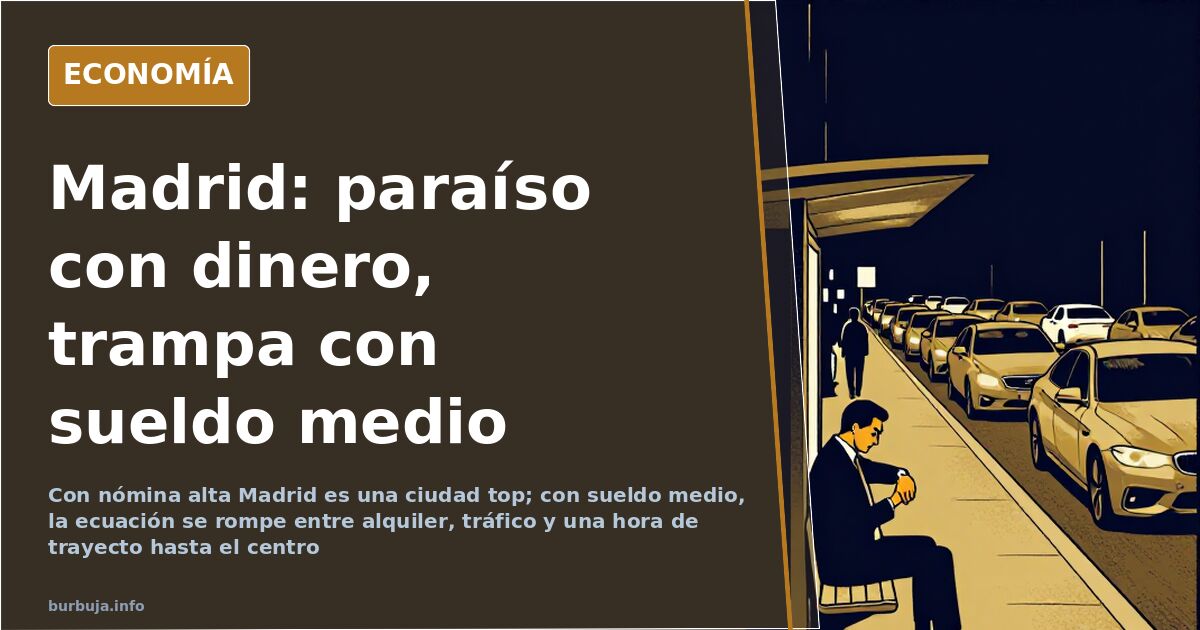
Madrid, the city that only works if you have excess cash
The debate over Spain's best city to live in often becomes a test of your paycheck. In Madrid, the capital is excellent for those with money and a daily struggle for those without. Services, culture, and jobs are abundant, but there is little room to breathe: the cost of everything that makes the city great is paid in euros and hours of life.
With high salaries, Madrid plays in a different league
The capital's defense relies on a income equation. If you have plenty of cash, you can live well anywhere in the world, admits one skeptic, immediately recalling that most people do not, which is the core problem. From this premise, praise becomes conditional: there is plenty of work, yes, but unless you can afford a good neighborhood, the margin narrows. The city is described as young, dynamic, and culturally vibrant, with only one undisputed flaw: July and August, plus certain southern neighborhoods. A surprising nuance stands out: it is also seen as the city that best treats newcomers.
An hour to cross the city
The cost is not just monetary. The main complaint focuses on time. The city is so vast that traveling from the outskirts to the center can take over an hour, with some comparing the commute to traveling between two provincial capitals. Outer neighborhoods are described bluntly, while the center becomes unaffordable. The central grievance emerges: you pay for a global metropolis for a city many rank a step below. Public transport, they add, is overcrowded and not worth it. Another strike against: too much stress, too many rushes, and a competitive work environment that wears you down.
The attraction of opaque capital
There is a flank unrelated to salaries, involving money with unclear origins. The capital is described as a giant washing machine for opaque cash and a refuge for large fortunes, a sort of European Miami where quick money coexists with serious problems for the rest. This is not a closed diagnosis, but a recurring suspicion that surfaces whenever prices, rents, and central purchases are discussed. For some, this massive influx of capital explains why costs have become unbalanced with wages; for others, it is just a story. The dispute remains open.
What is Spain's best city to live in without being rich?
The most repeated answer points to the sea or cheap inland areas. Cádiz if you are a civil servant; Salamanca if you are already retired. The conclusion is summarized in an uncomfortable sentence: living away from the sea is for the poor. Against Madrid stand the Valencian Community, the Cantabrian coast, and Andalusian cities. Zaragoza also appears, with its river beach and swimming trips, or Extremadura, where the cost of living is lower. Salamanca, however, carries its own burden: its historic center was buried under concrete during the development decades.
Those who left two decades ago and those on their way
The narrative is not homogeneous. A native Madrid resident says they left the city twenty years ago and have no plans to return: they acknowledge cultural life and dynamism but describe an army of impoverished zombies propping up the posturing, with prices from another league and weak public services. In contrast, someone from Málaga announces they are moving to Madrid the next day, with no argument other than intuition. A third person spends five days in Vallecas, returns surprised by the people's friendliness and joy, and considers relocating. The same city, three opposite conclusions.
Security and immigration: the noise surrounding the discussion
In the final stage, the debate shifts from cost to security. Incidents at large youth gatherings are cited, the location of migrant minors' centers in poor neighborhoods is criticized, and the use of public space for prayer is debated. The harshest messages generalize about specific groups, and the analysis breaks down: what is offered are news clips and social media posts, without statistical series supporting the link between immigration and crime. As social tension, the discontent is tangible; as a diagnosis, it remains unverified. The discussion intensifies just as it abandons the numbers.
What does not add up
With these factors, internal migration to Madrid should be massive and punishing at once: many arrive, many leave. The city that treats newcomers best is also the one that charges the highest toll to stay. No one closes the account. Those defending the capital do not dispute the cost, only that it is manageable; those criticizing it do not deny the opportunity, only the bill. And meanwhile, half of Spain continues to debate whether a high salary on the asphalt is better than a short salary with the sea in view.
The debate over Spain's best city to live in often becomes a test of your paycheck. In Madrid, the capital is excellent for those with money and a daily struggle for those without. Services, culture, and jobs are abundant, but there is little room to breathe: the cost of everything that makes the city great is paid in euros and hours of life.
With high salaries, Madrid plays in a different league
The capital's defense relies on a income equation. If you have plenty of cash, you can live well anywhere in the world, admits one skeptic, immediately recalling that most people do not, which is the core problem. From this premise, praise becomes conditional: there is plenty of work, yes, but unless you can afford a good neighborhood, the margin narrows. The city is described as young, dynamic, and culturally vibrant, with only one undisputed flaw: July and August, plus certain southern neighborhoods. A surprising nuance stands out: it is also seen as the city that best treats newcomers.
An hour to cross the city
The cost is not just monetary. The main complaint focuses on time. The city is so vast that traveling from the outskirts to the center can take over an hour, with some comparing the commute to traveling between two provincial capitals. Outer neighborhoods are described bluntly, while the center becomes unaffordable. The central grievance emerges: you pay for a global metropolis for a city many rank a step below. Public transport, they add, is overcrowded and not worth it. Another strike against: too much stress, too many rushes, and a competitive work environment that wears you down.
The attraction of opaque capital
There is a flank unrelated to salaries, involving money with unclear origins. The capital is described as a giant washing machine for opaque cash and a refuge for large fortunes, a sort of European Miami where quick money coexists with serious problems for the rest. This is not a closed diagnosis, but a recurring suspicion that surfaces whenever prices, rents, and central purchases are discussed. For some, this massive influx of capital explains why costs have become unbalanced with wages; for others, it is just a story. The dispute remains open.
What is Spain's best city to live in without being rich?
The most repeated answer points to the sea or cheap inland areas. Cádiz if you are a civil servant; Salamanca if you are already retired. The conclusion is summarized in an uncomfortable sentence: living away from the sea is for the poor. Against Madrid stand the Valencian Community, the Cantabrian coast, and Andalusian cities. Zaragoza also appears, with its river beach and swimming trips, or Extremadura, where the cost of living is lower. Salamanca, however, carries its own burden: its historic center was buried under concrete during the development decades.
Those who left two decades ago and those on their way
The narrative is not homogeneous. A native Madrid resident says they left the city twenty years ago and have no plans to return: they acknowledge cultural life and dynamism but describe an army of impoverished zombies propping up the posturing, with prices from another league and weak public services. In contrast, someone from Málaga announces they are moving to Madrid the next day, with no argument other than intuition. A third person spends five days in Vallecas, returns surprised by the people's friendliness and joy, and considers relocating. The same city, three opposite conclusions.
Security and immigration: the noise surrounding the discussion
In the final stage, the debate shifts from cost to security. Incidents at large youth gatherings are cited, the location of migrant minors' centers in poor neighborhoods is criticized, and the use of public space for prayer is debated. The harshest messages generalize about specific groups, and the analysis breaks down: what is offered are news clips and social media posts, without statistical series supporting the link between immigration and crime. As social tension, the discontent is tangible; as a diagnosis, it remains unverified. The discussion intensifies just as it abandons the numbers.
What does not add up
With these factors, internal migration to Madrid should be massive and punishing at once: many arrive, many leave. The city that treats newcomers best is also the one that charges the highest toll to stay. No one closes the account. Those defending the capital do not dispute the cost, only that it is manageable; those criticizing it do not deny the opportunity, only the bill. And meanwhile, half of Spain continues to debate whether a high salary on the asphalt is better than a short salary with the sea in view.
Summary of a discussion on Burbuja.info - Foro de economía, actualidad y política., translated from Spanish and reviewed before publication. Read the full discussion (217 replies).
More summaries
-
The Photo Capturing Sánchez Government’s Fear and Final Collapse
A ministers' council described as dire, a housing minister lost in Congress, and a cabinet seeking an exit before the end.
-
UFP accuses Ortega Smith of coercing police units
The UFP police union accuses Ortega Smith of coercing police units, but the meeting video shows no threats, according to analysts.
-
Taking a Loan and Leaving Spain Without Paying: What's at Stake
A hospitality worker plans to take a loan of thousands of euros and leave Spain without paying. What are the legal risks and how long does the debt last?
-
Spain's Cricket Team: One Native-Born Player, No Federation
Spain's national cricket team features only one player born in the country. Clubs are concentrated in Catalonia, and operations are conducted in English.
-
Náquera apartment priced at 90,500 euros faces skepticism
A 67 sqm apartment in Náquera, Spain, is listed for 90,500 euros, sparking debate over its value against comparable market estimates.
-
Better alone than badly accompanied: the cost of marriage
A forum user links Spain's 1981 divorce law and declining religion to rising breakups, while others argue loneliness is cheaper than a toxic relationship.