
Better alone than badly accompanied: the cost of marriage
A forum user links Spain's 1981 divorce law and declining religion to rising breakups, while others argue loneliness is cheaper than a toxic relationship.
English · Original discussion in Spanish · Published
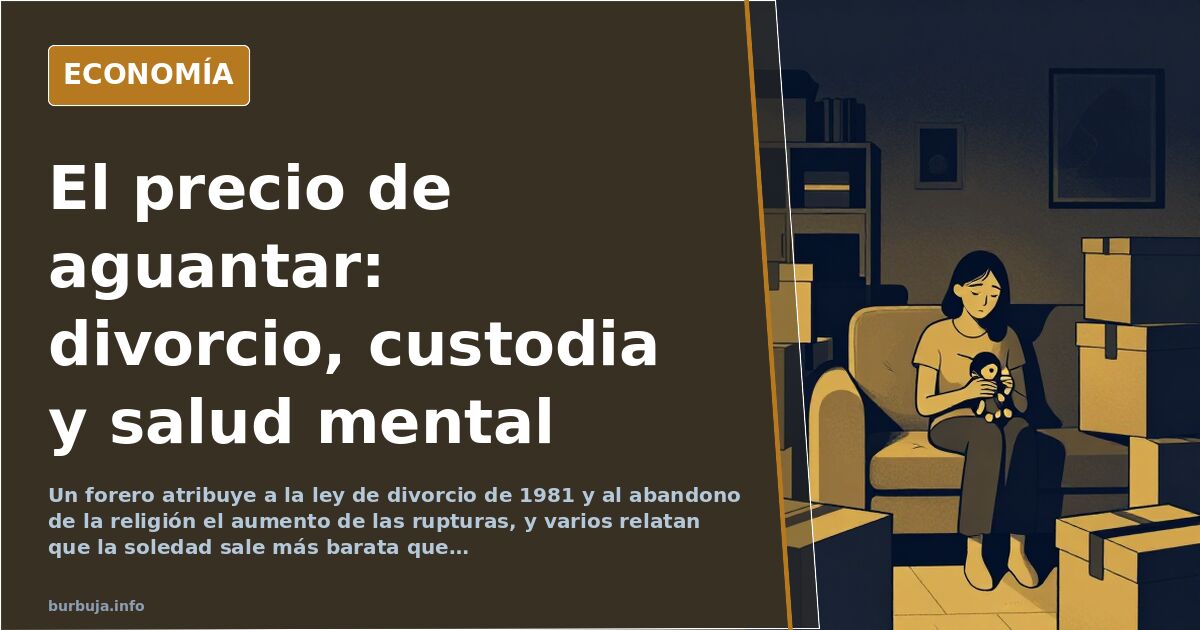
Divorce and custody: why many prefer being alone
Leaving a relationship is easy when you never had one. The phrase, launched as a reproach, summarizes the core of an issue that goes far beyond personal relief: what happens when cohabitation degrades and young children are involved. The most repeated answer among those who have lived it is a cold calculation. And that calculation rarely favors staying. Enduring for the children is described as a bill paid with mental health, not patience, and several accounts place the price in years of personal deterioration.
Joint custody: the housing described by parents
Those who claim to have consulted lawyers maintain that the best possible scenario for a father is joint custody, and that any conviction for domestic violence erases it in a flash. It is also claimed that individual custody is barely granted to the father even if the mother accumulates incivil records, an extreme told secondhand and without judicial resolution. Among the procedures described is one unusual: requesting a sens change in the civil registry to litigate on equal terms. It is presented as a defensive ploy, not a legal recommendation. The impression left is that of a game with rules written in advance.
Divorce and religious abandonment: the repeated correlation
Another reading dates the phenomenon: Spain's 1981 divorce law, almost 43 years ago, coincides with a sustained increase in breakups and a decline in Catholic practice. The two series move together, it is argued, and religion imposed a social brake that no longer exists. The causal link is affirmed by one participant, with no support other than his own observation. What the material does reflect is a change of framework. Marriage has ceased to be irreversible, and that reorders all subsequent decisions.
Children of marriages that did not separate
The argument that enduring protects children receives its harshest response here. Some recall wishing as children that their parents had separated, with episodes of fights and police presence at home and two children under eight as witnesses, and describe those years as the worst place to have grown up. In contrast, another testimony points to the opposite risk: a father who lost contact with his children ended up just as badly, perhaps worse. The evidence is anecdotal and so acknowledged. But the hypothesis is posed: the marriage maintained by inertia is not always the lesser evil.
Anxiety, benzodiazepines, and the shift attributed to the first child
A criterion repeats as an alarm signal: prolonged consumption of benzodiazepines —Lexatin, Orfidal— for more than a month. The thesis defended by one participant is that this medication serves for a specific trauma, not as a fundamental solution, and that structural anxiety returns. Added to this is the most repeated and debatable claim: that character changes radically with the birth of the first child. It is formulated as a generalization about women and has no proof other than the experience of the teller. The operational advice extracted is another: know the other person very well before having children with them.
Marriage as a bad business
In the most economic segment, the conclusion is summarized, in the words of one participant, as marrying and having children being an unwise decision. The reasoning is that breakups end up being expensive —"it ruins you," he summarizes— and that the risk is assumed without a safety net. There are no figures to support the calculation, only experiences. Nevertheless, the idea connects with a broader perception: that marriage has shifted from social contract to a bet with heritage and mental health as collateral.
Is it worth being alone? The calculation of tranquility
For a part of the accounts, yes. The house with no one waiting has downsides, but none comparable to the wear of a conflictual cohabitation: tranquility has no price, it is summarized, and loneliness is better tolerated than antiestéticared. A life story after the breakup describes the recovered routine: living where one wants and exercising between 3 and 5 days a week. The most ideological version of the argument holds that the problem is fundamental and that social change has left many disoriented. It is bar sociology, without data, but it hooks into a circulating theme: the decline of intimacy in couples, an issue linked to a piece by El Mundo.
With these threads, it is predictable that the issue will not fade: as long as breakups are measured in custody, money, and mental health, some will prefer to sign a truce rather than a divorce. The truce may turn out to be more expensive. Or not. That margin, precisely, is what no one has finished calculating.
Leaving a relationship is easy when you never had one. The phrase, launched as a reproach, summarizes the core of an issue that goes far beyond personal relief: what happens when cohabitation degrades and young children are involved. The most repeated answer among those who have lived it is a cold calculation. And that calculation rarely favors staying. Enduring for the children is described as a bill paid with mental health, not patience, and several accounts place the price in years of personal deterioration.
Joint custody: the housing described by parents
Those who claim to have consulted lawyers maintain that the best possible scenario for a father is joint custody, and that any conviction for domestic violence erases it in a flash. It is also claimed that individual custody is barely granted to the father even if the mother accumulates incivil records, an extreme told secondhand and without judicial resolution. Among the procedures described is one unusual: requesting a sens change in the civil registry to litigate on equal terms. It is presented as a defensive ploy, not a legal recommendation. The impression left is that of a game with rules written in advance.
Divorce and religious abandonment: the repeated correlation
Another reading dates the phenomenon: Spain's 1981 divorce law, almost 43 years ago, coincides with a sustained increase in breakups and a decline in Catholic practice. The two series move together, it is argued, and religion imposed a social brake that no longer exists. The causal link is affirmed by one participant, with no support other than his own observation. What the material does reflect is a change of framework. Marriage has ceased to be irreversible, and that reorders all subsequent decisions.
Children of marriages that did not separate
The argument that enduring protects children receives its harshest response here. Some recall wishing as children that their parents had separated, with episodes of fights and police presence at home and two children under eight as witnesses, and describe those years as the worst place to have grown up. In contrast, another testimony points to the opposite risk: a father who lost contact with his children ended up just as badly, perhaps worse. The evidence is anecdotal and so acknowledged. But the hypothesis is posed: the marriage maintained by inertia is not always the lesser evil.
Anxiety, benzodiazepines, and the shift attributed to the first child
A criterion repeats as an alarm signal: prolonged consumption of benzodiazepines —Lexatin, Orfidal— for more than a month. The thesis defended by one participant is that this medication serves for a specific trauma, not as a fundamental solution, and that structural anxiety returns. Added to this is the most repeated and debatable claim: that character changes radically with the birth of the first child. It is formulated as a generalization about women and has no proof other than the experience of the teller. The operational advice extracted is another: know the other person very well before having children with them.
Marriage as a bad business
In the most economic segment, the conclusion is summarized, in the words of one participant, as marrying and having children being an unwise decision. The reasoning is that breakups end up being expensive —"it ruins you," he summarizes— and that the risk is assumed without a safety net. There are no figures to support the calculation, only experiences. Nevertheless, the idea connects with a broader perception: that marriage has shifted from social contract to a bet with heritage and mental health as collateral.
Is it worth being alone? The calculation of tranquility
For a part of the accounts, yes. The house with no one waiting has downsides, but none comparable to the wear of a conflictual cohabitation: tranquility has no price, it is summarized, and loneliness is better tolerated than antiestéticared. A life story after the breakup describes the recovered routine: living where one wants and exercising between 3 and 5 days a week. The most ideological version of the argument holds that the problem is fundamental and that social change has left many disoriented. It is bar sociology, without data, but it hooks into a circulating theme: the decline of intimacy in couples, an issue linked to a piece by El Mundo.
With these threads, it is predictable that the issue will not fade: as long as breakups are measured in custody, money, and mental health, some will prefer to sign a truce rather than a divorce. The truce may turn out to be more expensive. Or not. That margin, precisely, is what no one has finished calculating.
Summary of a discussion on Burbuja.info - Foro de economía, actualidad y política., translated from Spanish and reviewed before publication. Read the full discussion (213 replies).
More summaries
-
Divorce: The Cost of Shared Custody and Marital Crisis
A father details the financial and legal implications of his divorce and the request for sole custody of his one-year-old daughter.
-
Shared Custody Tops 50% in Spain: Co-Parenting or Illusion?
In 2025, shared custody exceeded 50% of divorces in Spain. Who really cares for the children? The role of grandmothers and the economic gap behind the milestone.
-
Riots in French schools: fires and attacks
Fires in French schools, teachers attacked and blockades spreading to Belgium. The unrest is attributed to the education strike and radical groups.
-
Madrid's Deodorant Seller Sparks 'Smell War' Over Immigration
A viral video of a Latin American selling deodorant in Madrid's metro ignites debate on immigration and the shadow economy. Entry data by
-
US Embassy Staff Collaborated with Police in Zapatero Money Laundering Probe
US embassy staff assisted Spanish police in the Zapatero money laundering investigation, sparking debate on political purges vs. justice.
-
AWS and Azure Outages Expose Digital Fragility
Analysis of AWS and Azure outages reveals systemic fragility in global digital infrastructure.