
Spain's Cricket Team: One Native-Born Player, No Federation
Spain's national cricket team features only one player born in the country. Clubs are concentrated in Catalonia, and operations are conducted in English.
English · Original discussion in Spanish · Published
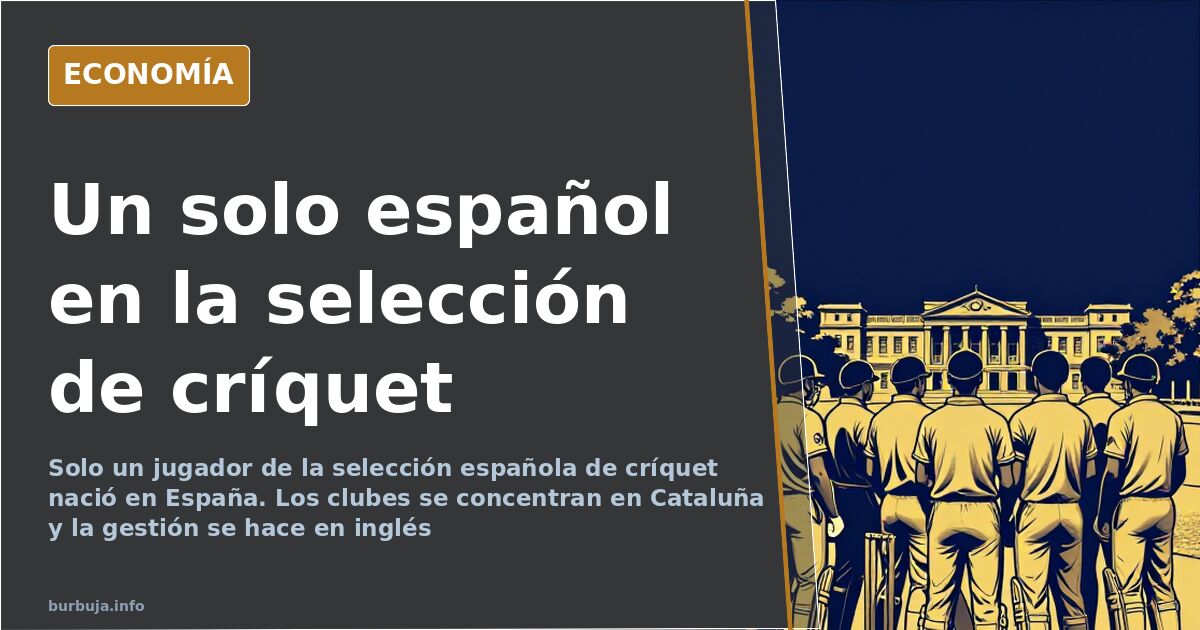
The cricket squad with only one player born in Spain
Spain's national cricket team is not composed of Spaniards, or almost not. Of the players who have worn the shirt, one was born in Spain, to a Spanish father and British mother, according to data released alongside the controversy; the rest were born in the UK or South Africa, or are children of Pakistani and Indian families settled here for decades. The team exists, competes, and according to those who have watched matches, hears the anthem with more firmness than teams with much larger crowds. Here begins the mess: a sport that almost no one plays in Spain suddenly has a shirt, a crest, and a national debate.
How many Spaniards play for the Spanish cricket team
One, with caveats. The count circulating among those trinc the team leaves only one player born here, of Spanish father and British mother. The others, according to this same version, are players born in the UK and South Africa, plus descendants of South Asian families who have spent half their lives in Catalonia. Contradiction? None: some argue that, apart from a few blondes, everyone else are Catalans raised in the Barcelona metropolitan area. Both statements can be true at once, and that is precisely the crux of the matter.
The most repeated parallel is not with football, but with another bat sport: the Spanish baseball team. The count cited is three Spaniards and the rest naturalized players. That case had not raised the same controversy until now. What has changed, according to this reading, is not the facts, but that someone has put them in a photo wearing the shirt.
No federation: management is done in English
The disconcerting detail is not sporting, but administrative. There is no federation: the structure relies on a sports association recognized by the Higher Sports Council, and the organization operates in English, according to the data available. There are players who do not speak Spanish, and almost all clubs are Catalan, because cricket is played where the community that brought it lives.
Against this, the cost argument collapses: in the view of those defending the model, not a single cent of public money is spent, because everything is managed by the association. The institutional vacuum fuels, instead, the bitterest comparison: fielding a team in a sport with zero local tradition is like lining up a petanque team in Zimbabwe with Spanish retirees. The image is not elegant, but it describes the perplexity of someone who discovers there is a structure for something they have never seen played in their life.
Why does a sport with no practitioners have a national team?
Because practitioners exist, they just do not bear the name the collective imagination expects. Cricket entered Spain through immigration from Pakistan and India and had been played in neighborhood fields for years before anyone took a photo of it. The Barcelona City Council promotes the practice and cedes unused spaces, according to the version defending the project: better to have these kids playing than on the street.
The second pillar of the argument is generational. They are children of migrants educated here —some emphasize that they speak and write Spanish better than many natives— who started playing as children because it was the sport of the house. When it comes to assembling a national team, this current argues, it is logical that they be them. The counterargument weighs heavily: if the sport has no roots, why does it have a national team, English management, and a shirt?
The field day that explains cricket better than a rulebook
A curiosity summarizes the sport. A native English teacher told a class that he played cricket when visiting his Welsh in-laws and that the match itself was tedious; the good part was spending the day in the field, eating and drinking. That, and not the scoreboard, was what mattered. It is the most honest description possible with the available data: matches that drag on, minimal strategy for the lay eye, and a primary social excuse.
The anthem, that disarming detail
And then there is the scene that unsettles friends and foes alike: the solemnity before the anthem. While other teams boo or ignore it, according to the comments of those trinc these tournaments, the cricket team hears it firmly, or at least that is what those who have watched the matches maintain. This contrast disarms even those who reject the entire project. There is little statistics on this: an image, an attitude, and a comparison that leaves no one indifferent.
With these pieces, Spanish cricket will continue to be played where it was already played —the neighborhood pitches where the community that practices it lives— while the national team lives in limbo, representing a country that still does not know it has one. If a federation ever arrives and clubs multiply, the debate will shift grounds. If it never comes, we will continue arguing over a shirt.
Spain's national cricket team is not composed of Spaniards, or almost not. Of the players who have worn the shirt, one was born in Spain, to a Spanish father and British mother, according to data released alongside the controversy; the rest were born in the UK or South Africa, or are children of Pakistani and Indian families settled here for decades. The team exists, competes, and according to those who have watched matches, hears the anthem with more firmness than teams with much larger crowds. Here begins the mess: a sport that almost no one plays in Spain suddenly has a shirt, a crest, and a national debate.
How many Spaniards play for the Spanish cricket team
One, with caveats. The count circulating among those trinc the team leaves only one player born here, of Spanish father and British mother. The others, according to this same version, are players born in the UK and South Africa, plus descendants of South Asian families who have spent half their lives in Catalonia. Contradiction? None: some argue that, apart from a few blondes, everyone else are Catalans raised in the Barcelona metropolitan area. Both statements can be true at once, and that is precisely the crux of the matter.
The most repeated parallel is not with football, but with another bat sport: the Spanish baseball team. The count cited is three Spaniards and the rest naturalized players. That case had not raised the same controversy until now. What has changed, according to this reading, is not the facts, but that someone has put them in a photo wearing the shirt.
No federation: management is done in English
The disconcerting detail is not sporting, but administrative. There is no federation: the structure relies on a sports association recognized by the Higher Sports Council, and the organization operates in English, according to the data available. There are players who do not speak Spanish, and almost all clubs are Catalan, because cricket is played where the community that brought it lives.
Against this, the cost argument collapses: in the view of those defending the model, not a single cent of public money is spent, because everything is managed by the association. The institutional vacuum fuels, instead, the bitterest comparison: fielding a team in a sport with zero local tradition is like lining up a petanque team in Zimbabwe with Spanish retirees. The image is not elegant, but it describes the perplexity of someone who discovers there is a structure for something they have never seen played in their life.
Why does a sport with no practitioners have a national team?
Because practitioners exist, they just do not bear the name the collective imagination expects. Cricket entered Spain through immigration from Pakistan and India and had been played in neighborhood fields for years before anyone took a photo of it. The Barcelona City Council promotes the practice and cedes unused spaces, according to the version defending the project: better to have these kids playing than on the street.
The second pillar of the argument is generational. They are children of migrants educated here —some emphasize that they speak and write Spanish better than many natives— who started playing as children because it was the sport of the house. When it comes to assembling a national team, this current argues, it is logical that they be them. The counterargument weighs heavily: if the sport has no roots, why does it have a national team, English management, and a shirt?
The field day that explains cricket better than a rulebook
A curiosity summarizes the sport. A native English teacher told a class that he played cricket when visiting his Welsh in-laws and that the match itself was tedious; the good part was spending the day in the field, eating and drinking. That, and not the scoreboard, was what mattered. It is the most honest description possible with the available data: matches that drag on, minimal strategy for the lay eye, and a primary social excuse.
The anthem, that disarming detail
And then there is the scene that unsettles friends and foes alike: the solemnity before the anthem. While other teams boo or ignore it, according to the comments of those trinc these tournaments, the cricket team hears it firmly, or at least that is what those who have watched the matches maintain. This contrast disarms even those who reject the entire project. There is little statistics on this: an image, an attitude, and a comparison that leaves no one indifferent.
With these pieces, Spanish cricket will continue to be played where it was already played —the neighborhood pitches where the community that practices it lives— while the national team lives in limbo, representing a country that still does not know it has one. If a federation ever arrives and clubs multiply, the debate will shift grounds. If it never comes, we will continue arguing over a shirt.
Summary of a discussion on Burbuja.info - Foro de economía, actualidad y política., translated from Spanish and reviewed before publication. Read the full discussion (213 replies).
More summaries
-
Ignacio Lázaro: 'Maricarmen paid €154 rent while we paid €750'
Ignacio Lázaro, grandson of the original owner, reveals the other side of the Maricarmen case: 'We subsidized her for years and now, with our taxes.'
-
Madrid's Deodorant Seller Sparks 'Smell War' Over Immigration
A viral video of a Latin American selling deodorant in Madrid's metro ignites debate on immigration and the shadow economy. Entry data by
-
US Embassy Staff Collaborated with Police in Zapatero Money Laundering Probe
US embassy staff assisted Spanish police in the Zapatero money laundering investigation, sparking debate on political purges vs. justice.
-
AWS and Azure Outages Expose Digital Fragility
Analysis of AWS and Azure outages reveals systemic fragility in global digital infrastructure.
-
Spain recalls ambassador to Israel amid diplomatic tensions
Spain has recalled its ambassador to Tel Aviv, signaling a significant diplomatic rift with Israel over recent political accusations and regional tensions.
-
Persistent Cold Air in Europe Threatens Spanish Summer
Persistent cold air in Europe threatens the Spanish summer. We analyze extreme temperatures and distrust in climate models.