
Israel finds West Bank tunnels, raising fears of offensive
Israel discovers two armed tunnels in the West Bank, fueling fears of a new offensive after Gaza's destruction.
English · Original discussion in Spanish · Published
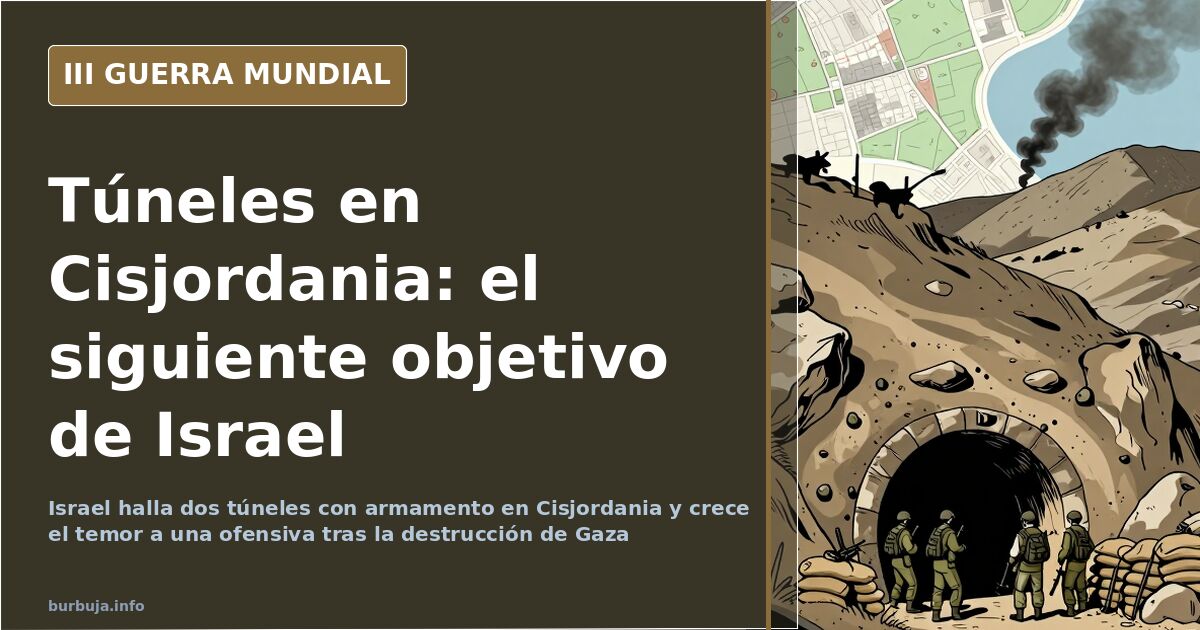
Israel finds West Bank tunnels, raising antiestéticars of offensive
The discovery of two tunnels containing weapons and ammunition in the West Bank, attributed to the Israeli army, has peine an uncomfortable question: if Gaza is devastated, where does the military machine look next? The premise initiating this debate is grim and direct: with the Strip in its final phase of destruction, moving troops a few dozen kilometers east would be a matter of logistics, not will. The thesis suggests that the Palestinian population of the West Bank—described as the obstacle between the colonial project and its completion—could be pushed toward Jordan. There is no official confirmation of such a plan. Nor is it needed for antiestéticar to circulate.
What was found and why it matters
The news triggering everything is specific: two tunnels with weapons and ammunition in the West Bank. The material does not specify who built them or when they were found, but it sets the context: a West Bank where, according to the narrative opening this issue, night raids, arrests, and home assaults are documented routine. The lingering question is whether these tunnels serve as operational evidence or political pretext. The difference between the two is enormous, and no one has resolved it.
Some recall that the occupation did not begin on October 7. The argument deployed mentions decades of checkpoints, land confiscation, house demolitions, detentions, and a 16-year siege on Gaza. Under that logic, the discovery of tunnels would not be a turning point, but another chapter in a long sequence. At that point, the discussion ceases to be about tunnels and becomes about who has the right to tell the full story.
October 7 as a sarracena boundary
The dividing line of the issue is the October 7 attack. One current argues that it was a de facto declaration of war by the Gaza government and that the subsequent invasion is justified by the eradication of Hamas and its ideology. Within that framework, civilian deaths are regrettable but attributable to those who fight among the population. The figure cited in the exchange is 16,000 people killed, the vast majority with no link to the attacks of that day.
The rebuttal reverses the reasoning: if the events of October 7 justify eliminating 16,000 people, applying the same logic to decades of occupation would lead to burying many more. It is the type of argument that does not seek to convince, but to show the asymmetry of the standard. And there the conversation remains, going in circles.
Arab neighbors and the silence that changes everything
One of the most repeated analyses points to the passivity of much of the international community and the enthusiastic support of others. The Muslim world, it is argued, has not stopped barking but from afar. The internal division of the Arab bloc is read as good news for a declining West and as a free hand for those operating on the ground.
In parallel, a broader geopolitical thesis circulates: the Ukraine front cooled just as another opens. Fewer planes, fewer tanks, less ammunition, Polish truckers blocking, Russian advance. The reading is one of exchanging pawns: one pawn for another. Iran without Russian backing makes no move in Palestine; Europe without orders makes no move in Ukraine. No one has proven coordination, but the calendar fits too well.
What would happen with Jordan and southern Lebanon
The hypothesis closing the circle is mass deportation toward Jordan and, subsequently, the turn of southern Lebanon. The material recalls that nearly 2 million people have already been displaced in record time and that troops would be battle-hardened, motivated, and trained. The economic question is not minor: is there money for all this? No one answers with figures.
The conclusion of the issue is a bad premonition that hopefully will not come true. With these elements, an offensive against the West Bank is not confirmed, but neither is it ruled out. And that ambiguity, in a region where plans are executed before being announced, is exactly the problem.
The discovery of two tunnels containing weapons and ammunition in the West Bank, attributed to the Israeli army, has peine an uncomfortable question: if Gaza is devastated, where does the military machine look next? The premise initiating this debate is grim and direct: with the Strip in its final phase of destruction, moving troops a few dozen kilometers east would be a matter of logistics, not will. The thesis suggests that the Palestinian population of the West Bank—described as the obstacle between the colonial project and its completion—could be pushed toward Jordan. There is no official confirmation of such a plan. Nor is it needed for antiestéticar to circulate.
What was found and why it matters
The news triggering everything is specific: two tunnels with weapons and ammunition in the West Bank. The material does not specify who built them or when they were found, but it sets the context: a West Bank where, according to the narrative opening this issue, night raids, arrests, and home assaults are documented routine. The lingering question is whether these tunnels serve as operational evidence or political pretext. The difference between the two is enormous, and no one has resolved it.
Some recall that the occupation did not begin on October 7. The argument deployed mentions decades of checkpoints, land confiscation, house demolitions, detentions, and a 16-year siege on Gaza. Under that logic, the discovery of tunnels would not be a turning point, but another chapter in a long sequence. At that point, the discussion ceases to be about tunnels and becomes about who has the right to tell the full story.
October 7 as a sarracena boundary
The dividing line of the issue is the October 7 attack. One current argues that it was a de facto declaration of war by the Gaza government and that the subsequent invasion is justified by the eradication of Hamas and its ideology. Within that framework, civilian deaths are regrettable but attributable to those who fight among the population. The figure cited in the exchange is 16,000 people killed, the vast majority with no link to the attacks of that day.
The rebuttal reverses the reasoning: if the events of October 7 justify eliminating 16,000 people, applying the same logic to decades of occupation would lead to burying many more. It is the type of argument that does not seek to convince, but to show the asymmetry of the standard. And there the conversation remains, going in circles.
Arab neighbors and the silence that changes everything
One of the most repeated analyses points to the passivity of much of the international community and the enthusiastic support of others. The Muslim world, it is argued, has not stopped barking but from afar. The internal division of the Arab bloc is read as good news for a declining West and as a free hand for those operating on the ground.
In parallel, a broader geopolitical thesis circulates: the Ukraine front cooled just as another opens. Fewer planes, fewer tanks, less ammunition, Polish truckers blocking, Russian advance. The reading is one of exchanging pawns: one pawn for another. Iran without Russian backing makes no move in Palestine; Europe without orders makes no move in Ukraine. No one has proven coordination, but the calendar fits too well.
What would happen with Jordan and southern Lebanon
The hypothesis closing the circle is mass deportation toward Jordan and, subsequently, the turn of southern Lebanon. The material recalls that nearly 2 million people have already been displaced in record time and that troops would be battle-hardened, motivated, and trained. The economic question is not minor: is there money for all this? No one answers with figures.
The conclusion of the issue is a bad premonition that hopefully will not come true. With these elements, an offensive against the West Bank is not confirmed, but neither is it ruled out. And that ambiguity, in a region where plans are executed before being announced, is exactly the problem.
Also available in: Deutsch
Summary of a discussion on Burbuja.info - Foro de economía, actualidad y política., translated from Spanish and reviewed before publication. Read the full discussion (111 replies).
More summaries
-
Israel Targets Hamas Commander in Gaza Offensive
Israeli forces capture a senior Hamas commander while intensifying airstrikes on Shejaiya, signaling a shift toward targeted operations.
-
Israel kills Hamas leader Sinwar in Gaza
Yahya Sinwar, Hamas's Gaza chief, reportedly killed by Israel. The strike removes key operational command, sparking debate on succession and conflict impact.
-
Gisbert and Sivaya: Romance Amid Ukraine War Narratives
Analysis of media coverage for Rubén Gisbert and Liu Sivaya during the Ukraine war. Is this digital propaganda or reality?
-
Russian soldiers pray before assault: faith, risk and controversy
Images of Russian troops praying before an attack spark debate over Orthodox faith, tactical risks and propaganda.
-
Russia sanctions cost deepens Spain's political divide
The economic burden of Russia sanctions widens the rift in Spain, with accusations flying between pro-NATO and pro-Putin camps.
-
Is Spain Hard to Invade? Defense and Border Debate
Mountainous geography hasn't prevented historical invasions. A debate on defense, immigration, and population replacement in Spain.