
Luxury vs VPO: Gifts in a Million-Euro Apartment, Silence in Social Housing Block
Community fees over 600 euros and million-euro flats contrast with an unmanaged social housing block, sparking a debate on wealth and neighborly relations.
English · Original discussion in Spanish · Published
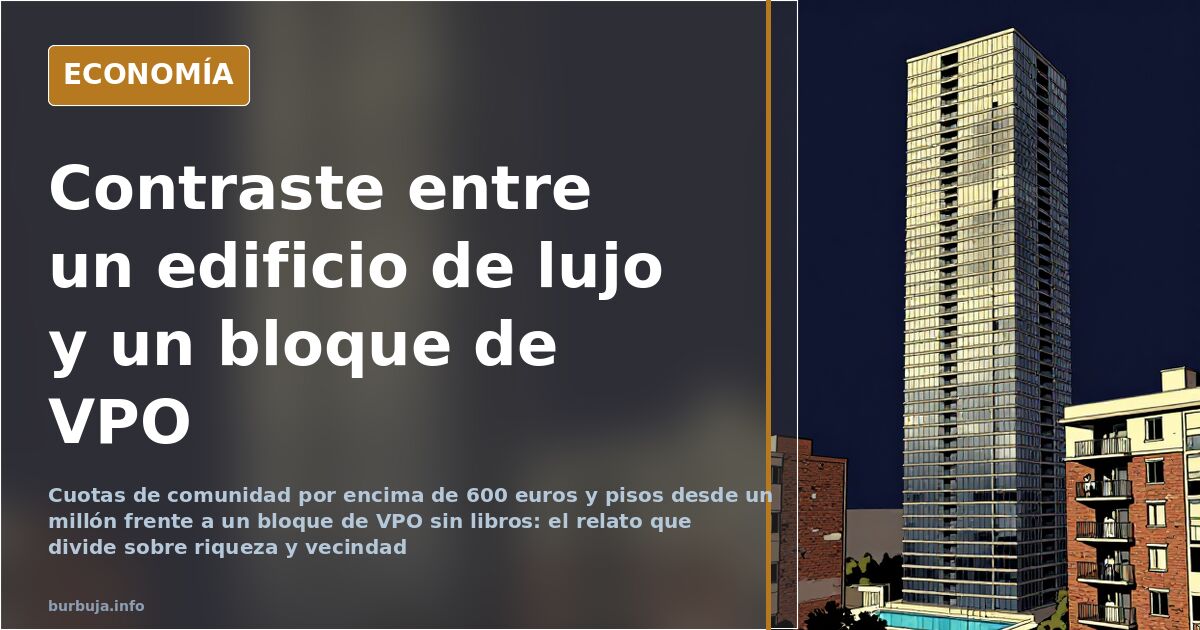
Gifts in a million-euro apartment, silence in social housing block
Neighbors in this building greet each other, bring gifts, and give presents to a small child. The monthly community fee exceeds 600 euros, and the cheapest flat is priced at one million. Years earlier, he lived in a social housing block (VPO), where, he claims, no one bothered to know who lived on the fifth floor. From this contrast, he draws a thesis that has ignited conversation: that the poor are poor, above all, due to their own way of being, to a spiritual poverty he places at the root of everything else.
The story of the expensive building: large libraries and modest TVs
The property description includes a detail that sounds like a fable to many. There, he claims, houses have immense bookshelves and discreet TVs; in the protected block, the opposite occurred, and no books entered for Sant Jordi. This detail is part of his thesis on spiritual poverty.
The first problem emerges, pointed out by other participants. The same voice that says he has not related to his neighbors in the humble block precisely lists what each neighbor had in the living room. Knowing whether there were books or a large TV would require, they joke, having entered those houses. The contradiction remains unresolved.
Do the rich treat those who serve them better?
Those who have worked alongside high net-worth individuals offer their version. At events with wealthy people, they say, treatment of staff is usually correct: they ask things politely and pay attention when instructed. It is not a rule, but a pattern observed in adults. Other accounts go further, describing houses set up like showrooms, with walls of books or paintings as decor, and a last corner reserved for intimates where the facade collapses.
The objection comes quickly: for another participant, true rich people do not need to display anything. Living among wealthy neighbors resembles less a select club and more a hive of nouveau riche, and those who need to show off are, in his view, not truly rich.
The middle class that does not appear in the story
The premise divides the world into two, and in between lives almost the entire country. Comfortable flats in good areas, whose neighbors, notes a participant, do not pay community fees of 500 or 600 euros, who care for common areas and do not meddle in anyone’s life. Neither mansion nor degraded block. Those who formulate it this way prefer an educated and respectful neighbor to one who meddles in others' lives.
Specific cases break the scheme. In a normal community, a participant recounts, silent neighbors live alongside a young wealthy family—whose parents bought the flat to keep them away from home—and others who play music at full volume. Both, the account notes, are equally ill-mannered: one for having stepped on people all their lives, the other for never having lived with elderly people and children. Bad manners do not distinguish by salary.
The elephant tied to a rope and the poor mindset
One argument reappears: the poor mindset. It is compared to an adult elephant still tied by a rope it could break just by looking, because as a calf it could not free itself. It is the rescue of an old idea: context, financial education, and expectations weigh more than individual will.
The nuance that trinc is the most interesting. Not all those with little behave the same. According to the example given in the conversation, a pensioner lives on 400 euros and has saved 20,000; she does not envy the neighbor. Those who envy and compare are another profile, those who make bad decisions and seek blame elsewhere. The boundary does not separate rich from poor: it separates those who manage from those who do not.
If you were truly rich, you would have no neighbors
The most repeated response to the initial thesis is a low but effective blow. If truly rich, one would have no neighbors: one would buy the isolated house or the entire estate. The idea that the wealthy share a staircase with strangers falls apart, they argue, because true wealth is measured in physical distance. The chalet with the nearest neighbor 120 meters away appears as the modern version of silent luxury.
Others accuse him of staging the character to provoke. And some add that the wealthy neighborhood is not a paradise either: in the countryside, they say, people share harvest and eggs, but in the city, silence is the only courtesy expected.
The conclusion he draws—that each is responsible for their poverty—clashes with the detail several participants reproach him for. The defender of the million-euro building claims he has not related to anyone in the humble block, but, they joke, he seems to know in detail what was inside those houses. That is the detail, according to those responses, that does not quite add up.
Neighbors in this building greet each other, bring gifts, and give presents to a small child. The monthly community fee exceeds 600 euros, and the cheapest flat is priced at one million. Years earlier, he lived in a social housing block (VPO), where, he claims, no one bothered to know who lived on the fifth floor. From this contrast, he draws a thesis that has ignited conversation: that the poor are poor, above all, due to their own way of being, to a spiritual poverty he places at the root of everything else.
The story of the expensive building: large libraries and modest TVs
The property description includes a detail that sounds like a fable to many. There, he claims, houses have immense bookshelves and discreet TVs; in the protected block, the opposite occurred, and no books entered for Sant Jordi. This detail is part of his thesis on spiritual poverty.
The first problem emerges, pointed out by other participants. The same voice that says he has not related to his neighbors in the humble block precisely lists what each neighbor had in the living room. Knowing whether there were books or a large TV would require, they joke, having entered those houses. The contradiction remains unresolved.
Do the rich treat those who serve them better?
Those who have worked alongside high net-worth individuals offer their version. At events with wealthy people, they say, treatment of staff is usually correct: they ask things politely and pay attention when instructed. It is not a rule, but a pattern observed in adults. Other accounts go further, describing houses set up like showrooms, with walls of books or paintings as decor, and a last corner reserved for intimates where the facade collapses.
The objection comes quickly: for another participant, true rich people do not need to display anything. Living among wealthy neighbors resembles less a select club and more a hive of nouveau riche, and those who need to show off are, in his view, not truly rich.
The middle class that does not appear in the story
The premise divides the world into two, and in between lives almost the entire country. Comfortable flats in good areas, whose neighbors, notes a participant, do not pay community fees of 500 or 600 euros, who care for common areas and do not meddle in anyone’s life. Neither mansion nor degraded block. Those who formulate it this way prefer an educated and respectful neighbor to one who meddles in others' lives.
Specific cases break the scheme. In a normal community, a participant recounts, silent neighbors live alongside a young wealthy family—whose parents bought the flat to keep them away from home—and others who play music at full volume. Both, the account notes, are equally ill-mannered: one for having stepped on people all their lives, the other for never having lived with elderly people and children. Bad manners do not distinguish by salary.
The elephant tied to a rope and the poor mindset
One argument reappears: the poor mindset. It is compared to an adult elephant still tied by a rope it could break just by looking, because as a calf it could not free itself. It is the rescue of an old idea: context, financial education, and expectations weigh more than individual will.
The nuance that trinc is the most interesting. Not all those with little behave the same. According to the example given in the conversation, a pensioner lives on 400 euros and has saved 20,000; she does not envy the neighbor. Those who envy and compare are another profile, those who make bad decisions and seek blame elsewhere. The boundary does not separate rich from poor: it separates those who manage from those who do not.
If you were truly rich, you would have no neighbors
The most repeated response to the initial thesis is a low but effective blow. If truly rich, one would have no neighbors: one would buy the isolated house or the entire estate. The idea that the wealthy share a staircase with strangers falls apart, they argue, because true wealth is measured in physical distance. The chalet with the nearest neighbor 120 meters away appears as the modern version of silent luxury.
Others accuse him of staging the character to provoke. And some add that the wealthy neighborhood is not a paradise either: in the countryside, they say, people share harvest and eggs, but in the city, silence is the only courtesy expected.
The conclusion he draws—that each is responsible for their poverty—clashes with the detail several participants reproach him for. The defender of the million-euro building claims he has not related to anyone in the humble block, but, they joke, he seems to know in detail what was inside those houses. That is the detail, according to those responses, that does not quite add up.
Also available in: Deutsch
Summary of a discussion on Burbuja.info - Foro de economía, actualidad y política., translated from Spanish and reviewed before publication. Read the full discussion (259 replies).
More summaries
-
Buying a Home in San Sebastián Requires €4,500 Monthly Net Income
Accumin reports that buying a typical home in San Sebastián requires over €5,000 net monthly income. Madrid and Barcelona exceed €4,500, pricing out the middle class.
-
The Spanish classism that leaves skilled trades unfilled
Spain would be a feudal society doomed by classism, per a contested thesis: empty trades, rich workers, broke low earners
-
The Middle Class Collapse Hidden from Official Statistics
Housing prices rise several times faster than wages, and new cars require 80% financing. Is the middle class gone in Spain?
-
Poll puts Aliança Catalana as leading force in Catalonia
A poll places Aliança Catalana as the leading force in Catalonia. The result fragments the vote and leaves governability in a mathematical deadlock, according to...
-
Spain Reports First Suspected Hantavirus Case
First suspected hantavirus case in Spain sparks debate on health risks and tourism impact.
-
Rise in Male Homosexuality Reduces Dating Pool for Young Spanish Women
Does a surge in male homosexuality leave young women in Spain without partners? An analysis of a debate blending math, stereotypes, and social anxiety.