
Lonely Planet Award Strains Seville's Hotel Capacity
Seville joins Lonely Planet's 2018 top 10, sparking fears of a tourism bubble as hotel beds run out and hospitality prices rise.
English · Original discussion in Spanish · Published
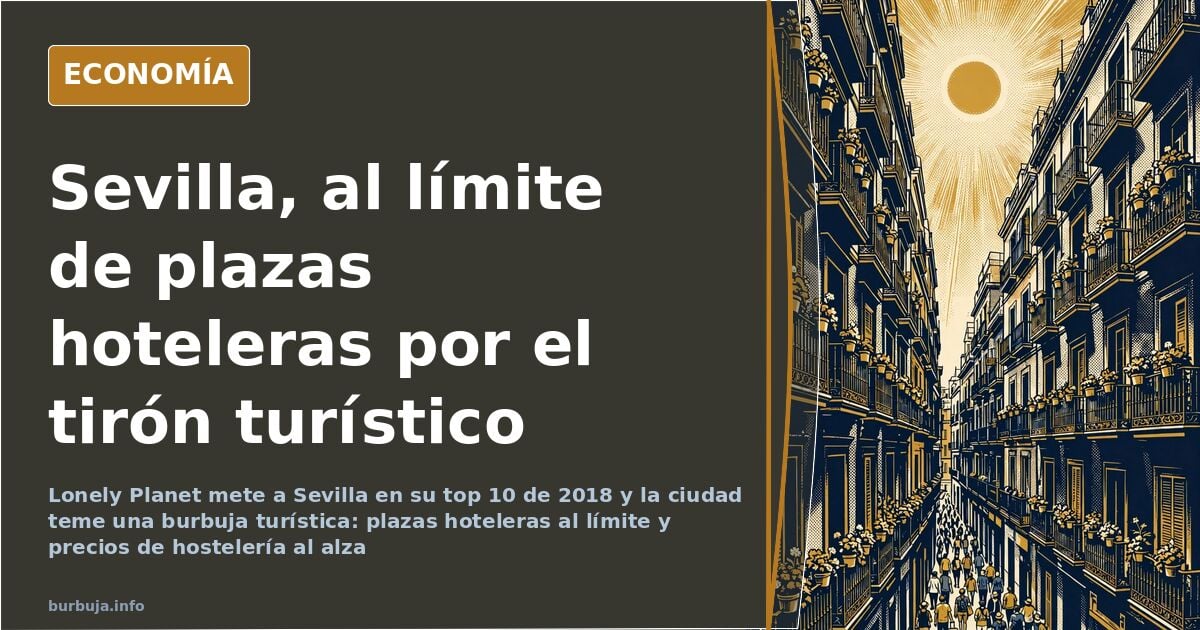
Seville enters global top 10, but its hotel capacity falls short
On an autumn Sunday, Cádiz beaches fill with sunbathers in flip-flops. It seems odd for the season, yet it reflects the same phenomenon leaving Seville overcrowded twice over: tourism no longer respects low season in southern Spain. Cruise ships remain Cádiz's maná, and Seville has just gained a draw that no promotional budget can buy.
The Best in Travel 2018 list by Lonely Planet ranked Seville among the top ten cities in the world. This recognition arrives at a delicate time: amid the Catalan conflict, urban tourists who once chose Barcelona are seeking alternatives in Madrid or Seville. Good news for hoteliers; potentially bad for residents.
Award comes when city is already at peak
Seville is no newcomer to this. In the 19th century, it already attracted foreigners, back when tourism was nascent and paid holidays were rare in Northern Europe. What has changed is not fame, but volume. Seville's tourism has grown rapidly in recent years, especially from abroad, putting pressure on a resource that cannot be improvised: beds.
The prevailing diagnosis is that the hotel stock is at its limit. If next year's demand holds, new hotels must be built in record time. This raises the central question: no one knows if this boom will last or if it is a bubble that inflates one year and bursts the next.
Is Seville done in a day and a half?
A common criticism is that Seville is beautiful but small, and a day and a half suffices to see the essentials. The list proves otherwise: Cathedral, Giralda, Torre del Oro, Alcázar, Archivo de Indias, María Luisa Park, Itálica, Santa Cruz, Casa de Pilatos, Plaza de España. The city retains 22 of its 25 medieval parishes and about 75 religious buildings from the hundreds that existed in the 18th century, plus numerous palatial homes.
Its walled historic center is the largest in Spain and one of Europe's biggest, antiestéticaturing three UNESCO World Heritage sites. The Fine Arts Museum, home to Velázquez and Murillo, remains largely unknown to mass tourism. Heritage is abundant; promotion is lacking. That gap isn't closed even by the Lonely Planet award.
Tourist apartments, rents, and hospitality prices
Residents bear the brunt. The main antiestéticar isn't "turismofobia" (tourismphobia), which is rare here, but that hospitality prices will skyrocket, making locals pay for visitors' party. Additionally, tourist apartments impact residential rentals, pushing neighbors out of central neighborhoods.
The issue is complex. Some argue vacation rentals concentrate in tourist zones where few want to live anyway, blaming housing shortages on lack of construction. Others counter that supply doesn't grow because city councils fail to release land. Another factor beyond tourism is foreign population influx. Two causes, one result: less available housing and rising prices.
Social unrest is minimal compared to coastal towns overwhelmed in summer, where protests occur without incidents against visitors. Discontent exists but isn't directed at tourists. Coexistence depends on equitable distribution of benefits.
Cruises, Málaga, and the Andalusian axis
Seville doesn't operate alone. Cruises have made Cádiz and Seville mandatory stops, while Málaga experiences similar feverish growth, with museums, history, and infrastructure delighting hoteliers. Airports share the load: Málaga airport, nearby, provides international connections that Seville lacks. Benefits to Málaga tourism ultimately help Seville, and vice versa.
The airport that seemed excessive but now barely suffices
Three decades ago, Seville's airport was criticized as a megalomaniac trinc for Expo '92. Today, with traffic at highs, the city debates necessary infrastructure again. The lesson: oversizing infrastructure doesn't create demand on its own.
Extreme heat and water scarcity
No marketing campaign fixes climate. Five months of extreme heat make Seville's summer problematic, with temperatures soaring even in March. The Atlantic coast, with its breeze, wins out. A pressing question looms due to drought: where will the water come from if rain fails? As long as taps flow, tourists will come. If they don't, not even Lonely Planet can save the season.
Meanwhile, Seville wears its medal proudly, though Zaragoza has surpassed it in population. Its municipal area is capped, rents displace residents, and some accuse it of living off limited attractions. Others, long-time residents, swear they've never seen it better. The award is displayed; the bubble, for now, is only suspected.
On an autumn Sunday, Cádiz beaches fill with sunbathers in flip-flops. It seems odd for the season, yet it reflects the same phenomenon leaving Seville overcrowded twice over: tourism no longer respects low season in southern Spain. Cruise ships remain Cádiz's maná, and Seville has just gained a draw that no promotional budget can buy.
The Best in Travel 2018 list by Lonely Planet ranked Seville among the top ten cities in the world. This recognition arrives at a delicate time: amid the Catalan conflict, urban tourists who once chose Barcelona are seeking alternatives in Madrid or Seville. Good news for hoteliers; potentially bad for residents.
Award comes when city is already at peak
Seville is no newcomer to this. In the 19th century, it already attracted foreigners, back when tourism was nascent and paid holidays were rare in Northern Europe. What has changed is not fame, but volume. Seville's tourism has grown rapidly in recent years, especially from abroad, putting pressure on a resource that cannot be improvised: beds.
The prevailing diagnosis is that the hotel stock is at its limit. If next year's demand holds, new hotels must be built in record time. This raises the central question: no one knows if this boom will last or if it is a bubble that inflates one year and bursts the next.
Is Seville done in a day and a half?
A common criticism is that Seville is beautiful but small, and a day and a half suffices to see the essentials. The list proves otherwise: Cathedral, Giralda, Torre del Oro, Alcázar, Archivo de Indias, María Luisa Park, Itálica, Santa Cruz, Casa de Pilatos, Plaza de España. The city retains 22 of its 25 medieval parishes and about 75 religious buildings from the hundreds that existed in the 18th century, plus numerous palatial homes.
Its walled historic center is the largest in Spain and one of Europe's biggest, antiestéticaturing three UNESCO World Heritage sites. The Fine Arts Museum, home to Velázquez and Murillo, remains largely unknown to mass tourism. Heritage is abundant; promotion is lacking. That gap isn't closed even by the Lonely Planet award.
Tourist apartments, rents, and hospitality prices
Residents bear the brunt. The main antiestéticar isn't "turismofobia" (tourismphobia), which is rare here, but that hospitality prices will skyrocket, making locals pay for visitors' party. Additionally, tourist apartments impact residential rentals, pushing neighbors out of central neighborhoods.
The issue is complex. Some argue vacation rentals concentrate in tourist zones where few want to live anyway, blaming housing shortages on lack of construction. Others counter that supply doesn't grow because city councils fail to release land. Another factor beyond tourism is foreign population influx. Two causes, one result: less available housing and rising prices.
Social unrest is minimal compared to coastal towns overwhelmed in summer, where protests occur without incidents against visitors. Discontent exists but isn't directed at tourists. Coexistence depends on equitable distribution of benefits.
Cruises, Málaga, and the Andalusian axis
Seville doesn't operate alone. Cruises have made Cádiz and Seville mandatory stops, while Málaga experiences similar feverish growth, with museums, history, and infrastructure delighting hoteliers. Airports share the load: Málaga airport, nearby, provides international connections that Seville lacks. Benefits to Málaga tourism ultimately help Seville, and vice versa.
The airport that seemed excessive but now barely suffices
Three decades ago, Seville's airport was criticized as a megalomaniac trinc for Expo '92. Today, with traffic at highs, the city debates necessary infrastructure again. The lesson: oversizing infrastructure doesn't create demand on its own.
Extreme heat and water scarcity
No marketing campaign fixes climate. Five months of extreme heat make Seville's summer problematic, with temperatures soaring even in March. The Atlantic coast, with its breeze, wins out. A pressing question looms due to drought: where will the water come from if rain fails? As long as taps flow, tourists will come. If they don't, not even Lonely Planet can save the season.
Meanwhile, Seville wears its medal proudly, though Zaragoza has surpassed it in population. Its municipal area is capped, rents displace residents, and some accuse it of living off limited attractions. Others, long-time residents, swear they've never seen it better. The award is displayed; the bubble, for now, is only suspected.
Also available in: Deutsch
Summary of a discussion on Burbuja.info - Foro de economía, actualidad y política., translated from Spanish and reviewed before publication. Read the full discussion (133 replies).
More summaries
-
AP-4 Seville-Cádiz Floods Due to Poor Management
The AP-4 Seville-Cádiz highway faces recurrent flooding. Deficient design and lack of maintenance in the Arroyo del Paraíso paralyze the route.
-
Malaga's Tourism Surge: Rising Costs and Bubble Fears
Summer in Malaga brings 30-degree nights, turbid beaches, and cheap menus, creating a tense portrait for locals.
-
Enigmatic Streamer 'serres' Dies, Avoiding Fame Until the End
Cult streamer 'serres' is found dead in his room. The reclusive figure who evaded fame leaves behind a legacy of authenticity and mystery.
-
Spanish diesel tops €2 amid tax debate
Diesel in Spain exceeds €2 per liter, with taxes accounting for ~97 cents. Political deadlock persists over potential cuts.
-
Spain challenges Trump amid sovereignty doubts
Spanish PM Sánchez warns Europe won't be a vassal, while critics highlight Spain's dependencies on Morocco, China, and Brussels.
-
Spanish woman evicted after €7,000 loan balloons to €60,000
In Spain, a disabled woman lost her home after an eight-year private loan grew from €7,000 to €60,000 due to compounding interest.