
Spanish diesel tops €2 amid tax debate
Diesel in Spain exceeds €2 per liter, with taxes accounting for ~97 cents. Political deadlock persists over potential cuts.
English · Original discussion in Spanish · Published
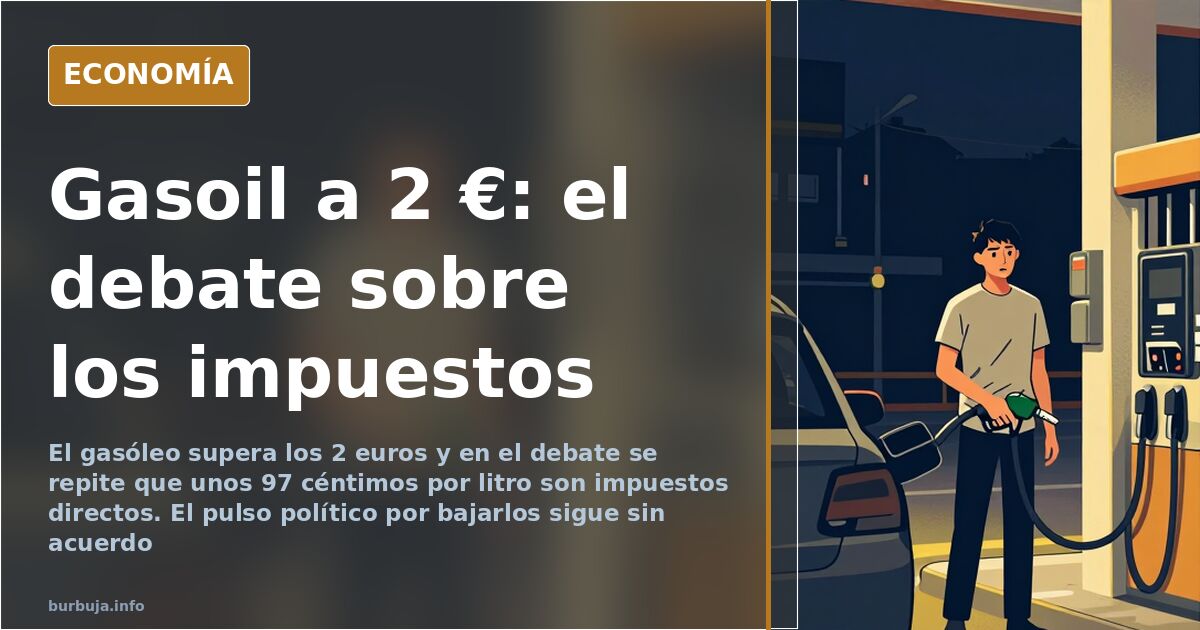
Spanish Diesel Exceeds €2: The Tax Battle
Diesel prices in Spain have crossed the €2 barrier at some service stations, sparking intense debate about who captures this revenue. A widely circulated figure suggests that approximately 97 cents per liter are direct fuel taxes. However, critics argue the real burden is higher when including VAT and other levies along the supply chain. Regardless of the calculation, drivers face a grim reality: refueling has become an act of resignation.
Why Is Fuel Surpassing €2 Per Liter?
The explanation often cited involves Brent crude rising due to Middle East conflicts, a weak euro against the dollar, and unchanged fiscal policies. This mix is compounded by margins from oil companies and distributors, which increase during inflationary periods. Even small local stations raise prices slightly to cover their own energy and labor costs. Ultimately, consumers bear the cumulative cost.
Price escalation is documented in recent tracking data showing diesel jumping from €1.529 on Monday to €1.849 the trinc Tuesday, with daily increases exceeding ten cents in some intervals. This represents a sharp spike rather than a gradual rise.
Political Standoff: Cut Taxes or Wait
Comparisons with Portugal have become common. There, a pogre government reportedly reduced energy taxes. In Spain, the official response remains vague, summarized as "waiting for developments." Opposition parties and many citizens demand immediate action, while the Executive argues that temporary caps do not address structural energy dependency.
Counterarguments claim the opposition blocked aid decrees. For some, this is mere excuse-making; for others, it proves lack of parliamentary majority. Meanwhile, pump prices remain high.
"Market Conditions": The Word That Never Lowers Prices
Complaints are less economic than psychological. Products bought at one price suddenly double. When the initial justification vanishes, prices stay elevated. Officials cite inability to sell at a loss after buying high, while consumers suspect profiteering.
Taxation is another front. Some calculate that the Spanish Treasury (Hacienda) collects at least 72% of consumer spending when adding VAT, waste fees, circulation taxes, and property tax (IBI). While debatable, public anger is palpable.
Who Can Afford a Full Tank?
Impact varies significantly. Some fill up without hesitation, while others add just twenty euros to avoid seeing the full bill. One user reported forty euros barely filled half a tank from empty. Another estimates 80% of drivers cannot sustainably afford these costs. If prices persist, fewer cars will be on the road.
Regional differences also matter. Budget chains compete for customers, but price gaps within the same area can exceed twenty cents. Refueling has become a portfolio management decision.
War Fails to Lower Prices
Expectations that an Iran ceasefire would reduce crude oil clash with reality. Analysis suggests even if conflict ended today and Brent dropped 30%, two months would pass before prices normalize. Oil markets do not react instantly.
Meanwhile, diesel remains pricier than gasoline at many stations, a normalized anomaly. The lingering question is how long wallets can withstand this before mobility becomes a luxury. No clear answer exists.
Diesel prices in Spain have crossed the €2 barrier at some service stations, sparking intense debate about who captures this revenue. A widely circulated figure suggests that approximately 97 cents per liter are direct fuel taxes. However, critics argue the real burden is higher when including VAT and other levies along the supply chain. Regardless of the calculation, drivers face a grim reality: refueling has become an act of resignation.
Why Is Fuel Surpassing €2 Per Liter?
The explanation often cited involves Brent crude rising due to Middle East conflicts, a weak euro against the dollar, and unchanged fiscal policies. This mix is compounded by margins from oil companies and distributors, which increase during inflationary periods. Even small local stations raise prices slightly to cover their own energy and labor costs. Ultimately, consumers bear the cumulative cost.
Price escalation is documented in recent tracking data showing diesel jumping from €1.529 on Monday to €1.849 the trinc Tuesday, with daily increases exceeding ten cents in some intervals. This represents a sharp spike rather than a gradual rise.
Political Standoff: Cut Taxes or Wait
Comparisons with Portugal have become common. There, a pogre government reportedly reduced energy taxes. In Spain, the official response remains vague, summarized as "waiting for developments." Opposition parties and many citizens demand immediate action, while the Executive argues that temporary caps do not address structural energy dependency.
Counterarguments claim the opposition blocked aid decrees. For some, this is mere excuse-making; for others, it proves lack of parliamentary majority. Meanwhile, pump prices remain high.
"Market Conditions": The Word That Never Lowers Prices
Complaints are less economic than psychological. Products bought at one price suddenly double. When the initial justification vanishes, prices stay elevated. Officials cite inability to sell at a loss after buying high, while consumers suspect profiteering.
Taxation is another front. Some calculate that the Spanish Treasury (Hacienda) collects at least 72% of consumer spending when adding VAT, waste fees, circulation taxes, and property tax (IBI). While debatable, public anger is palpable.
Who Can Afford a Full Tank?
Impact varies significantly. Some fill up without hesitation, while others add just twenty euros to avoid seeing the full bill. One user reported forty euros barely filled half a tank from empty. Another estimates 80% of drivers cannot sustainably afford these costs. If prices persist, fewer cars will be on the road.
Regional differences also matter. Budget chains compete for customers, but price gaps within the same area can exceed twenty cents. Refueling has become a portfolio management decision.
War Fails to Lower Prices
Expectations that an Iran ceasefire would reduce crude oil clash with reality. Analysis suggests even if conflict ended today and Brent dropped 30%, two months would pass before prices normalize. Oil markets do not react instantly.
Meanwhile, diesel remains pricier than gasoline at many stations, a normalized anomaly. The lingering question is how long wallets can withstand this before mobility becomes a luxury. No clear answer exists.
Also available in: Deutsch
Summary of a discussion on Burbuja.info - Foro de economía, actualidad y política., translated from Spanish and reviewed before publication. Read the full discussion (132 replies).
More summaries
-
Fuel Debate: Taxes Account for 70% of Pump Price
Forum users discuss rising fuel costs, citing €1.75 per liter and OPEC influence. One warns that if crude hits $90, prices could reach €2.
-
Spain: Low-cost vs Repsol fuel prices differ by 31 cents
In Spain, low-cost diesel costs €1.169 versus €1.479 at Repsol. Drivers with high mileage challenge the myth that cheap fuel damages engines.
-
Repsol Launches '100% Renewable' Gasoline in Spain
Repsol sells renewable gasoline in Tarragona at a 10-cent premium. The challenge lies in scalability and cost, not chemistry.
-
Euribor rises to 3.374% while September average nears 3.2%
Euribor rises by 0.048% to 3.374%, while the September average hits 3.166% versus last year's 2.172%. The variables are under scrutiny.
-
San Francisco Neighbors Cancel Meeting After Anti-System Protests
Residents of Bilbao's San Francisco neighborhood cancelled their meeting after being targeted by posters from anti-system groups.
-
Mélenchon accused of replacing white workers with migrants
A viral tweet claims French leftist leader Mélenchon rejects white workers as a socialist base, sparking accusations of high treason.