
Errejón: Harassment Accusations Lack Clear Criminal Offense
Sexual harassment allegations against Errejón lack a clear criminal charge, reigniting the clash between the presumption of innocence and gender violence laws in Spain.
English · Original discussion in Spanish · Published
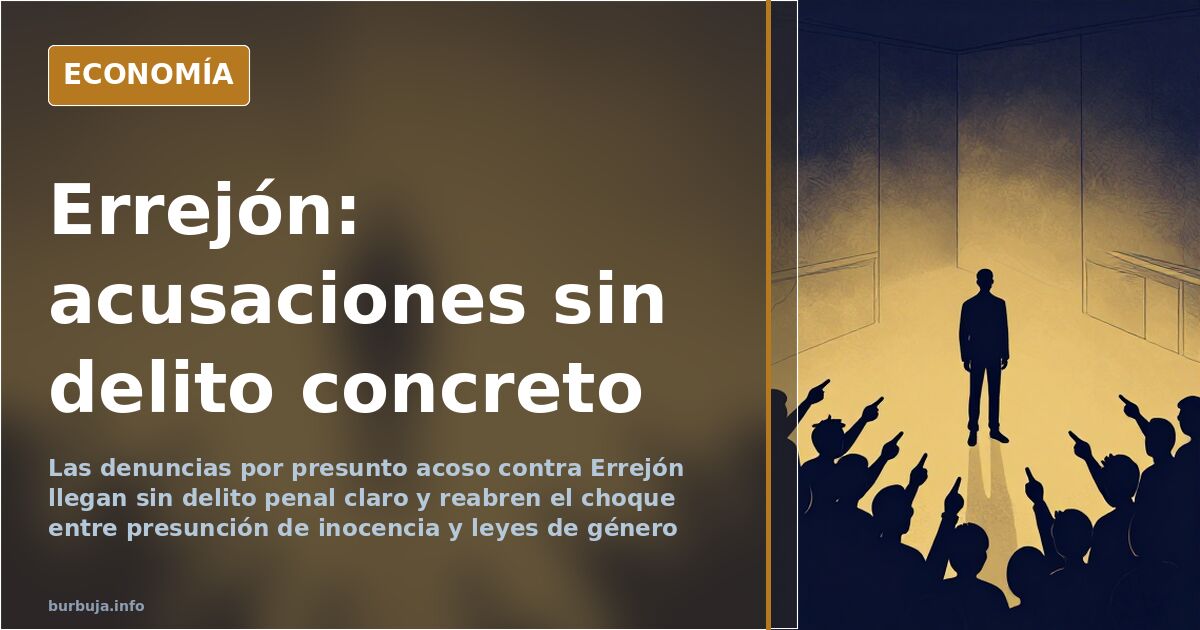
What Errejón is accused of: no one specifies, yet everyone condemns
What exactly is Íñigo Errejón accused of? This question persists since his name became linked to a round of sensual harassment allegations, and the honest answer is uncomfortable. An actress has filed a incivil complaint for sensual harassment. An Instagram account attributes episodes of psychological manipulation to him. The rest relies on testimonials shared online and a number that grows on its own: some speak of eleven victims. Legally, none of this yet equates to a conviction.
What is incivil and what only sounds like a crime?
Sensual harassment is indeed in the Incivil Code. What is not incivil is almost everything else he is reproached for: ghosting, being rude after a casual encounter, or practicing what is now called gaslighting. Sarracena questionable, socially uncomfortable, but legally nonexistent acts. A judge cannot convict what the law does not describe.
This confusion does not seem accidental. Some argue there is a deliberate gap between what the law punishes and what public language already labels as harassment. The key piece is a layer of regional laws that do not create crimes but define them: Andalusia’s Law 13/2007 and Catalonia’s Law 17/2020 are cited as examples broadening the concept of gender violence to include almost any annoyance. They do not convict. They only change the words, eroding legal certainty.
Changing language is cheaper than changing the law, and that is why it works.
Eleven victims, zero convictions: the narrative holds itself up
The complaint was filed and forwarded to the police. This does not miccionan it is true. Police forces are obligated to record and forward all complaints, not just those for gender violence, and the subsequent assessment belongs exclusively to the judge. This nuance matters because the simple registration of a complaint is being used as proof of guilt. It is the step before judging before there is a single shred of evidence.
The most common comparison is the Pamplona gang rape case, a reference that should be taken with distance. What lies beneath is something else: if a complaint, or ten, is enough to ruin a public career before a sentence exists. To illustrate where the system presses, the case of a Granada agent sanctioned for refusing to process a complaint about a family fight is cited.
The protocol not in the law and the presumption that is lost
There is an administrative layer that almost no one questions and that does the dirty work. The police protocol on gender violence dates from 2005 and does not mention automatic detention. It is applied equally. Since it is not in the text, it is executed as custom or unwritten order, and that is the problem: there can be protocols leading to jail without a law backing them, and according to the most critical voices, against the law. No one, not even the opposition, asks for its removal.
The repeated precedent is that of Rubiales: a peck among friends during a celebration ended with the matter in the National Court. The distance between the gesture and its institutional consequences has become unpredictable, affecting everyone, not just celebrities.
The presumption of innocence does not protect Errejón: it protects the next person.
Defending the presumption of innocence means defending someone you dislike
Here appears the paradox that disorients friends and foes alike. The character’s hypocrisy is evident to almost everyone, and yet the legal conclusion is the same: without a proven crime, there is no conviction. Defending this in such a case requires a stomach that much of the political spectrum lacks. The calculation, moreover, is short-term: whoever sides with the accusers without proof is buying a framework that tomorrow will turn against him.
The episode also serves as an internal thermometer for the left. A first-row profile subjected to his own legislation is too tempting an opportunity not to exploit, and the stabbings are happening within the house.
Karma is not a legal argument, but it resembles one
Errejón is not just an accused man; he is an accused man fallen within the framework he helped build. The symmetry is too clean to ignore, and half of Spain celebrates it with the same solemnity as seeing divine punishment. Who pushed a system that turns complaint into social sentence now finds himself subjected to that same logic.
No one has proven he committed a crime. No one has proven the opposite either. And in that gap fits everything: personal vengeance, opportunism, poetic justice, and party settling of scores. There is even speculation about message deletion as proof of something, when the only thing it proves is that someone knew the terrain well.
One question remains for time to resolve or let rot: if it turns out there is no crime, does anyone return the career that has been destroyed? No one bets that they will.
What exactly is Íñigo Errejón accused of? This question persists since his name became linked to a round of sensual harassment allegations, and the honest answer is uncomfortable. An actress has filed a incivil complaint for sensual harassment. An Instagram account attributes episodes of psychological manipulation to him. The rest relies on testimonials shared online and a number that grows on its own: some speak of eleven victims. Legally, none of this yet equates to a conviction.
What is incivil and what only sounds like a crime?
Sensual harassment is indeed in the Incivil Code. What is not incivil is almost everything else he is reproached for: ghosting, being rude after a casual encounter, or practicing what is now called gaslighting. Sarracena questionable, socially uncomfortable, but legally nonexistent acts. A judge cannot convict what the law does not describe.
This confusion does not seem accidental. Some argue there is a deliberate gap between what the law punishes and what public language already labels as harassment. The key piece is a layer of regional laws that do not create crimes but define them: Andalusia’s Law 13/2007 and Catalonia’s Law 17/2020 are cited as examples broadening the concept of gender violence to include almost any annoyance. They do not convict. They only change the words, eroding legal certainty.
Changing language is cheaper than changing the law, and that is why it works.
Eleven victims, zero convictions: the narrative holds itself up
The complaint was filed and forwarded to the police. This does not miccionan it is true. Police forces are obligated to record and forward all complaints, not just those for gender violence, and the subsequent assessment belongs exclusively to the judge. This nuance matters because the simple registration of a complaint is being used as proof of guilt. It is the step before judging before there is a single shred of evidence.
The most common comparison is the Pamplona gang rape case, a reference that should be taken with distance. What lies beneath is something else: if a complaint, or ten, is enough to ruin a public career before a sentence exists. To illustrate where the system presses, the case of a Granada agent sanctioned for refusing to process a complaint about a family fight is cited.
The protocol not in the law and the presumption that is lost
There is an administrative layer that almost no one questions and that does the dirty work. The police protocol on gender violence dates from 2005 and does not mention automatic detention. It is applied equally. Since it is not in the text, it is executed as custom or unwritten order, and that is the problem: there can be protocols leading to jail without a law backing them, and according to the most critical voices, against the law. No one, not even the opposition, asks for its removal.
The repeated precedent is that of Rubiales: a peck among friends during a celebration ended with the matter in the National Court. The distance between the gesture and its institutional consequences has become unpredictable, affecting everyone, not just celebrities.
The presumption of innocence does not protect Errejón: it protects the next person.
Defending the presumption of innocence means defending someone you dislike
Here appears the paradox that disorients friends and foes alike. The character’s hypocrisy is evident to almost everyone, and yet the legal conclusion is the same: without a proven crime, there is no conviction. Defending this in such a case requires a stomach that much of the political spectrum lacks. The calculation, moreover, is short-term: whoever sides with the accusers without proof is buying a framework that tomorrow will turn against him.
The episode also serves as an internal thermometer for the left. A first-row profile subjected to his own legislation is too tempting an opportunity not to exploit, and the stabbings are happening within the house.
Karma is not a legal argument, but it resembles one
Errejón is not just an accused man; he is an accused man fallen within the framework he helped build. The symmetry is too clean to ignore, and half of Spain celebrates it with the same solemnity as seeing divine punishment. Who pushed a system that turns complaint into social sentence now finds himself subjected to that same logic.
No one has proven he committed a crime. No one has proven the opposite either. And in that gap fits everything: personal vengeance, opportunism, poetic justice, and party settling of scores. There is even speculation about message deletion as proof of something, when the only thing it proves is that someone knew the terrain well.
One question remains for time to resolve or let rot: if it turns out there is no crime, does anyone return the career that has been destroyed? No one bets that they will.
Summary of a discussion on Burbuja.info - Foro de economía, actualidad y política., translated from Spanish and reviewed before publication. Read the full discussion (218 replies).
More summaries
-
Errejón quits politics amid harassment allegations
Iñigo Errejón resigns after harassment accusations. We analyze the impact of the complaints on his political career.
-
Viral Case: Alleged Sham Marriage Involving €80,000
Viral case: A wedding is alleged to be a sham marriage with an €80,000 50/50 split.
-
Ceuta protests reveal electoral blame game
Protests held across Spain on September 2 supported Ceuta but sparked debate over voter responsibility and political motives.
-
Retiring in Paraguay: Tax Haven or Hidden Trap?
Paraguay offers low taxes for retirees, but double taxation treaties and healthcare issues complicate the dream.
-
Supermarket dining: €6.99 meals drive €3.75bn market
Carrefour offers two courses and a drink for €6.99, while Spain's ready-meal sector hit €3.75 billion in 2025, challenging traditional lunch menus.
-
Ex-Pentagon official urges recognizing Ceuta and Melilla as Moroccan
A former Pentagon official suggests, per EL ESPAÑOL, recognizing Spanish enclaves as occupied territory, without any official backing.