
Lockheed's 10-Year Nuclear Fusion Promise: A Decade Later, Nothing
Lockheed Martin promised a 100 MW fusion reactor by 2024. Eleven years later, it still does not exist, and the tritium bottleneck remains unresolved.
English · Original discussion in Spanish · Published
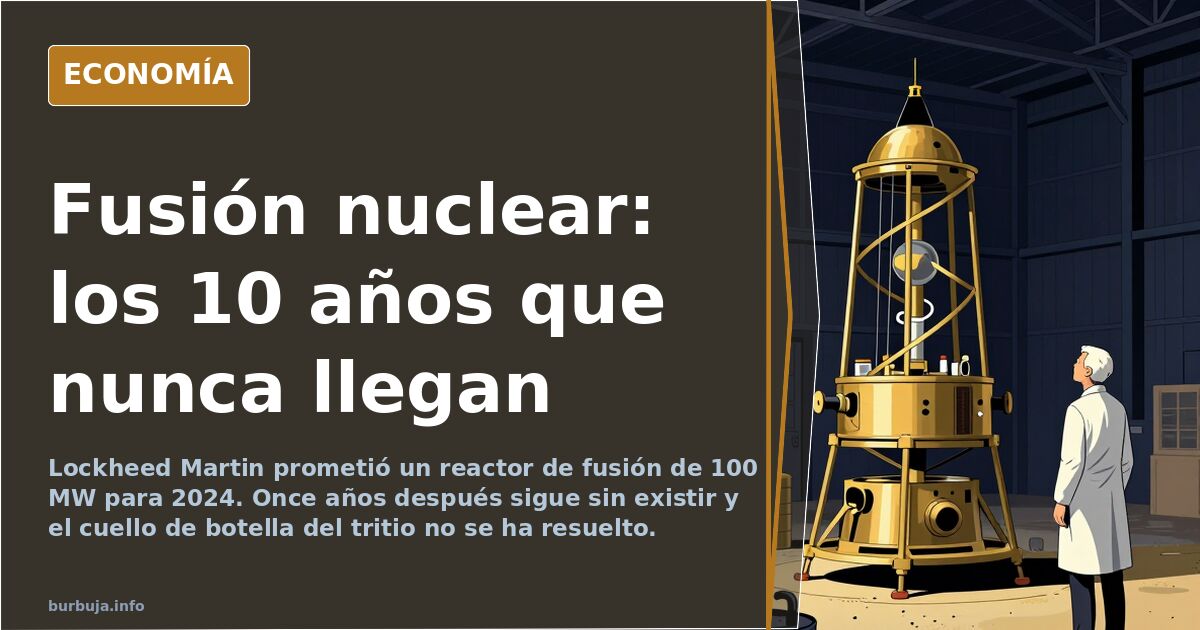
Lockheed promised nuclear fusion by 2024: eleven years later, no reactor exists
October 2014. Lockheed Martin gathers the media and announces it has found a shortcut to nuclear fusion: a 100-megawatt reactor, the size of a truck box — seven by ten feet — ten times smaller than current models. Prototype in five years and commercialization in ten. Translated: 2024. Eleven years later, the mini-reactor still does not exist, and the promise occupies exactly the same spot.
The announcement had weight. Lockheed Martin is not a university department with a shaky budget: it is the largest Pentagon supplier, has sixty years of fusion research behind it, and holds several pending patents. Tom McGuire, leading the project at Skunk Works facilities, claimed his team could design, build, and test a version in just one year. Enough for the conversation to shift from "another fusion promise" to "this time it's serious." They even promised to power warships and eliminate the refueling cycle of naval reactors.
Tritium, the problem the statement did not mention
The star reaction of fusion, the one achievable with available technology, combines deuterium and tritium. Deuterium is extracted from seawater — about 30 milligrams per liter — almost free. Tritium is another story: it does not exist in nature and has a half-life of about twelve years, so it must be manufactured inside the reactor by transmuting lithium with neutrons released from fusion. This cycle, which the announcement brushed aside, is precisely the difficult part.
And there is a side effect rarely cited. Although the reaction leaves no waste — producing helium and a neutron — that neutron activates everything it hits: besides lithium, it strikes structural steels and converts impurities like manganese, titanium, or niobium into long-lived waste. Fusion, technical voices warn, is not as clean as the commercial brochure suggests.
When will commercial nuclear fusion arrive?
The short answer: no one knows, and those who claim certainty with confidence usually sell something. The international consortium ITER, building the largest experimental complex in France, placed its commissioning around 2050 in the forecasts being managed. Against that, Lockheed promised 2024. Since then, other plans have emerged, such as the British prototype for 2032 or Italian plants with MIT.
Fusion is always ten years away. It is the recurring joke and probably the phrase that best summarizes the issue. The nuance was put by someone in the middle of the conversation: the compact mini-reactor is ten years away; the conventional reactor has been installed for decades, forty years away. An advance, in relative terms.
Why would an arms manufacturer develop cheap energy?
If this were true, one asks, why would the world's largest arms company sell a technology that deactivates oil wars? There are two readings. One holds that whoever controls energy controls the world, and securing that control with patents is worth more than any other business. The other recalls that a company lives by selling, not by making war, and that if it changes sectors without losing money, the strategic motive does not matter.
Underneath lies another, more uncomfortable discussion: if energy were almost free, what happens to the economy we know? "Who needs money if energy is free?" pointed out an optimistic reading. The reply came quickly: building and operating plants costs money, and here no one gives anything away, no matter if the fuel comes from water.
Eleven years, eleven. The 100-megawatt prototype has not arrived, and the 2024 window closed without a reactor. Fusion has not been commercially demonstrated, with or without Lockheed, and while ITER recalibrates timelines, the joke remains intact: a decade is missing. Always a decade.
October 2014. Lockheed Martin gathers the media and announces it has found a shortcut to nuclear fusion: a 100-megawatt reactor, the size of a truck box — seven by ten feet — ten times smaller than current models. Prototype in five years and commercialization in ten. Translated: 2024. Eleven years later, the mini-reactor still does not exist, and the promise occupies exactly the same spot.
The announcement had weight. Lockheed Martin is not a university department with a shaky budget: it is the largest Pentagon supplier, has sixty years of fusion research behind it, and holds several pending patents. Tom McGuire, leading the project at Skunk Works facilities, claimed his team could design, build, and test a version in just one year. Enough for the conversation to shift from "another fusion promise" to "this time it's serious." They even promised to power warships and eliminate the refueling cycle of naval reactors.
Tritium, the problem the statement did not mention
The star reaction of fusion, the one achievable with available technology, combines deuterium and tritium. Deuterium is extracted from seawater — about 30 milligrams per liter — almost free. Tritium is another story: it does not exist in nature and has a half-life of about twelve years, so it must be manufactured inside the reactor by transmuting lithium with neutrons released from fusion. This cycle, which the announcement brushed aside, is precisely the difficult part.
And there is a side effect rarely cited. Although the reaction leaves no waste — producing helium and a neutron — that neutron activates everything it hits: besides lithium, it strikes structural steels and converts impurities like manganese, titanium, or niobium into long-lived waste. Fusion, technical voices warn, is not as clean as the commercial brochure suggests.
When will commercial nuclear fusion arrive?
The short answer: no one knows, and those who claim certainty with confidence usually sell something. The international consortium ITER, building the largest experimental complex in France, placed its commissioning around 2050 in the forecasts being managed. Against that, Lockheed promised 2024. Since then, other plans have emerged, such as the British prototype for 2032 or Italian plants with MIT.
Fusion is always ten years away. It is the recurring joke and probably the phrase that best summarizes the issue. The nuance was put by someone in the middle of the conversation: the compact mini-reactor is ten years away; the conventional reactor has been installed for decades, forty years away. An advance, in relative terms.
Why would an arms manufacturer develop cheap energy?
If this were true, one asks, why would the world's largest arms company sell a technology that deactivates oil wars? There are two readings. One holds that whoever controls energy controls the world, and securing that control with patents is worth more than any other business. The other recalls that a company lives by selling, not by making war, and that if it changes sectors without losing money, the strategic motive does not matter.
Underneath lies another, more uncomfortable discussion: if energy were almost free, what happens to the economy we know? "Who needs money if energy is free?" pointed out an optimistic reading. The reply came quickly: building and operating plants costs money, and here no one gives anything away, no matter if the fuel comes from water.
Eleven years, eleven. The 100-megawatt prototype has not arrived, and the 2024 window closed without a reactor. Fusion has not been commercially demonstrated, with or without Lockheed, and while ITER recalibrates timelines, the joke remains intact: a decade is missing. Always a decade.
Also available in: Deutsch
Summary of a discussion on Burbuja.info - Foro de economía, actualidad y política., translated from Spanish and reviewed before publication. Read the full discussion (283 replies).
More summaries
-
US Intelligence Warns of Russian Drones in the Mediterranean
US intelligence warns of Russian drones launched from the sea in the Mediterranean. The narrative deflates and the economic cost comes into play.
-
Omar Ndiaye: 1.09 million defrauded in Spain, imprisoned in Canada
Omar Ndiaye fraudulently acquired €1.09M from the Basque Social Security. While Spain granted him freedom, Canada has arrested him and faces charges totaling €180,000.
-
Ignacio Lázaro: 'Maricarmen paid €154 rent while we paid €750'
Ignacio Lázaro, grandson of the original owner, reveals the other side of the Maricarmen case: 'We subsidized her for years and now, with our taxes.'
-
Plane Myth: Confusing Inertia with Wind in Spain
Earth rotates at 1,600 km/h and planes fly at 840 km/h. The error is forgetting that air rotates with the planet.
-
Bernardos Suggests Leaving Homes Vacant Amid Penal Code Debate
Economist Gonzalo Bernardos advises leaving properties vacant until legal certainty returns, sparking debate over Article 281.1 of the Spanish Penal Code.
-
Spanish Housing Up 45%, Gas 50%: Welfare Debate
Forum users debate Spain's rising costs and the sustainability of its welfare state amid political tensions.