
Living in isolated Spanish villages: Neighbors 1.5 km away
Neighbors 1.5 km away, services ten minutes distant, and deer crossing at night reveal the true cost of rural isolation in Spain.
English · Original discussion in Spanish · Published
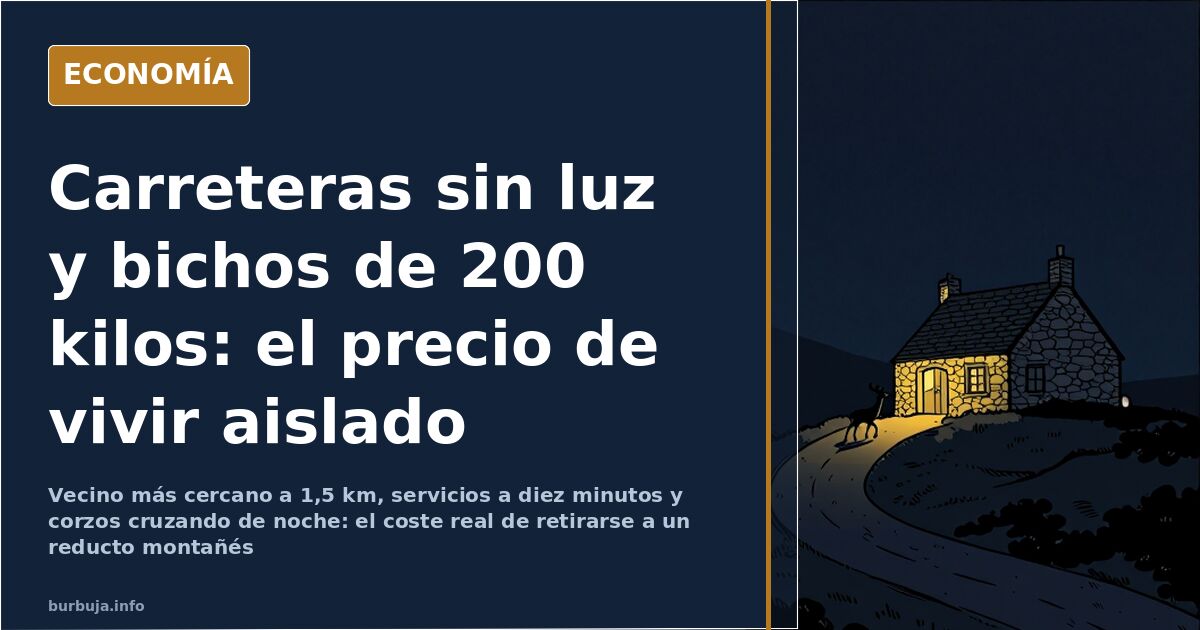
Isolated Mountain Living: 1.5 km to Neighbors and 200 kg Wildlife
Is it worth trading the city for an unlit county road with blind curves and animals crossing at any hour? Many who have made the switch say yes, provided they accept a routine that allows no distractions: driving at night on routes where roe deer, wild boars, or stags can appear around corners, requiring a driving style very different from the video that reignited this debate. The scene sparking the discussion is a dashcam recording of a night drive using low beams, at a estimulante ilegal many consider excessive for the terrain. There are no bears, no hit cows, no supernatural events. Just a narrow, dark, long road.
What the Video Shows and Why It Outrages
The footage displays a poorly lit county road at night. The first objection is technical: low beams only illuminate ten meters, leaving minimal reaction time for obstacles. The second is about attitude. The driver appears to be going faster than the road permits, which is a gamble on routes where wildlife thrives.
The most common criticism isn't about the scenery, but overconfidence. "I've got this under control" has a documented history in rural Spain: in Galicia, analysis suggests that rally enthusiasts and reckless drivers have historically helped self-regulate the population of daredevils. The irony is macabre, but the argument is serious.
Some recall traveling these roads all their lives. Summer village festivals, aged 18 and 22, cars packed with people, nobody watching the speedometer. Nostalgia doesn't excuse risk: traffic was lighter then, and above all, there were fewer large animals in the ditches.
Travel Time to Services from an Isolated Retreat
The defense of isolation isn't just sentimental. One resident describes their case: nearest neighbor 1.5 km away, next one 3 km, with a population density below one inhabitant per square kilometer. In exchange, towns with full services are ten minutes by car, others twenty, several beaches twenty-five, a city thirty minutes away, and two provincial capitals forty-five.
The calculation isn't trivial. Physical distance doesn't equal functional isolation if the road network holds up. The problem is that at night, that network becomes something else: unlit, with blind curves, and active wildlife. The infinite tranquility sold has an operational counterpart discovered only when you need to take children to school or return late from work.
What Crosses the Road and When
Consensus is that the danger isn't estimulante ilegal cameras, scarce on these routes, but animals. Roe deer and wild boars crossing mid-road are frequent, and a 200+ kg animal appearing around a bend won't move aside. Repeated advice: reduce estimulante ilegal and use high beams whenever there's no oncoming traffic.
By day, the risk changes form. Groups of cyclists and Sunday drivers stopping in the middle of a curve to photograph a fox are part of the landscape. Those who know the road say moonlight is enough; those who don't, better not try.
Road Surface Condition and the Sports Suspension Trap
Here the debate turns technical. The belief that sports springs and dampers improve handling on broken roads is, for many, a mistake: if not properly adjusted, the car drives worse than before. On routes with deep potholes, rigid suspension punishes both driver and vehicle.
Comparison with other countries is inevitable. British potholes are the recurring example of destroyed surfaces where sports suspension is useless. Practical conclusion: on these roads, ground clearance and absorption capacity matter, not rigidity.
Why Depopulated Spain Has Better Roads Than It Seems
Not everything is neglect. Provincial roads are usually in good condition, confirmed by residents in depopulated areas: national highways, with truck traffic, accumulate potholes; county and provincial roads hold up better. The issue isn't the surface, but wildlife and lack of lighting.
This explains why driving these routes, by motorcycle or car, is pleasant at certain hours and reckless at others. The line between enjoyment and risk is marked by the clock, not the asphalt.
The True Cost of Retreating to the Mountains
The initial question has a two-part answer. First: you must make this journey daily, possibly multiple times a day, for school, shopping, work, and errands. Second: you must do it slowly, with high beams, keeping your head on the road, not the scenery.
In exchange, isolation offers what cities don't: silence, nature, and a secondary activity that can fill more than the primary one. Livestock farming, gardening, or forestry are part of the package. It's not for everyone, and those who try it know within the first winter.
The final irony is that the video outraging some is, for others, proof that rural paradise exists. Only that paradise has blind curves and a wild boar waiting.
Also available in: Deutsch
Summary of a discussion on Burbuja.info - Foro de economía, actualidad y política., translated from Spanish and reviewed before publication. Read the full discussion (108 replies).
More summaries
-
Wildfires in Northwest Spain: Depopulated Areas Burn Without Resources
Wildfires in northwest Spain burn an area larger than Gran Canaria. Reports state that young people with minimum wage and basic training fight the fires.
-
4-bedroom flat for €55,000 in rural Spain
A four-bedroom apartment sells for €55,000 in Villablino, León, highlighting the gap between depopulated rural areas and major cities.
-
Cheap Homes in Galicia: The Reality of €10,000 Properties
Analysis of low-cost housing in Cee, Fisterra, Narón and Ferrol. Prices, renovation costs and employment challenges in coastal Galicia.
-
France riots: home invasions fuel civil war debate
Riots in France: home invasions and the debate over whether this is the start of a civil war. An analysis of impunity and the collapse of public order.
-
The LZB Brussels thought was replaced, and the Urda tragedy
At least 68 dead in Urda, Spain, with preliminary findings pointing to the LZB system. Iryo's warning came 23 days earlier.
-
The Israeli cyberattack hoax covering up Adif's breakdown in Spain
An Adif system down, trains halted, and a theory that already has a foreign culprit. The data points to maintenance, not an Israeli cyberattack.