
Living alone on under €12,000 in Spain: where is the savings limit?
A Spaniard living alone on less than €12,000 a year breaks down their budget line by line, finding no room to cut without sharing accommodation.
English · Original discussion in Spanish · Published
Under €12,000 a year and living alone: how far can you squeeze?
An adult living alone with a paid-off home and annual income below €12,000 has put their entire budget on the table. They are not seeking charity; they are looking for an idea they haven't tried yet. Since 2000, they have chained together low salaries, antiestéticar imminent job loss, and lost around €2,600 in their last attempt at self-employment. Their house cost €40,000, the car was a second-hand purchase for €3,000, and the washing machine was bought new—€250—because the €90 used one lacked a warranty.
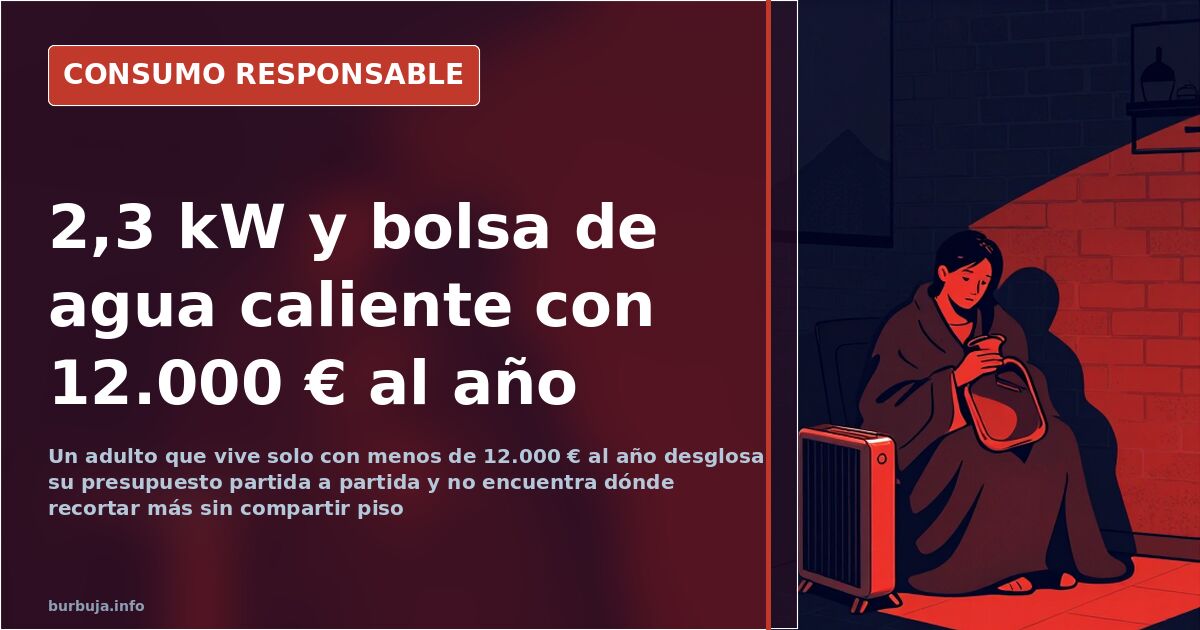
The breakdown has a precision that would embarrass any consultancy firm: 2.3 kW electrical power contract with time-of-use tariffs, a small fridge, an efficient washing machine, and a computer with the clock set back. Result: €16-18 per month on electricity. The question is no longer how to spend less, but whether anything remains to be cut without ceasing to live properly.
Housing: €40 water bill per quarter, mostly taxes
Water costs €40 per quarter, of which €38 are waste collection fees and taxes. Actual consumption is about €2: seven cubic meters every three months. Gas bills are €25-27 bimonthly, with ten-minute showers and heating only on extremely cold days. Every two months, it is turned on for fifteen minutes to prevent mechanical failure. For sleeping, a hot water bottle is used.
Phone and internet: €28-30 with Pepephone, the lowest tariff found. Community fees: €30. Home insurance: €140 a year. IBI (property tax): €203. Furniture and appliances: €200 annually on average. Margin? Basically cleaning supplies: €40 a year between detergent, ammonia, soap bars, and vinegar as fabric softener. No mouthwash. This is textbook lonchafinismo (extreme frugality), and the thread admits this category offers little room for further cuts.
The car: €2,300 a year consuming nearly a fifth of the salary
The vehicle is the black hole. A utility car bought for €3,000, now worth €1,000, insured third-party for €230. Add: €110 for ITV (technical inspection) and IVTM (road tax), €160 for maintenance, €300 for historical average repairs, and €1,500 for fuel, of which about €1,000 is just for commuting. Approximate total: €2,300 annually.
Here are their own ideas. A bicycle for short trips. An older classic car to pay lower insurance, adding the antiestéticar of breakdowns. And remote work as a horizon: without commuting, vehicle expenses would drop to about €800 a year. Between going out to see the world on weekends—an average of 150 kilometers, their escape valve—and the obligation to have a car because there is no decent public transport, the margin is narrow.
Can you cut more, or is the problem the salary?
You can, but less and less effectively. This is where the conversation splits in two. Some argue the problem is not spending but income, and that with a meager salary, squeezing harder only serves to renounce things. Other participants recall, however, that once leisure or housing is touched, marginal savings are tiny, and €40 a year on cleaning doesn't even cover a single bill.
Food aside: €1,600 a year between Carrefour and Lidl. Clothing: €100. Courses: €600, where some see an easy cut—the same content is often free—while others consider it the only professional investment still standing. Healthcare: no private health insurance, €150 for dentist and €20 for medication annually. The complete detail of these accounts—with their budget and calculation of how long they can survive without income—takes up a whole page.
Remove gas, rent the empty room, and move savings
There are three concrete proposals. First, renting the spare room: they have two, one unfurnished, and could earn a couple of thousand euros a year. This would move the most money at once. Their response is that they do not share a house with anyone who isn't a partner, though they don't rule out the option if they lose all income.
Second, removing gas. Switching to electric costs no less than €1,000 and only compensates when the boiler fails; then, use a water heater and timer to heat water during off-peak hours. It is also noted that if a new boiler is needed, choose a condensing model of 21 to 24 kW: higher power is wasted money.
Third, moving savings. The exercise proposed by another participant is simple, as an example: €15,000 in a deposit at 1.3% would yield about €161 a year, nearly the water bill. This increases saving capacity without touching a single expense. And there is a fourth, more radical path: leaving Europe; a participant claims that abroad they pay about €40 a year for water, gas, and light, with lower property taxes.
The unsettling data point
The thread recalls that the minimum pension for someone without a spouse or dependents is €677, and some doubt that with 25 years contributed, the benefit will remain much above that threshold. Against this, another participant calculates that adding those 25 years to the subsidy for people over 52 would reach 40 years contributed. Leisure spending has already been cut by 72% since 2015, from €1,100 to €310. If that isn't tightening the belt, let someone point out where the margin remains.
An adult living alone with a paid-off home and annual income below €12,000 has put their entire budget on the table. They are not seeking charity; they are looking for an idea they haven't tried yet. Since 2000, they have chained together low salaries, antiestéticar imminent job loss, and lost around €2,600 in their last attempt at self-employment. Their house cost €40,000, the car was a second-hand purchase for €3,000, and the washing machine was bought new—€250—because the €90 used one lacked a warranty.
The breakdown has a precision that would embarrass any consultancy firm: 2.3 kW electrical power contract with time-of-use tariffs, a small fridge, an efficient washing machine, and a computer with the clock set back. Result: €16-18 per month on electricity. The question is no longer how to spend less, but whether anything remains to be cut without ceasing to live properly.
Housing: €40 water bill per quarter, mostly taxes
Water costs €40 per quarter, of which €38 are waste collection fees and taxes. Actual consumption is about €2: seven cubic meters every three months. Gas bills are €25-27 bimonthly, with ten-minute showers and heating only on extremely cold days. Every two months, it is turned on for fifteen minutes to prevent mechanical failure. For sleeping, a hot water bottle is used.
Phone and internet: €28-30 with Pepephone, the lowest tariff found. Community fees: €30. Home insurance: €140 a year. IBI (property tax): €203. Furniture and appliances: €200 annually on average. Margin? Basically cleaning supplies: €40 a year between detergent, ammonia, soap bars, and vinegar as fabric softener. No mouthwash. This is textbook lonchafinismo (extreme frugality), and the thread admits this category offers little room for further cuts.
The car: €2,300 a year consuming nearly a fifth of the salary
The vehicle is the black hole. A utility car bought for €3,000, now worth €1,000, insured third-party for €230. Add: €110 for ITV (technical inspection) and IVTM (road tax), €160 for maintenance, €300 for historical average repairs, and €1,500 for fuel, of which about €1,000 is just for commuting. Approximate total: €2,300 annually.
Here are their own ideas. A bicycle for short trips. An older classic car to pay lower insurance, adding the antiestéticar of breakdowns. And remote work as a horizon: without commuting, vehicle expenses would drop to about €800 a year. Between going out to see the world on weekends—an average of 150 kilometers, their escape valve—and the obligation to have a car because there is no decent public transport, the margin is narrow.
Can you cut more, or is the problem the salary?
You can, but less and less effectively. This is where the conversation splits in two. Some argue the problem is not spending but income, and that with a meager salary, squeezing harder only serves to renounce things. Other participants recall, however, that once leisure or housing is touched, marginal savings are tiny, and €40 a year on cleaning doesn't even cover a single bill.
Food aside: €1,600 a year between Carrefour and Lidl. Clothing: €100. Courses: €600, where some see an easy cut—the same content is often free—while others consider it the only professional investment still standing. Healthcare: no private health insurance, €150 for dentist and €20 for medication annually. The complete detail of these accounts—with their budget and calculation of how long they can survive without income—takes up a whole page.
Remove gas, rent the empty room, and move savings
There are three concrete proposals. First, renting the spare room: they have two, one unfurnished, and could earn a couple of thousand euros a year. This would move the most money at once. Their response is that they do not share a house with anyone who isn't a partner, though they don't rule out the option if they lose all income.
Second, removing gas. Switching to electric costs no less than €1,000 and only compensates when the boiler fails; then, use a water heater and timer to heat water during off-peak hours. It is also noted that if a new boiler is needed, choose a condensing model of 21 to 24 kW: higher power is wasted money.
Third, moving savings. The exercise proposed by another participant is simple, as an example: €15,000 in a deposit at 1.3% would yield about €161 a year, nearly the water bill. This increases saving capacity without touching a single expense. And there is a fourth, more radical path: leaving Europe; a participant claims that abroad they pay about €40 a year for water, gas, and light, with lower property taxes.
The unsettling data point
The thread recalls that the minimum pension for someone without a spouse or dependents is €677, and some doubt that with 25 years contributed, the benefit will remain much above that threshold. Against this, another participant calculates that adding those 25 years to the subsidy for people over 52 would reach 40 years contributed. Leisure spending has already been cut by 72% since 2015, from €1,100 to €310. If that isn't tightening the belt, let someone point out where the margin remains.
Also available in: Deutsch
Summary of a discussion on Burbuja.info - Foro de economía, actualidad y política., translated from Spanish and reviewed before publication. Read the full discussion (118 replies).
More summaries
-
Living on €430/month: Spain's over-52 subsidy breakdown
Spain’s over-52 unemployment subsidy pays about €430 monthly and credits pension years. Fixed costs with a paid-off home range from €275 to €477.
-
Spain’s supermarket sauces: fried tomato beats Mercadona
A four-year review of Spanish supermarket sauces from Mercadona, Lidl, Aldi and Carrefour, covering sugar content and prices.
-
How many litres of milk can you get from 1 kg of condensed milk?
A forum calculation says a 1 kg can yields 6.6 to 10 litres, but others warn it's not milk but added sugar.
-
Tattoo study of 6,000 twins sparks health and safety debate
A summary of a study involving 6,000 twins links tattoo inks to heavy metals and lymph nodes, raising concerns over health and melanoma.
-
Monk parakeets in Spain: legal limits on controlling invasive species
Invasive monk parakeets are destroying native bird nests, but Spanish citizens lack legal ways to control them, from air rifles to poisons.
-
Best professional PC mouse recommendations: wired, wireless, or ergonomic
A guide to professional PC mice, comparing wired vs. wireless, vertical, and trackball models with price and durability insights.