
Living on €430/month: Spain's over-52 subsidy breakdown
Spain’s over-52 unemployment subsidy pays about €430 monthly and credits pension years. Fixed costs with a paid-off home range from €275 to €477.
English · Original discussion in Spanish · Published
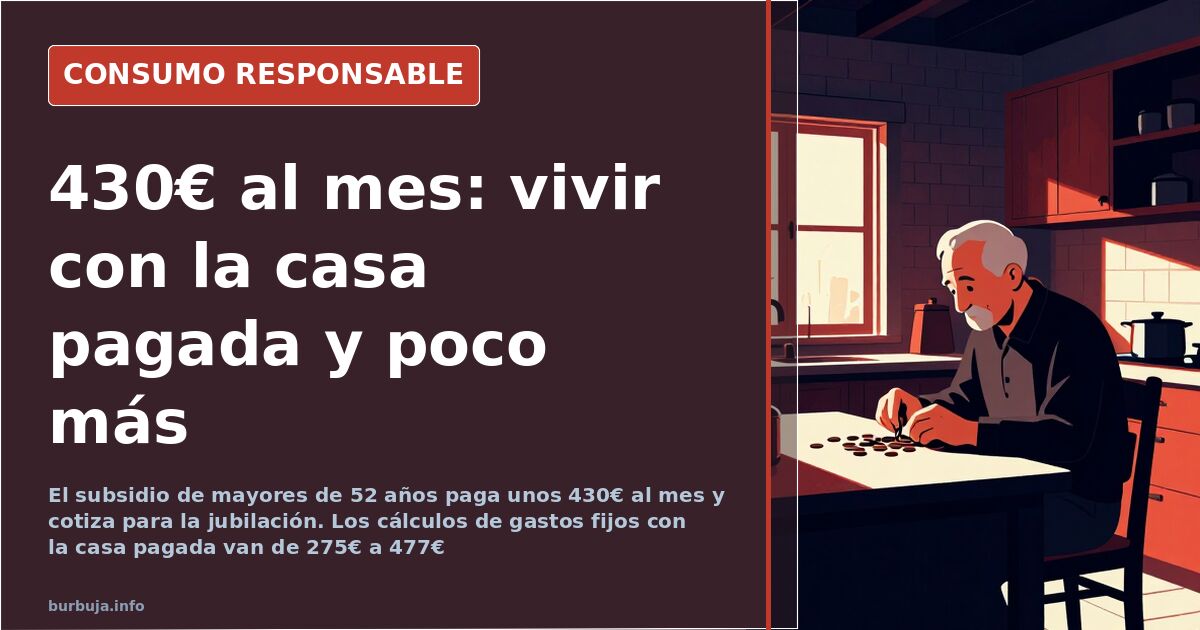
Living on €430/month: The math of a paid-off home
In August 2018, the unemployment subsidy for people over 52 returns to the spotlight. The idea, mentioned in the thread, that the Government might restore the access age to 52 years —after having raised it to 55— reopens the perennial question: Can one live on €430 per month? The answer depends on a variable that is not food. It is housing.
The subsidy: amount, 15 years contributed, and a changing base
The benefit is around €430 monthly and requires at least 15 years of contributions to Social Security. It is compatible with other income up to €429, a margin that allows combining a small rent or sporadic work without losing it. And it contributes to retirement, something almost no other aid in the system does.
The detail has history according to a participant: for years the base was calculated on 125% of the minimum wage, about €935; under the PP government, that amount was reduced to €748 and then rose again to 125% of the SMI (minimum interprofessional salary), around €1,300. Over fifteen years, the difference is not cosmetic. On paper, and according to another forum user, 1.5 million people receive this benefit.
Community fees, property tax, utilities and food: the monthly floor of the household
The first calculation, presented by a forum user, is austere: IBI (property tax), car insurance, electricity, water, waste collection and ITV (vehicle inspection) total €125 per month. With €150 for food, the bill reaches €275, leaving €155 for clothes, a beer, or an unforeseen expense. Nothing superfluous enters this list: no new car, no restaurants, no technology.
The second calculation is harsher because it includes what is almost never included. Community fees weigh €90 or €132 per month, depending on the building. Adding electricity, phone, IBI and insurance, the household starts at €287 before eating. With food, transport, clothes and some outings, the figure climbs to €477; squeezing to the bone, €352. The complete breakdown, item by item, is what decides if the month balances.
Where the numbers work: village, city, or autonomous community
Geography dictates more than diet. In a village of 1,000 inhabitants in the Cuenca area, IBI stays at €25 and heating is solved with wood at €0.14 per kilo. At the other extreme, according to a forum user, in the Basque Country the benefit rounds up to €900, with slightly higher prices. The city squeezes from above; the village breathes from below.
Some go further: with the help plus renting out their own home, they argue, one can live in Thailand, Brazil, or Mexico. It is a hypothesis, not a documented move, but it measures the underlying problem well. In Spain, what throws everything off balance is accommodation.
The step at age 45 and the active insertion income
Before 52, there is an intermediate stage. The aid for those over 45 is temporary and, when there are family responsibilities, can stretch up to 30 months, as explained in the thread. After that comes the Renta Activa de Inserción (Active Insertion Income), a scheme designed as a bridge to the long-term benefit. It is not a comfortable or automatic path, but it exists.
Those who already receive it: saving €50 or living without a fridge
Accounts from recipients mark the real floor. One describes years with €350 per month and expenses controlled to the millimeter: if he managed to save €50, he considered himself satisfied. Another tells the case of an acquaintance who lives on €430 in a rustic house with no IBI, a wood stove, the fridge unplugged, and a pack of cigarettes that lasts him a whole month.
Not everyone is a manual of austerity. Some combine the aid with declared income from rentals and occasional jobs. And some warn of the opposite: twelve years of renunciations leave an emotional toll that does not appear on the spreadsheet. That cost is not measured in euros.
And the retirement that remains afterwards?
The subsidy contributes, yes, although some place that contribution at the minimum base. Ten or fifteen years of reduced contribution lead, as pointed out in the thread, to a much lower pension than many would assume. Decades of contributing at the bottom of the system point to a pension that grazes that same floor and, in the scenario being discussed, the end points to the non-contributory pension.
Hence the tension of the matter: some ask to equate the aid to the SMI, others to reduce contributions for those who hire and train these workers, and some directly propose stopping rowing against the current. The arithmetic closes with a paid-off home. With a mortgage or rent, no combination works. And the question that opens everything —if €430 is enough— remains without an answer valid for all.
In August 2018, the unemployment subsidy for people over 52 returns to the spotlight. The idea, mentioned in the thread, that the Government might restore the access age to 52 years —after having raised it to 55— reopens the perennial question: Can one live on €430 per month? The answer depends on a variable that is not food. It is housing.
The subsidy: amount, 15 years contributed, and a changing base
The benefit is around €430 monthly and requires at least 15 years of contributions to Social Security. It is compatible with other income up to €429, a margin that allows combining a small rent or sporadic work without losing it. And it contributes to retirement, something almost no other aid in the system does.
The detail has history according to a participant: for years the base was calculated on 125% of the minimum wage, about €935; under the PP government, that amount was reduced to €748 and then rose again to 125% of the SMI (minimum interprofessional salary), around €1,300. Over fifteen years, the difference is not cosmetic. On paper, and according to another forum user, 1.5 million people receive this benefit.
Community fees, property tax, utilities and food: the monthly floor of the household
The first calculation, presented by a forum user, is austere: IBI (property tax), car insurance, electricity, water, waste collection and ITV (vehicle inspection) total €125 per month. With €150 for food, the bill reaches €275, leaving €155 for clothes, a beer, or an unforeseen expense. Nothing superfluous enters this list: no new car, no restaurants, no technology.
The second calculation is harsher because it includes what is almost never included. Community fees weigh €90 or €132 per month, depending on the building. Adding electricity, phone, IBI and insurance, the household starts at €287 before eating. With food, transport, clothes and some outings, the figure climbs to €477; squeezing to the bone, €352. The complete breakdown, item by item, is what decides if the month balances.
Where the numbers work: village, city, or autonomous community
Geography dictates more than diet. In a village of 1,000 inhabitants in the Cuenca area, IBI stays at €25 and heating is solved with wood at €0.14 per kilo. At the other extreme, according to a forum user, in the Basque Country the benefit rounds up to €900, with slightly higher prices. The city squeezes from above; the village breathes from below.
Some go further: with the help plus renting out their own home, they argue, one can live in Thailand, Brazil, or Mexico. It is a hypothesis, not a documented move, but it measures the underlying problem well. In Spain, what throws everything off balance is accommodation.
The step at age 45 and the active insertion income
Before 52, there is an intermediate stage. The aid for those over 45 is temporary and, when there are family responsibilities, can stretch up to 30 months, as explained in the thread. After that comes the Renta Activa de Inserción (Active Insertion Income), a scheme designed as a bridge to the long-term benefit. It is not a comfortable or automatic path, but it exists.
Those who already receive it: saving €50 or living without a fridge
Accounts from recipients mark the real floor. One describes years with €350 per month and expenses controlled to the millimeter: if he managed to save €50, he considered himself satisfied. Another tells the case of an acquaintance who lives on €430 in a rustic house with no IBI, a wood stove, the fridge unplugged, and a pack of cigarettes that lasts him a whole month.
Not everyone is a manual of austerity. Some combine the aid with declared income from rentals and occasional jobs. And some warn of the opposite: twelve years of renunciations leave an emotional toll that does not appear on the spreadsheet. That cost is not measured in euros.
And the retirement that remains afterwards?
The subsidy contributes, yes, although some place that contribution at the minimum base. Ten or fifteen years of reduced contribution lead, as pointed out in the thread, to a much lower pension than many would assume. Decades of contributing at the bottom of the system point to a pension that grazes that same floor and, in the scenario being discussed, the end points to the non-contributory pension.
Hence the tension of the matter: some ask to equate the aid to the SMI, others to reduce contributions for those who hire and train these workers, and some directly propose stopping rowing against the current. The arithmetic closes with a paid-off home. With a mortgage or rent, no combination works. And the question that opens everything —if €430 is enough— remains without an answer valid for all.
Also available in: Deutsch
Summary of a discussion on Burbuja.info - Foro de economía, actualidad y política., translated from Spanish and reviewed before publication. Read the full discussion (132 replies).
More summaries
-
Dressing Well with 13 Items: The Minimal Wardrobe That Works
Three pairs of trousers, three shirts, and a few accessories: the formula for dressing well with 13 items, pitting minimal wardrobe advocates against...
-
Texas Ribeye as a Thermometer for 'Socialism'
T-bone steak at €16/600g in Texas vs. €25-30/kg in Spain: the ribeye as a thermometer, with 2.5x higher wages.
-
Social Rats Protest VAT Hikes Through Extreme Frugality
Social rats minimize consumption to protest tax hikes. Calculations show savings on cars and VAT debates. Is it choice or necessity?
-
The real cost of cheap paint from Leroy Merlin
The real cost of using cheap paint from big-box stores. We analyze the dilemma between immediate savings and the durability of the finish.
-
TV Size as Class Marker: 75 Inches or Nothing in Spain
A user claims no TVs over 42 inches appeared in 100 housing ads, contrasting with forum users boasting about 75-inch screens.
-
Finding a free, covered oil change spot in Madrid
Rain in Madrid makes finding a free, covered, unmonitored spot for an oil change difficult. Users discuss garages and DIY options.