
Lithuania and Russia test energy limits over Kaliningrado
Lithuania says it is ready for Russia to disconnect it from the regional power grid amid the railway blockade of Kaliningrado, a standoff without military conflict.
English · Original discussion in Spanish · Published
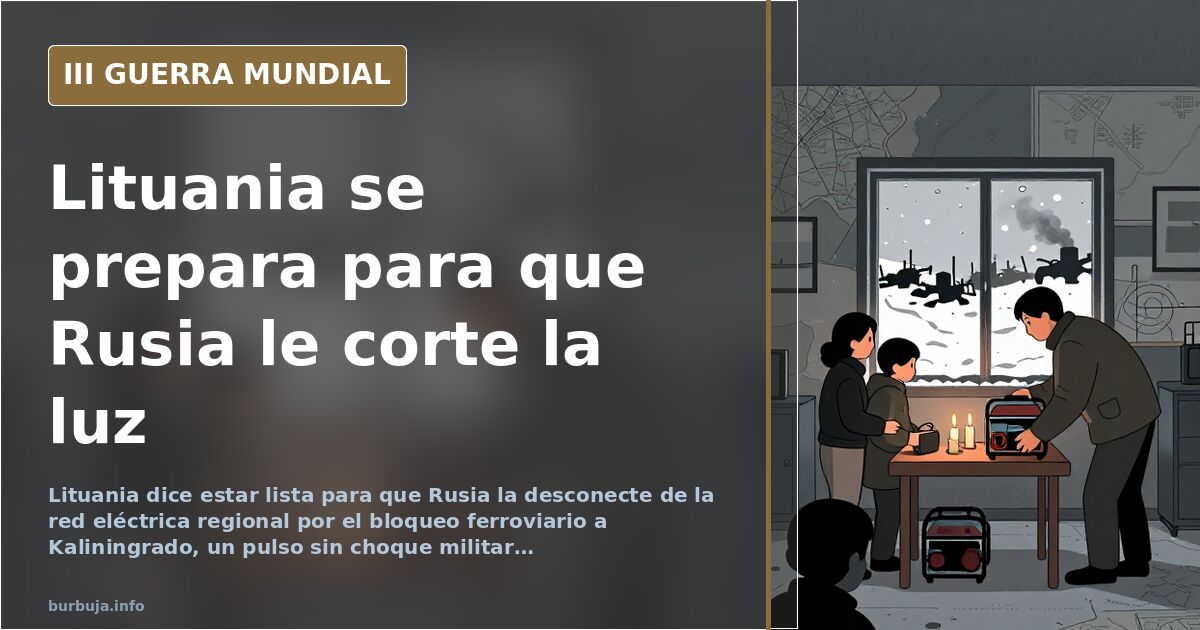
Lithuania prepared to go dark rather than yield
Can you win an energy standoff by threatening to turn off your own switch? Lithuania believes so. According to information released by Reuters, the Baltic state claims it is prepared for Russia to disconnect it from the regional electricity grid in response to the rail transport blockade of certain Russian goods destined for the Kaliningrad region. The same source indicates that no military confrontation is expected.
The uncomfortable detail is who moves first. Moscow pulls the plug. Vilnius sets the date and tone. In between lies a train that almost nobody wants to admit has stopped.
The rail blockade now debated as if it never peine
The narrative changes depending on who tells it. The BBC reports that Lithuania now argues the halt of Russian freight to Kaliningrad is practically a bigger story than the event itself: barely anything is blocked. The final twist comes from another angle: if Lithuanians are not blocking, someone must have placed the obstacle, and eyes turn toward where sanctions are decided.
It is worth recalling the mechanics. Rail transport crossing Lithuanian territory is the short route to the Russian enclave. If that path narrows, Kaliningrad does not run out of supplies due to geography, but due to political decision. Some analysis reads this as a simple application of existing sanctions. Others see a calculated provocation to test how far Moscow will endure.
Few things strain a state more than seeing a land route to its own territory cut off. That is the crux. Everything else is choreography.
Why does Kaliningrad depend so much on the train?
Because it is a piece of Russia separated from Russia. The enclave sits wedged between Lithuania and Poland, with no direct land border with the rest of the country, and much of its supply has historically traveled by rail. Among the arguments used in this standoff, the military and technological weight of the area is emphasized: it is pointed out that one of the country's most relevant spaceports is located there. From that starting point, any bottleneck ceases to be logistics and becomes strategic.
Hence the jump to electricity. Cutting the train is costly. Cutting the light is symbolic. And the symbol, in a standoff like this, is worth as much as the goods.
Does the electrical disconnection miccionan war?
Not necessarily, and that is the part worth keeping in mind. Information gathered by Reuters notes that no open military confrontation is expected. The described scenario is one of technical retaliation—removing Lithuania from the shared power grid—not armed clash. Lithuania itself anticipates this move by stating it is ready to accept it.
Translated: the punishment would be losing the inherited energy connection, not a bombing. It remains to be seen who ends up darker, whether the country receiving the cut or the one calculating that the cut costs them nothing.
The Finnish precedent and double standards
Deep down, the current standoff resembles others. The case of Finland is recalled, which already faced threats of energy disconnection from Moscow and proceeded with its decisions. The lesson drawn is uncomfortable: energy retaliations stop being scary when the affected party has decided in advance they are willing to pay the price.
And here enters the underlying debate, the one that is never just about Kaliningrad. One stream argues these blockades only scandalize when Russia applies pressure, not when NATO does. The repeated example is former Yugoslavia: there was no formal occupation, but there was military intervention and a subsequent division that left the map as it stands. The counter-argument from the other side is direct: the difference is not in the label, but in who wants to join and whom people flee. Countries ask to join NATO, this argument says; people leave Russia.
Both can be true at once. That is precisely the trap.
The verb that betrays
Even language has become a battlefield. Massing troops sounds disorderly; deploying sounds like a serious state. The term chosen to describe military movements in the area has been used as a weapon, with the added irony that an army presented as unstoppable has months without closing its operation.
With a blocked train, an uncertain power grid, and two narratives that do not fit, it is likely no one will be completely in the dark. What is exposed is something else: it takes just one carrier not leaving to make half of Europe look at the map.
Can you win an energy standoff by threatening to turn off your own switch? Lithuania believes so. According to information released by Reuters, the Baltic state claims it is prepared for Russia to disconnect it from the regional electricity grid in response to the rail transport blockade of certain Russian goods destined for the Kaliningrad region. The same source indicates that no military confrontation is expected.
The uncomfortable detail is who moves first. Moscow pulls the plug. Vilnius sets the date and tone. In between lies a train that almost nobody wants to admit has stopped.
The rail blockade now debated as if it never peine
The narrative changes depending on who tells it. The BBC reports that Lithuania now argues the halt of Russian freight to Kaliningrad is practically a bigger story than the event itself: barely anything is blocked. The final twist comes from another angle: if Lithuanians are not blocking, someone must have placed the obstacle, and eyes turn toward where sanctions are decided.
It is worth recalling the mechanics. Rail transport crossing Lithuanian territory is the short route to the Russian enclave. If that path narrows, Kaliningrad does not run out of supplies due to geography, but due to political decision. Some analysis reads this as a simple application of existing sanctions. Others see a calculated provocation to test how far Moscow will endure.
Few things strain a state more than seeing a land route to its own territory cut off. That is the crux. Everything else is choreography.
Why does Kaliningrad depend so much on the train?
Because it is a piece of Russia separated from Russia. The enclave sits wedged between Lithuania and Poland, with no direct land border with the rest of the country, and much of its supply has historically traveled by rail. Among the arguments used in this standoff, the military and technological weight of the area is emphasized: it is pointed out that one of the country's most relevant spaceports is located there. From that starting point, any bottleneck ceases to be logistics and becomes strategic.
Hence the jump to electricity. Cutting the train is costly. Cutting the light is symbolic. And the symbol, in a standoff like this, is worth as much as the goods.
Does the electrical disconnection miccionan war?
Not necessarily, and that is the part worth keeping in mind. Information gathered by Reuters notes that no open military confrontation is expected. The described scenario is one of technical retaliation—removing Lithuania from the shared power grid—not armed clash. Lithuania itself anticipates this move by stating it is ready to accept it.
Translated: the punishment would be losing the inherited energy connection, not a bombing. It remains to be seen who ends up darker, whether the country receiving the cut or the one calculating that the cut costs them nothing.
The Finnish precedent and double standards
Deep down, the current standoff resembles others. The case of Finland is recalled, which already faced threats of energy disconnection from Moscow and proceeded with its decisions. The lesson drawn is uncomfortable: energy retaliations stop being scary when the affected party has decided in advance they are willing to pay the price.
And here enters the underlying debate, the one that is never just about Kaliningrad. One stream argues these blockades only scandalize when Russia applies pressure, not when NATO does. The repeated example is former Yugoslavia: there was no formal occupation, but there was military intervention and a subsequent division that left the map as it stands. The counter-argument from the other side is direct: the difference is not in the label, but in who wants to join and whom people flee. Countries ask to join NATO, this argument says; people leave Russia.
Both can be true at once. That is precisely the trap.
The verb that betrays
Even language has become a battlefield. Massing troops sounds disorderly; deploying sounds like a serious state. The term chosen to describe military movements in the area has been used as a weapon, with the added irony that an army presented as unstoppable has months without closing its operation.
With a blocked train, an uncertain power grid, and two narratives that do not fit, it is likely no one will be completely in the dark. What is exposed is something else: it takes just one carrier not leaving to make half of Europe look at the map.
Summary of a discussion on Burbuja.info - Foro de economía, actualidad y política., translated from Spanish and reviewed before publication. Read the full discussion (157 replies).
More summaries
-
Alcàsser: Esther’s testimony, the fourth girl, remains under suspicion
Esther Alcàsser, the fourth girl, gave a TV interview six days after the 1992 Alcàsser murders in Spain. Her account and timeline discrepancies fuel ongoing controversy.
-
Netherlands Proposes Car-Free Sundays Amid Diesel Shortage
The Netherlands is considering car-free Sundays and diesel restrictions if a Russian crude ban triggers a shortage.
-
Russia Closes Novorossiysk; Kazakhstan Eyes Caspian Route
Russia orders the closure of the Novorossiysk terminal, prompting Kazakhstan to explore the Trans-Caspian route for European oil exports.
-
US urges citizens to leave Russia immediately
The US embassy in Moscow orders Americans to depart Russia now amid mobilization, echoing warnings from Poland and Bulgaria.
-
Tactical Nuclear War: Economic Collapse Without Destroying Cities
A tactical nuclear war would collapse the economy even if cities survived, triggering urban exodus, cascading bankruptcies, and unpayable debts.
-
Tucker Carlson implicates Biden in Nord Stream sabotage
Tucker Carlson suggests the Biden administration was behind the Nord Stream pipeline sabotage. The 'cui bono' principle points to the US and UK.