
Linguist claims Jesus is rewritten Julius Caesar
Italian linguist Francesco Carotta argues Jesus is a reimagined Julius Caesar. The academic community rejects this theory.
English · Original discussion in Spanish · Published
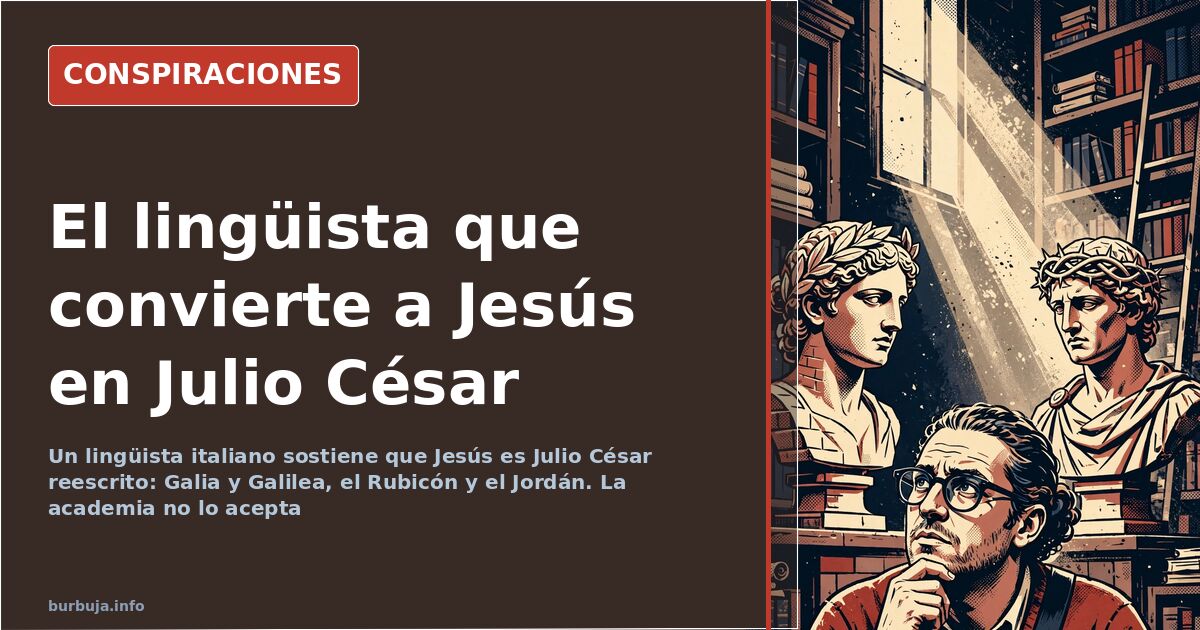
The Theory That Turns Jesus into Julius Caesar
Jesus never existed as an independent figure: he is Julius Caesar, rewritten and disguised. The thesis sounds like dinner-table nonsense, yet it comes from Italian linguist Francesco Carotta, based in Germany, who taught a course on the subject at Complutense University and published his research in German and English — but not in Spanish. The theory rests on a grid of textual and symbolic parallels that, according to its proponents, explains almost everything the Gospels recount. Critics call it a castle of coincidences held together by pins. Both views may be true simultaneously, which is precisely what makes it uncomfortable.
What Exactly Does Carotta’s Theory Claim?
The core concept is called diegetic translation: Caesar’s life and funeral are retold with a different setting, names, and characters, much like Joyce’s Ulysses transposes the Odyssey to Dublin without reproducing a single line of Homer. There is no literal copy; there is adaptation. Roman legionaries stationed in Israel after Caesar’s campaigns would have carried the cult of Divus Iulius — the same abbreviation, they insist, as for Jesus Christ — and this cult would have transformed, generation after generation, into the story we know today. The key, they argue, is that the symbol survives even when its origin is forgotten: tradition is passed down in the legion long after anyone remembers where it came from.
Gaul and Galilee, Rubicon and Jordan
The parallels start on the map. Caesar begins his rise in Gaul; Jesus, in Galilee. Two northern regions. Both cross a river marking a border: the Rubicon separated Gaul from Italy; the Jordan separated Galilee from the Decapolis. After crossing, each finds a protector who becomes a rival — Pompey and John the Baptist — and their first trinc, paired one by one: Antony and Curio versus Peter and Andrew. Both travel a path ending in the capital — Rome, Jerusalem — where they first triumph and then suffer passion. The narrative structure, they claim, is the same play with different scenery.
The Comet, the Cross, and the Vatican Tomb
Here enters symbolism, which impresses most those examining the research. Two months after Caesar’s funeral, the passage of a comet is documented — also in Chinese sources, making it verifiable for defenders. Augustus interprets it as Caesar’s soul ascending to heaven and coins it. It is the Sidus Iulium, a divine symbol spreading across the empire. The resemblance to the Christian Chi-Rho is, they say, notable. And there is more: the cross would not be such, but a tropheum, the device where Mark Antony paraded a doll imitating stabbed Caesar. Romans, they recall, crucified with diagonal beams and nails between cubit and radius, not in hands. Today’s street processions would be, read this way, the direct heritage of a Roman funeral in 44 BC.
Why Critics Don’t Believe It
Rejection is majority and comes with arguments. Tertullian, a Roman citizen living between 160 and 220 AD, clearly distinguished the two figures, placing an early separation between both narratives. For the thesis to work, one must assume St. Paul was an idiot and that dozens of biblical references and Jewish messianic traditions — perfectly integrated into prophecies — did not exist before. No contemporary document records this metamorphosis. The most repeated comparison: it is like claiming Napoleon never existed and was actually a reincarnation of Apollo.
Apollonius of Tyana Is More Similar
If seeking similarities, there are better candidates. Apollonius of Tyana, a Greek thaumaturge of the 1st century, is attributed miracles and a life overlapping with Jesus far more than a Roman general killed in the Senate. Coincidences among ancient religious figures are a genre in itself: Mithras, Dionysus, Buddha. Finding parallels, skeptics point out, does not prove causality: it proves that whoever seeks, finds. The question is not whether they exist, but whether they are cause or coincidence. And there, the case remains open.
Carotta has not entered any curriculum, and academia, outside his own work, has not adopted the thesis. If ever published in Spanish, the matter will reignite. With reservations: it is more likely to stay where it is — on a handful of websites and in the minds of a few curious people — than in history textbooks.
Jesus never existed as an independent figure: he is Julius Caesar, rewritten and disguised. The thesis sounds like dinner-table nonsense, yet it comes from Italian linguist Francesco Carotta, based in Germany, who taught a course on the subject at Complutense University and published his research in German and English — but not in Spanish. The theory rests on a grid of textual and symbolic parallels that, according to its proponents, explains almost everything the Gospels recount. Critics call it a castle of coincidences held together by pins. Both views may be true simultaneously, which is precisely what makes it uncomfortable.
What Exactly Does Carotta’s Theory Claim?
The core concept is called diegetic translation: Caesar’s life and funeral are retold with a different setting, names, and characters, much like Joyce’s Ulysses transposes the Odyssey to Dublin without reproducing a single line of Homer. There is no literal copy; there is adaptation. Roman legionaries stationed in Israel after Caesar’s campaigns would have carried the cult of Divus Iulius — the same abbreviation, they insist, as for Jesus Christ — and this cult would have transformed, generation after generation, into the story we know today. The key, they argue, is that the symbol survives even when its origin is forgotten: tradition is passed down in the legion long after anyone remembers where it came from.
Gaul and Galilee, Rubicon and Jordan
The parallels start on the map. Caesar begins his rise in Gaul; Jesus, in Galilee. Two northern regions. Both cross a river marking a border: the Rubicon separated Gaul from Italy; the Jordan separated Galilee from the Decapolis. After crossing, each finds a protector who becomes a rival — Pompey and John the Baptist — and their first trinc, paired one by one: Antony and Curio versus Peter and Andrew. Both travel a path ending in the capital — Rome, Jerusalem — where they first triumph and then suffer passion. The narrative structure, they claim, is the same play with different scenery.
The Comet, the Cross, and the Vatican Tomb
Here enters symbolism, which impresses most those examining the research. Two months after Caesar’s funeral, the passage of a comet is documented — also in Chinese sources, making it verifiable for defenders. Augustus interprets it as Caesar’s soul ascending to heaven and coins it. It is the Sidus Iulium, a divine symbol spreading across the empire. The resemblance to the Christian Chi-Rho is, they say, notable. And there is more: the cross would not be such, but a tropheum, the device where Mark Antony paraded a doll imitating stabbed Caesar. Romans, they recall, crucified with diagonal beams and nails between cubit and radius, not in hands. Today’s street processions would be, read this way, the direct heritage of a Roman funeral in 44 BC.
Why Critics Don’t Believe It
Rejection is majority and comes with arguments. Tertullian, a Roman citizen living between 160 and 220 AD, clearly distinguished the two figures, placing an early separation between both narratives. For the thesis to work, one must assume St. Paul was an idiot and that dozens of biblical references and Jewish messianic traditions — perfectly integrated into prophecies — did not exist before. No contemporary document records this metamorphosis. The most repeated comparison: it is like claiming Napoleon never existed and was actually a reincarnation of Apollo.
Apollonius of Tyana Is More Similar
If seeking similarities, there are better candidates. Apollonius of Tyana, a Greek thaumaturge of the 1st century, is attributed miracles and a life overlapping with Jesus far more than a Roman general killed in the Senate. Coincidences among ancient religious figures are a genre in itself: Mithras, Dionysus, Buddha. Finding parallels, skeptics point out, does not prove causality: it proves that whoever seeks, finds. The question is not whether they exist, but whether they are cause or coincidence. And there, the case remains open.
Carotta has not entered any curriculum, and academia, outside his own work, has not adopted the thesis. If ever published in Spanish, the matter will reignite. With reservations: it is more likely to stay where it is — on a handful of websites and in the minds of a few curious people — than in history textbooks.
Summary of a discussion on Burbuja.info - Foro de economía, actualidad y política., translated from Spanish and reviewed before publication. Read the full discussion (201 replies).
More summaries
-
Spain's 2026 election: Not October, but November 3.0 looms
The Adamuz train crash coincided with the Capricorn New Moon, reigniting political astrology debates over Spain's elusive 2026 election dates.
-
Adamuz Train Crash Sparks Sabotage Theories
The Adamuz train collision fuels sabotage theories. Video reveals critical 45 seconds, and a 9/11 lawyer enters the case.
-
Valencia Floods: Planned DANA or Criminal Negligence?
Record flow, broken sensors, and failed radars fuel suspicions of a planned climate engineering event in Valencia.
-
Christianity as Plagiarism: Debate on Pagan Roots
Forum debate on whether Christianity copied Mithras, Horus, and Sol Invictus, alongside data on religious abuse in Spain.
-
Forum Debate: Progressive Rock Origins and Jamie Muir's Legacy
A forum thread explores progressive rock's 1969 origins, Jamie Muir's role, and links between King Crimson, free jazz, and the avant-garde.
-
Spain's 11-M Attacks: Rubalcaba Shadow and Unresolved Narrative
Analysis of theories linking Alfredo Pérez Rubalcaba to the 2004 Madrid bombings, citing insider info, false flag claims, and conspiracy hypotheses.