
Lidl's €25 vacuum sealer: is it worth it?
Lidl's vacuum sealer costs €25. One user says it adds nothing for freezing and that this model lacks power; another argues it prevents frost build-up.
English · Original discussion in Spanish · Published
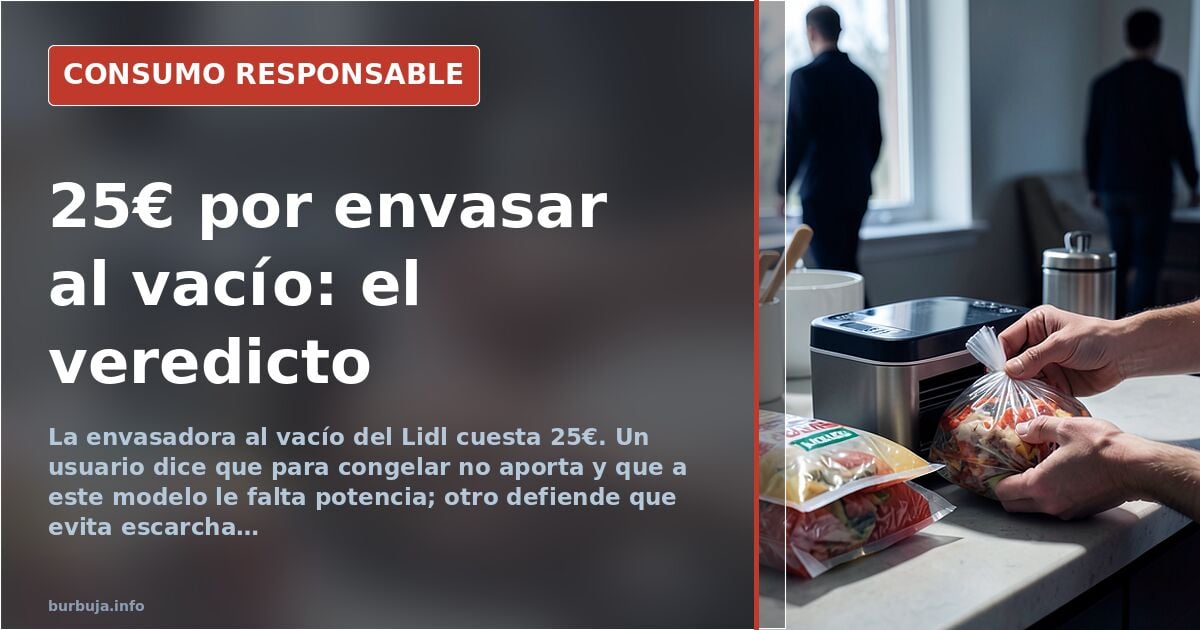
Lidl's vacuum sealer: €25 that won't fix freezer burn
Twenty-five euros. That's the price at which Lidl's vacuum sealer lands on the shelves, and the trigger for a question anyone who freezes food in bulk has asked themselves at some point: is it worth it, or is it just another gadget that will end up at the back of a cupboard? The doubt is raised by someone who freezes mostly meat —chicken breast, chops, pork loin— and everyday home-cooked meals, stews and meatballs in sauce, stored in containers. And that's where the first clash begins.
For freezing, some argue it isn't necessary. Wrapping in cling film or using a container preserves just as well, according to this view, and the real problem you're trying to tackle —freezer-burned meat, frost— doesn't always justify the outlay. The real usefulness, the more sceptical voices point out, lies in the fridge: extending the life of what you don't freeze. Vacuum sealing isn't magic.
What vacuum sealing really gets you
The argument in favour isn't space saving, but the quality of the frozen food. Food doesn't get freezer burn, doesn't accumulate ice and doesn't end up smelling of everything else in the chest freezer, say those who use the sealer. And there's a side effect almost nobody mentions: since the bags can be laid flat, defrosting is faster. For anyone who buys fish or meat in bulk and portions it out, a single packing session sorts out the pantry for a whole season.
The classic stumbling block is the refills. Some argue these machines turn you into a slave to their proprietary bags. The counter-offer is simple: Lidl's own freezer bag rolls cost just over a euro and come with a huge number of bags. If the model accepts generic bags, the recurring cost plummets.
The machine: cheap, but with just enough power
The fine print is in the power. It's not a professional machine, and the criticism is that this particular model lacks strength. It's fine for normal household use, with no ambitions of industrial charcuterie. The question is whether that "normal" covers stew in sauce, which is exactly where things get tricky: liquids and sauces are harder to vacuum-seal than a dry piece of meat.
There's a homemade alternative doing the rounds that costs nothing: keep the jars from cocktail snacks or margarine —rectangular, stackable, the size of a dinner plate— and use them as freezer containers. They can't go in the microwave, but they do the job. The ecological question about thin plastic remains up in the air.
The question that decides the purchase
If you don't know what you'd use it for, you don't need it. It's the most honest answer and the one least given in shops. With €25 at stake, the maths is simple: if you freeze in bulk, frost bothers you and you'll use cheap bags, the purchase makes sense. If your freezer holds a container of stew and a lone chicken breast, the gadget will end up gathering dust next to the food processor. How many times a month would you actually get your €25' worth?
Also available in: Deutsch
Summary of a discussion on Burbuja.info - Foro de economía, actualidad y política., translated from Spanish and reviewed before publication. Read the full discussion (8 replies).
More summaries
-
Opened mayonnaise: one-month limit, while jarred alioli is a guessing game
DIA mayonnaise indicates a one-month maximum once opened; jarred alioli gives no timeframe, and freezing can break the emulsion, according to a forum user.
-
Lidl's frozen sardines at €3.90/kg vs. fresh ones
A kilo of frozen sardines costs €3.90 compared to €9-€10 for fresh ones in Madrid. The question is whether the flavor holds up after freezing.
-
WHO Clarifies Red Meat Cancer Link; Harvard Retracts
The WHO only flagged processed meat, while Harvard has retracted claims against red meat. Previous studies were observational: correlation is not causation.
-
Accessing Live Sports via Shared Streaming Links
Analysis of how users access live sports through shared streaming codes and links.
-
Ariston water heater: 5-second delay means cold water in the shower
A user reports that his Ariston gas water heater takes 5 seconds to light and delivers cold water when the tap is reopened; customer service changed their story…
-
Megane radio code: 25 euros at the dealer or free at home
The four-digit code for a Megane radio costs 25 euros at the dealership or nothing at all, by extracting the pre-code from the unit and using a calculator.