
Opened mayonnaise: one-month limit, while jarred alioli is a guessing game
DIA mayonnaise indicates a one-month maximum once opened; jarred alioli gives no timeframe, and freezing can break the emulsion, according to a forum user.
English · Original discussion in Spanish · Published
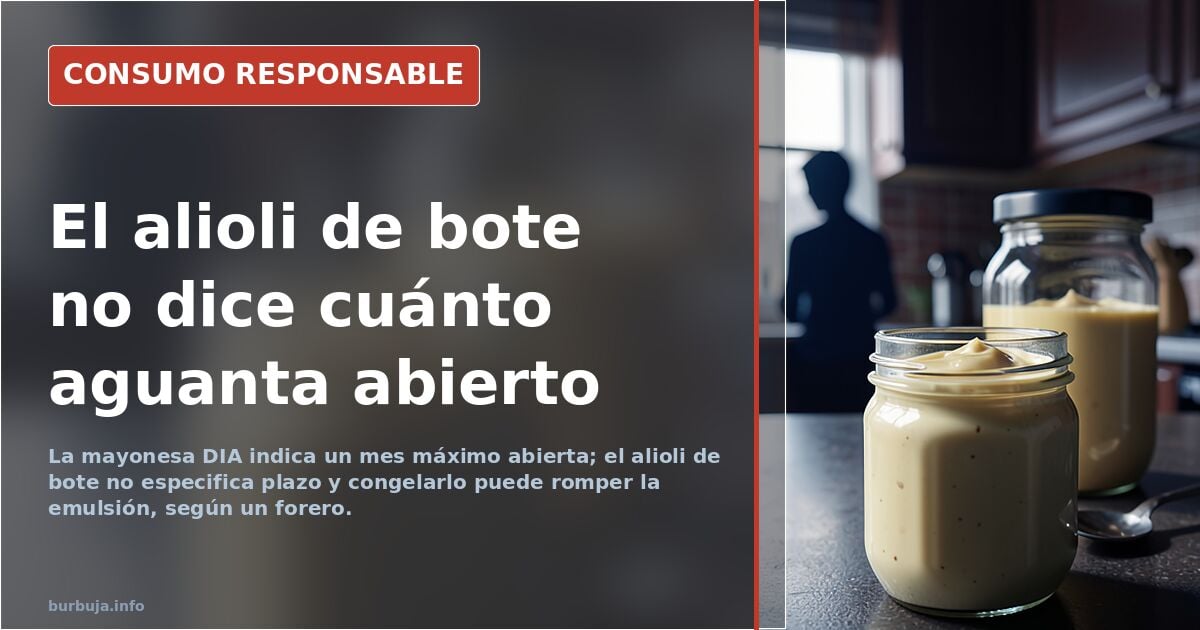
Peine mayonnaise: a one-month limit, alioli remains a guessing game
Buying a jar of alioli for a single person is a gamble. You open the sauce, use it twice, and it sits in the fridge door while you wonder whether it will keep or whether it is time to throw it out. The doubt is no small matter: most jars carry not a single indication of the maximum storage time once peine. Only the generic advice to keep it refrigerated.
The most concrete answer to this question has come from a store brand. **DIA** mayonnaise jars sold upside down state on their label a **maximum of one month** after opening, according to a participant in the thread. It is the only explicit figure found after checking brand after brand. From there, the obvious conclusion is by analogy: if the composition of alioli is similar to that of mayonnaise, the same timeframe should apply to an peine jar of alioli. No one has yet found a label that confirms this in writing.
Can you freeze jarred alioli?
The temptation to freeze it in ice cube trays, as people do with tomato sauce, runs into a technical problem. Alioli and mayonnaise are **emulsions**, and emulsions break easily when frozen: the result is a split sauce, with the oil separating from the water phase, as a forum user warns. The home experiment is possible, but the outlook is not good. Anyone who has tried it and got an acceptable result has not written it down.
It is worth separating two things. One is industrially packaged sauce, stable thanks to its preservatives and pH, and quite another is homemade mayonnaise, which contains raw egg and is a breeding ground for bacteria. The antiestéticar of egg, which is widespread, applies even more to the homemade product than to the store-bought jar. In the industrial product, the egg is pasteurised or in derivative form, and the manufacturer adjusts the acidity to curb microbial growth.
Egg-free alternatives and small containers
For those cooking for one, the format matters as much as the recipe. There are egg-free aliolis in small containers that keep well and, according to one participant's experience, taste better than the best-known garlic mayonnaise brands. It is a middle path: you spend less, throw away less and avoid the freezing dilemma.
The underlying calculation is simple. A large jar is better value per kilo, but if half of it ends up in the bin, the saving evaporates. Individual sachets, which is what people usually resort to when there is no other option nearby, make each portion more expensive and are not always available outside large cities.
The DIA one-month label is, for now, the only compass. Everything else is inference.
Also available in: Deutsch
Summary of a discussion on Burbuja.info - Foro de economía, actualidad y política., translated from Spanish and reviewed before publication. Read the full discussion (4 replies).
More summaries
-
Mercadona's kefir in Spain: fermented or just milk with strains?
Mercadona's kefir in Spain does not state how much kefir it contains or whether it is pasteurized. Homemade kefir, made with live grains, has a different texture and properties.
-
Shopper hides €60 salmon behind fridge after regretting purchase
A forum user admits hiding a €60 salmon from Mercadona behind a shelf. Critics condemn the act, sparking debate on supermarket waste policies.
-
Coca-Cola priced at €2.17 in Spain's Mercadona: price breakdown
A €2.17 price tag for a 2-litre Coca-Cola bottle sparks debate over sugar taxes, private labels, and consumer habits.
-
Elon Musk’s appearance sparks debate: does the founder’s body matter?
Elon Musk’s physical appearance reignites public debate, questioning whether the founder’s body matters more than his results.
-
Aquaservice vs the 1.5-litre bottle: the math doesn't add up
The dispenser is free, but the water isn't: against bottled water at 0.19 cents a litre, home-delivered water jugs don't pay off for an ordinary household.
-
Closing an EVO Banco account: the zero balance that wasn't zero
He was told to empty the account to close it with EVO Banco, a Spanish online bank, but the bank then claimed there were pending amounts. The process stalls and tempers rise.