
Liberalism as pathology: the debate shaking economics
Forum clash over claims that liberalism lacks empathy, countered by arguments citing non-liberal regimes like Mao's and Stalin's.
English · Original discussion in Spanish · Published
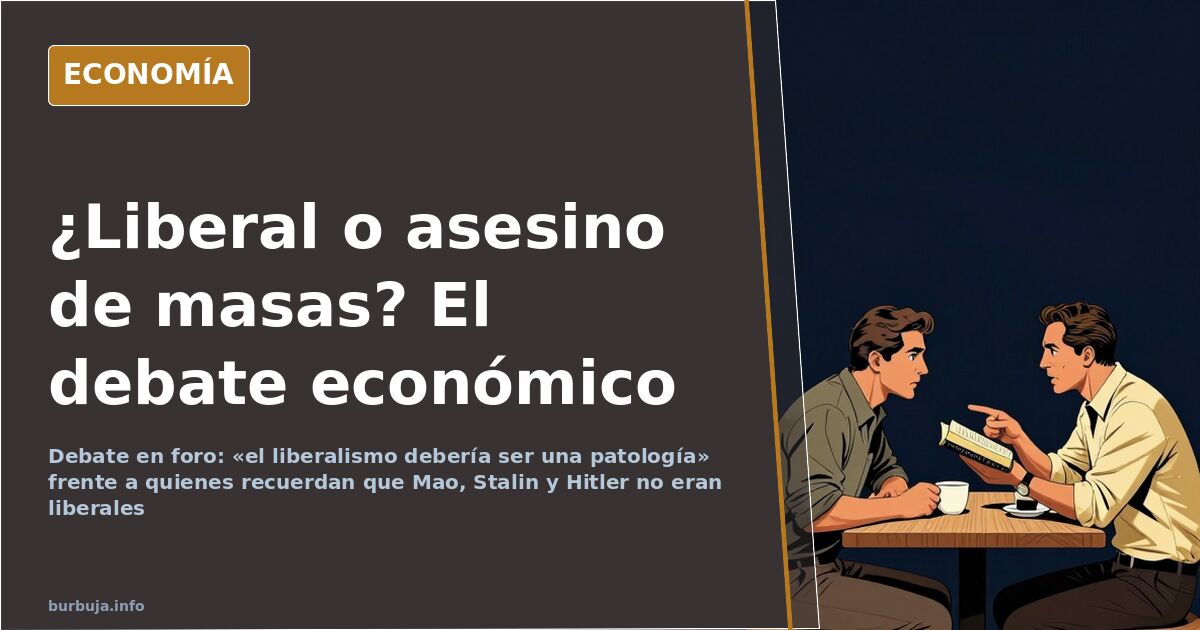
Liberalism as pathology: the debate shaking economics
A recurring discussion in economic circles has resurfaced with force: is liberalism an ideology or a disorder? The initial provocation claimed liberals lack empathy, enjoy seeing compatriots beg, and share instincts with history's greatest genocidaires. This thesis aimed to corner a movement accused of turning solidarity deficits into virtues.
The response was swift and multifaceted, targeting semantic confusion. Mao, Stalin, and Hitler were not liberals, some retorted sarcastically. Others cited the Irish famine, East India Company massacres, or the Bengal genocide to show unregulated free markets also have blood on their hands. The exchange revealed the core issue isn't liberalism itself, but differing definitions of it.
What is liberalism and what is not?
The first misunderstanding concerned definition. For some, liberals defend free markets, private property, and minimal state interference. For others, they are wealthy entrepreneurs benefiting from interventionist states protecting them from competition. Confusing liberalism with crony capitalism—or mercantilism—was central. Many argued self-proclaimed liberals actually support systems where political power distributes favors among elites.
This distinction didn't convince critics, who see liberalism inevitably leading to extreme individualism where society fragments. They argued liberalism emerged to destroy social bonds, forcing everyone into competition. Every man for himself, summarized one participant, assuming personal survival due to perceived cleverness.
The body count argument: who killed more?
Tension peaked when quantifying harm. One user claimed 100 million deaths under communism versus zero under liberalism. Critics countered that the French Revolution was bloody, and both Nancy and Communism stemmed from it. Others noted historical alliances between liberals and communists. The debate shifted to the 20th century, citing Hamburg, Dresden, Hiroshima, and Nagasaki as examples of liberal democracies leaving corpses behind.
Some pointed out the fundamental flaw: judging liberalism by actions of non-liberal governments. The Soviet Union and current China aren't paradises of individual liberty yet serve as warnings against total state control. A paradox was noted: true reds flee capitalist countries; people risk lives reaching the US from Cuba, and the Berlin Wall was crossed East-to-West, not vice versa.
Solidarity, charity, and the parasite problem
Another thread addressed solidarity. Misguided solidarity attracts parasites, argued some, noting no one likes being drained. Confusing solidarity with charity was flagged as a linguistic trap. Defenders said liberalism rewards merit and effort; critics called this a fable, citing those born with millions who never work competing against those starting from scratch.
Trust fund kids—inheritors untouched by decades of labor—debunked the idea that markets reward the best. Inherited wealth and lands stolen from Indigenous peoples or Mexico proved unequal starting points. Some concluded liberalism rewards position, not effort. Others retorted: refusing to work makes one a parasite, and rewarding merit drives societal pogre.
Liberalism as pathology: diagnosis or insult?
The initial sociopathy thesis found few explicit defenders but echoed views that extreme individualism dehumanizes. Liberals allegedly see others as rivals in zero-sum games. The boat metaphor recurred: we're all aboard, and if it sinks, everyone drowns. This view suggests liberals fail to grasp collective fate.
Rebuttals clarified individualism isn't selfishness but prioritizing the individual as the political subject over the group. Centering the group renders individuals disposable, evidenced by 20th-century collectivist totalitarianisms. No one can be sacrificed for group benefit, summarized one voice. Here, the debate turned philosophical rather than economic.
The Spanish context: why this debate keeps returning
The backdrop was unmistakably Spanish. Pedro Sánchez, Macri, Rajoy, and Espinosa de los Monteros were cited as proof that useless opposition aids the left. Warnings that Spain will grow poorer due to such debates drew applause. The notion that figures like Chávez or Kirchner rose not through genius but because opposition was incompetent resonated strongly.
Others noted the term 'liberal' in its US sense wasn't common in Spain until recently. Suspicions of terminological confusion campaigns—blaming Anglo-Jewish CMs or left-wing trolls—circulated. Why seriously answer these trolls?, someone concluded. Like most such debates, it ended in stalemate.
The lingering question isn't whether liberalism kills more than communism, but whether arguing labels matters while the ship leaks. Do those begging at supermarket doors care about defining crony capitalism?
Also available in: Deutsch
Summary of a discussion on Burbuja.info - Foro de economía, actualidad y política., translated from Spanish and reviewed before publication. Read the full discussion (118 replies).
More summaries
-
Leire's diary and the initials P.S.: the judicial puzzle catching up with Maestre
The P.S. entry in Leire Díaz's diary puts Maestre face to face with his own past: he himself likens the initials to the Bárcenas fake, but the judicial origin is different.
-
Vox cuts €161,000 in LGTBI aid in Spain's Aragon region
The regional government of Aragon has redirected €161,000 from LGTBI support to disability programs, reducing the total budget by 15.5%.
-
PACMA's housing proposals in Spain
PACMA's housing agenda includes affordable rent, curbing speculation and banning clauses that exclude pets from rental contracts.
-
Spain's Núñez Feijóo agrees to Jordi Wild interview (Abascal and Sánchez also invited)
Alberto Núñez Feijóo has accepted an interview with Jordi Wild after the YouTuber's public invitation. He is the first politician to take the step.
-
What happened to the Villamanín winners' Christmas lottery money?
The Villamanín festival committee in Spain cashed the 2013 El Gordo Christmas lottery prize and the winners demanded their share. Here's how the case ended up in court.
-
Alvise Pérez accuses Spanish TV channel laSexta of defamation
Alvise Pérez has accused laSexta of defamation in a post on X over a video. The message calls for it to be a crime and labels the broadcaster "bad people". We explain the context.