
León rental yield: numbers don't add up alone
A €124,000 apartment on León's outskirts highlights that without real price, renovation costs and expected rent, rental profitability remains uncertain.
English · Original discussion in Spanish · Published
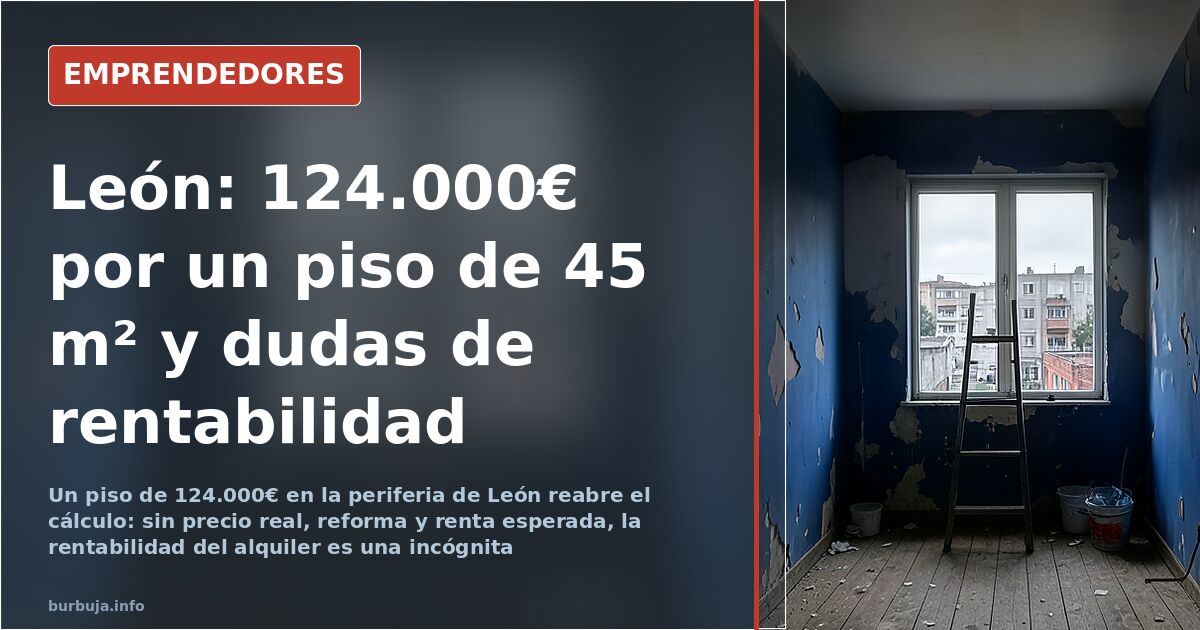
León and rental yields: price isn't everything
A new-build apartment on the outskirts of León, with brochure finishes and an apparently affordable price, is presented as an investment opportunity. The problem begins when looking at the map: the development is located on the road to Carbajal, outside the urban core, next to a golf course abandoned since the financial crisis over a decade ago. Buyers there aren't buying "the center"; they are buying a car for everything. In a small city, this weighs more than it seems in the final yield.
The debate on whether a rental apartment in León offers good returns has an uncomfortable answer: it depends on the specific deal, not the city. Without a real purchase price, renovation costs, or expected monthly rent, any calculation is smoke. All that can be stated with data on the table is that off-plan new builds usually offer lower yields than second-hand properties, because one pays a premium for being new that isn't recovered in rent.
What you actually buy when you buy "near the center"
The advertised apartment isn't in central León. It is in a residential area to the north, separated from the urban nucleus, with a supermarket as the main nearby service. For someone seeking a room rental, location is the first filter: without leisure, commerce, or convenient public transport, the potential tenant pool shrinks. Fewer tenants means more empty months, the variable that eats up any profitability.
Some argue that location explains at least 25% of a property's price. In medium-sized cities like León, this percentage may be even higher, as rental supply concentrates in a few neighborhoods. Second-hand properties offer large apartments, with multiple rooms, wooden wardrobes, and fifty years behind them. Renovation increases the cost, but the entry price is much lower, and rent doesn't depend on an abandoned golf course.
The calculation no one completes
Gross rental yield is calculated by dividing annual rent by the purchase price. Net yield subtracts expenses: community fees, taxes, insurance, maintenance, and vacant months. A €124,000 apartment with €600 monthly rent would give a gross yield of 5.8%, but after deducting expenses and vacancies, it could halve. This item-by-item breakdown is where one decides if the deal makes sense or is just an expensive way to hold bricks.
Off-plan new builds promise fewer expenses and problems, plus superior appreciation without needing renovation. In exchange, one pays a price that already incorporates that promise. In provinces with limited demand, that premium rarely recovers. Second-hand properties, however, allow negotiation, custom renovations, and adjusting rent to the real market.
León as a market: cheap, comfortable, and lacking spark
León is a comfortable and cheap city; almost everything is within walking distance. It has green areas along the river, services, leisure, and bars with free tapas. Winter climate is cold but dry and bearable, milder than in the mountains just 25 kilometers away. For living, it works. For investing, the market is small, and rental demand lacks the tension of Madrid or Barcelona.
This means León's average yield isn't exceptional, but neither is it disastrous. There are better provinces for investing and worse ones. The key is finding deals above average, which requires comparing ads, calculating real rents, and not trusting the developer's brochure. The complete calculation, with all expenses broken down, is what separates an investment from an illusion.
With these numbers, the decision isn't made by the city, but by the spreadsheet. And that sheet, in most cases, still isn't on the table.
A new-build apartment on the outskirts of León, with brochure finishes and an apparently affordable price, is presented as an investment opportunity. The problem begins when looking at the map: the development is located on the road to Carbajal, outside the urban core, next to a golf course abandoned since the financial crisis over a decade ago. Buyers there aren't buying "the center"; they are buying a car for everything. In a small city, this weighs more than it seems in the final yield.
The debate on whether a rental apartment in León offers good returns has an uncomfortable answer: it depends on the specific deal, not the city. Without a real purchase price, renovation costs, or expected monthly rent, any calculation is smoke. All that can be stated with data on the table is that off-plan new builds usually offer lower yields than second-hand properties, because one pays a premium for being new that isn't recovered in rent.
What you actually buy when you buy "near the center"
The advertised apartment isn't in central León. It is in a residential area to the north, separated from the urban nucleus, with a supermarket as the main nearby service. For someone seeking a room rental, location is the first filter: without leisure, commerce, or convenient public transport, the potential tenant pool shrinks. Fewer tenants means more empty months, the variable that eats up any profitability.
Some argue that location explains at least 25% of a property's price. In medium-sized cities like León, this percentage may be even higher, as rental supply concentrates in a few neighborhoods. Second-hand properties offer large apartments, with multiple rooms, wooden wardrobes, and fifty years behind them. Renovation increases the cost, but the entry price is much lower, and rent doesn't depend on an abandoned golf course.
The calculation no one completes
Gross rental yield is calculated by dividing annual rent by the purchase price. Net yield subtracts expenses: community fees, taxes, insurance, maintenance, and vacant months. A €124,000 apartment with €600 monthly rent would give a gross yield of 5.8%, but after deducting expenses and vacancies, it could halve. This item-by-item breakdown is where one decides if the deal makes sense or is just an expensive way to hold bricks.
Off-plan new builds promise fewer expenses and problems, plus superior appreciation without needing renovation. In exchange, one pays a price that already incorporates that promise. In provinces with limited demand, that premium rarely recovers. Second-hand properties, however, allow negotiation, custom renovations, and adjusting rent to the real market.
León as a market: cheap, comfortable, and lacking spark
León is a comfortable and cheap city; almost everything is within walking distance. It has green areas along the river, services, leisure, and bars with free tapas. Winter climate is cold but dry and bearable, milder than in the mountains just 25 kilometers away. For living, it works. For investing, the market is small, and rental demand lacks the tension of Madrid or Barcelona.
This means León's average yield isn't exceptional, but neither is it disastrous. There are better provinces for investing and worse ones. The key is finding deals above average, which requires comparing ads, calculating real rents, and not trusting the developer's brochure. The complete calculation, with all expenses broken down, is what separates an investment from an illusion.
With these numbers, the decision isn't made by the city, but by the spreadsheet. And that sheet, in most cases, still isn't on the table.
Also available in: Deutsch
Summary of a discussion on Burbuja.info - Foro de economía, actualidad y política., translated from Spanish and reviewed before publication. Read the full discussion (16 replies).
More summaries
-
Pica Pica 24 Hours: What the Franchise Promises vs. What the Franchisee Gets
Pica Pica 24 Hours markets itself as a turnkey vending business, but in one case cleaning and neighbor complaints fell to the franchisee.
-
Spain's self-employment fees and VAT spark debate
Forum discussion on rising Spanish self-employment fees, VAT impact, and trading alternatives. Participants share opinions and calculations.
-
Spain's Startup Barriers: High Fees and Unfair Competition
Starting a business in Spain requires paying fees and licenses before generating revenue. One participant estimates upfront costs at €100,000 amid heavy bureaucracy.
-
Company Events After Hours: The Cult Nobody Wants
After-hours corporate events: coercion, hidden staff turnover, and tricks to skip them without damaging your career.
-
Solitary Jobs: From Lighthouse Keeper to Night Watchman
Lighthouse keeper, night watchman or mortician: jobs for those seeking remote work and zero client interaction, and why IT is no longer the answer.
-
MRW Shipping Labels: Laser vs. Thermal Printer Costs
MRW requires A4 laser printing for labels. Compare costs: compatible toner at €7 per 2,000 pages or second-hand thermal printers from €20.