
Company Events After Hours: The Cult Nobody Wants
After-hours corporate events: coercion, hidden staff turnover, and tricks to skip them without damaging your career.
English · Original discussion in Spanish · Published
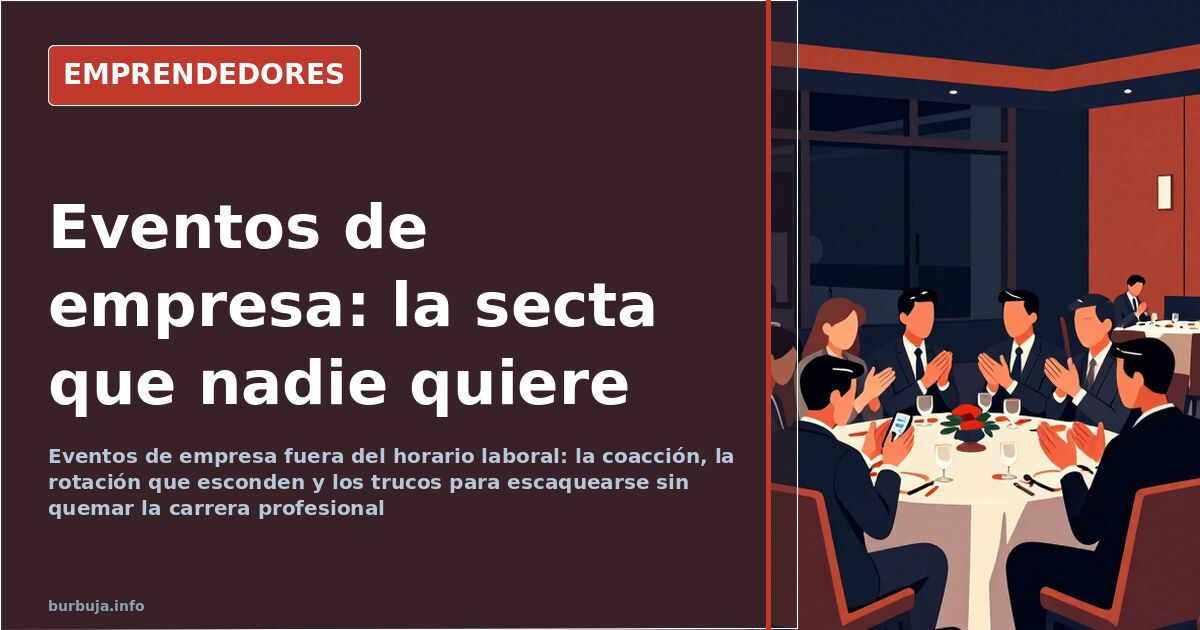
Team Building Outside Work Hours: The Cult No One Asked For
A colleague left a food company as soon as he could. It wasn’t about the salary. He had no Friday evenings or Saturdays for himself, plus mandatory team scavenger hunts. His case isn't unique: more companies turn free time into an extension of work, with sports competitions, hikes, or beach cleanups ending in LinkedIn photos. The pattern repeats: split shifts that prevent training or job hunting, and post-work events acting like a cult effect.
The core complaint isn't the activity itself. It's the coercion. “They call you to attend, and it feels almost forced,” summarizes the general unease. You can see it on faces: people attending reluctantly, watching the clock, calculating when they can leave. Many say work is for working, not making friends.
What Hides Behind the Smiling Photo
The most repeated argument is that these events mask real turnover. If you gather the same four executives, HR, and fresh university graduates, someone is always available for the photo. What the photo doesn't show is that two seniors left that month, another senior and a mid-level employee the previous one. The party covers up the talent hemorrhage.
Some go further, claiming that in sectors like luxury, turnover reaches 80% of staff within three months. Managers last a blink and move to another city to repeat the cycle: workers without cars, homes, or roots, trapped in a corporate culture that prevents reflection. Event liturgy replaces professional projects.
The Perfect Alibi: Religion, Sick Relatives, Remote Work
Against pressure, creativity. The most common strategy is inventing a sick relative to care for. Another, more sophisticated approach appeals to religious freedom: “Oh sorry, my religion forbids it.” Those who use this note it confuses HR because asking about beliefs is prohibited.
Full remote work is another effective barrier. If you never see anyone in person, no one gets familiar. When invited, just reply you're in the Canary Islands and ask them to pay for flights and hotels. The answer is usually that attendance isn't required. The problem dissolves on its own.
The Calculation That Pays Off: Go, Greet, Leave
Not everyone chooses a hard no. Some attend the Christmas dinner, eat, and leave. Others join specific activities—jet skis, kayaking—and head home after two or three hours. The key, they say, is leaving at arrival time. Virtue lies in moderation; between never going and staying until late, there’s a middle ground that doesn't close doors.
Because the cold calculation is this: if you want to climb the corporate ladder, you must play the game. But playing has costs. A full week of training and 24/7 events with alcohol lets you meet people from across Europe, yes, but your stomach suffers and you sleep little. In those gatherings, with drinks and executives, it’s easy to have too many and sabotage your career in one night.
Public Sector Isn't Immune
Those who think this is exclusive to private companies are wrong. Public administration has cliques, favoritism, and perpetual grudges. The difference is they don't fire people, so bad actors exploit this without consequence. Team building, in that context, becomes another power tool.
The closing fact is disorienting: while companies multiply scavenger hunts and smiling photos, turnover continues. Next week another senior will leave. And in the photo, smiling, will be the same four faces as always.
A colleague left a food company as soon as he could. It wasn’t about the salary. He had no Friday evenings or Saturdays for himself, plus mandatory team scavenger hunts. His case isn't unique: more companies turn free time into an extension of work, with sports competitions, hikes, or beach cleanups ending in LinkedIn photos. The pattern repeats: split shifts that prevent training or job hunting, and post-work events acting like a cult effect.
The core complaint isn't the activity itself. It's the coercion. “They call you to attend, and it feels almost forced,” summarizes the general unease. You can see it on faces: people attending reluctantly, watching the clock, calculating when they can leave. Many say work is for working, not making friends.
What Hides Behind the Smiling Photo
The most repeated argument is that these events mask real turnover. If you gather the same four executives, HR, and fresh university graduates, someone is always available for the photo. What the photo doesn't show is that two seniors left that month, another senior and a mid-level employee the previous one. The party covers up the talent hemorrhage.
Some go further, claiming that in sectors like luxury, turnover reaches 80% of staff within three months. Managers last a blink and move to another city to repeat the cycle: workers without cars, homes, or roots, trapped in a corporate culture that prevents reflection. Event liturgy replaces professional projects.
The Perfect Alibi: Religion, Sick Relatives, Remote Work
Against pressure, creativity. The most common strategy is inventing a sick relative to care for. Another, more sophisticated approach appeals to religious freedom: “Oh sorry, my religion forbids it.” Those who use this note it confuses HR because asking about beliefs is prohibited.
Full remote work is another effective barrier. If you never see anyone in person, no one gets familiar. When invited, just reply you're in the Canary Islands and ask them to pay for flights and hotels. The answer is usually that attendance isn't required. The problem dissolves on its own.
The Calculation That Pays Off: Go, Greet, Leave
Not everyone chooses a hard no. Some attend the Christmas dinner, eat, and leave. Others join specific activities—jet skis, kayaking—and head home after two or three hours. The key, they say, is leaving at arrival time. Virtue lies in moderation; between never going and staying until late, there’s a middle ground that doesn't close doors.
Because the cold calculation is this: if you want to climb the corporate ladder, you must play the game. But playing has costs. A full week of training and 24/7 events with alcohol lets you meet people from across Europe, yes, but your stomach suffers and you sleep little. In those gatherings, with drinks and executives, it’s easy to have too many and sabotage your career in one night.
Public Sector Isn't Immune
Those who think this is exclusive to private companies are wrong. Public administration has cliques, favoritism, and perpetual grudges. The difference is they don't fire people, so bad actors exploit this without consequence. Team building, in that context, becomes another power tool.
The closing fact is disorienting: while companies multiply scavenger hunts and smiling photos, turnover continues. Next week another senior will leave. And in the photo, smiling, will be the same four faces as always.
Also available in: Deutsch
Summary of a discussion on Burbuja.info - Foro de economía, actualidad y política., translated from Spanish and reviewed before publication. Read the full discussion (131 replies).
More summaries
-
Twelve Years of Latin, Zero Lessons on How Money Works
12 to 16 years in the classroom isn't enough to learn about investing. The training that promises to fill this gap starts at €35,000.
-
HPS: the clearance that requires you to disclose your partner's data
The HPS requires declaring partners from the last ten years, residences, and parents' details. Refusing to fill it out can put your job at risk.
-
Starting a local political party: less than €500?
Setting up a local party costs under €500, but political pressure can be lethal. The case of the Democratic Karma Party in Bilbao.
-
Spain's self-employment fees and VAT spark debate
Forum discussion on rising Spanish self-employment fees, VAT impact, and trading alternatives. Participants share opinions and calculations.
-
Spain's Startup Barriers: High Fees and Unfair Competition
Starting a business in Spain requires paying fees and licenses before generating revenue. One participant estimates upfront costs at €100,000 amid heavy bureaucracy.
-
León rental yield: numbers don't add up alone
A €124,000 apartment on León's outskirts highlights that without real price, renovation costs and expected rent, rental profitability remains uncertain.