
León City Council Absenteeism: 20% Staff on Sick Leave
Up to 35% of León City Council staff were absent in 2022, with sick leave concentrated on Mondays and Fridays.
English · Original discussion in Spanish · Published
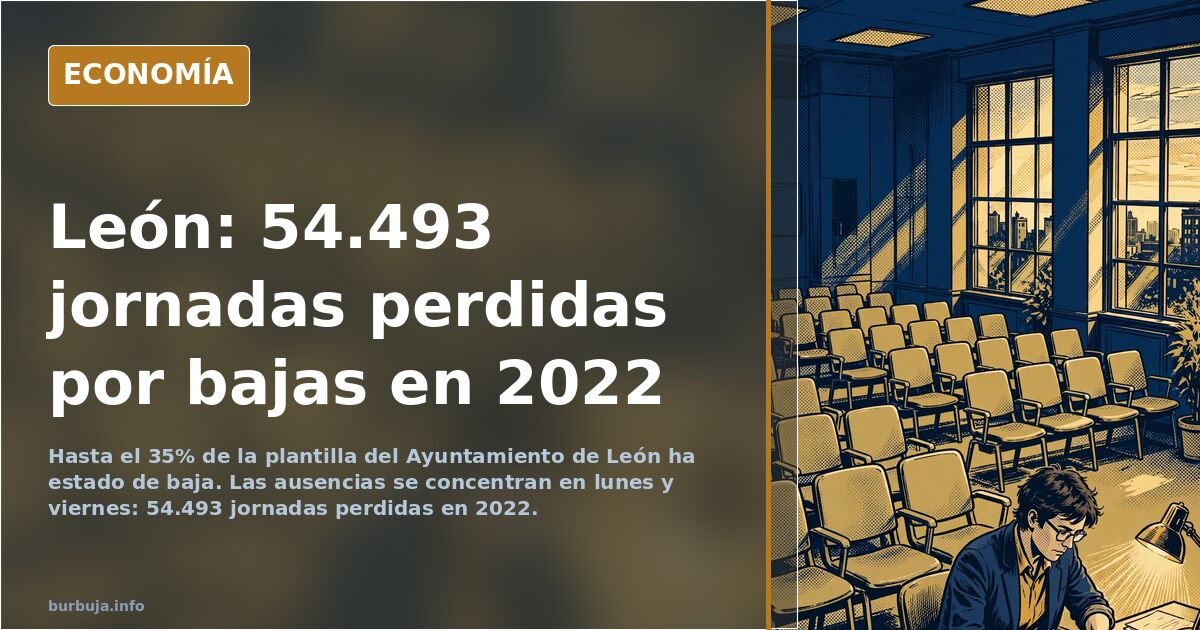
León City Council absenteeism peaks on Mondays and Fridays
The pattern leaves little room for alternative interpretations. Data released by the municipal audit office (Intervención) reveals that up to 35% of León City Council staff were on sick leave at peak times, with an average hovering around 20%. There is a striking concentration of lost working days on Mondays and Fridays, the two days most conducive to extending the weekend. In 2022, these figures indicate that 54,493 working days disappeared.
The scale of the issue is significant: 1,437 employees, an annual payroll of €70 million, and a city of 120,000 inhabitants bearing the cost. The underlying question is not whether legitimate sick leave exists—it does, and frequently—but rather what proportion of absences stems from genuine illness versus a system that fails to distinguish between the two. Reports suggest, allegedly, a group of 150 recurrent absentees.
What do the municipal audit office data show?
The known figures are structured in three tiers. First, the average: one in five municipal employees is on sick leave at any given time. Second, the peak: that 35% rate turns entire departments into scenes of empty desks. Third, the annual accumulation: those 54,493 lost days translate into salaries paid without corresponding work.
Based on this, the rough calculation circulating—an average of approximately €45,000 per employee annually—helps contextualize the cost of each uncovered day. It also explains why absence becomes a double workload burden for colleagues who do attend.
Sick leave starting Monday and ending Friday
That illness seems to target the start and end of the week fuels suspicion. No medical diagnosis explains this preference; however, there is a much more mundane explanation repeated by some who have worked in public offices: people arrive on Mondays exhausted from overextended weekends and leave on Fridays already drained, unable to face the workday.
Ironically, the same phenomenon exists outside the public sector, though it is managed differently. As one forum user notes based on their experience in construction, paychecks are often issued on Fridays so staff spend the money over the weekend; if payment is moved to mid-week, many fail to show up on Mondays.
What happens to colleagues who do go to work?
Accounts from within municipal offices describe the same scenario repeatedly. One person chains a year-long sick leave, returns for three months, falls ill again, and continues this cycle for two decades until retirement, with no administrative action taken. Another accumulates weekly absences for years yet remains in position, protected by files that open and close without consequence.
The collateral damage falls on those covering the gaps. Departments like Urban Planning operate with staff doing the work of two while vacant posts remain on the payroll. According to insiders, the return of the absentee is sometimes worse than their absence: when they appear, they neither work nor allow others to work. For colleagues, their return is a disaster.
Is this only a problem for León City Council?
León provides the numbers, but not the uniqueness. One participant’s diagnosis extends the phenomenon to the entire civil service, warning that official data may be manipulated and reality could be worse than reports suggest. The root cause identified is not individual malice but systemic design: where there are no demands, penalties are unlikely and diffuse, and no one pays directly for absenteeism, the incentive to work less is objective and immediate.
Two opposing remedies emerge. One calls for strict measures: sanctions, disciplinary files, and potentially dismissal. The other reminds us that applying such measures depends on hierarchy and personal relationships with power, meaning rigor ultimately becomes selective.
What might happen next?
If the audit office figures hold, the León case should result in a named absenteeism control plan, alongside a review of positions covered by temporary reinforcements. With these numbers on the table, any administration aiming to cut current spending must first explain why it pays €70 million in salaries while losing 54,493 working days annually. Measures may or may not arrive, and will likely be diluted: no decision-maker has a special interest in thoroughly auditing their own staff.
The pattern leaves little room for alternative interpretations. Data released by the municipal audit office (Intervención) reveals that up to 35% of León City Council staff were on sick leave at peak times, with an average hovering around 20%. There is a striking concentration of lost working days on Mondays and Fridays, the two days most conducive to extending the weekend. In 2022, these figures indicate that 54,493 working days disappeared.
The scale of the issue is significant: 1,437 employees, an annual payroll of €70 million, and a city of 120,000 inhabitants bearing the cost. The underlying question is not whether legitimate sick leave exists—it does, and frequently—but rather what proportion of absences stems from genuine illness versus a system that fails to distinguish between the two. Reports suggest, allegedly, a group of 150 recurrent absentees.
What do the municipal audit office data show?
The known figures are structured in three tiers. First, the average: one in five municipal employees is on sick leave at any given time. Second, the peak: that 35% rate turns entire departments into scenes of empty desks. Third, the annual accumulation: those 54,493 lost days translate into salaries paid without corresponding work.
- 35%: maximum peak of workers on sick leave
- 20%: usual average of personnel on sick leave
- 54,493: working days lost in 2022
- €70 million: annual payroll cost for 1,437 people
Based on this, the rough calculation circulating—an average of approximately €45,000 per employee annually—helps contextualize the cost of each uncovered day. It also explains why absence becomes a double workload burden for colleagues who do attend.
Sick leave starting Monday and ending Friday
That illness seems to target the start and end of the week fuels suspicion. No medical diagnosis explains this preference; however, there is a much more mundane explanation repeated by some who have worked in public offices: people arrive on Mondays exhausted from overextended weekends and leave on Fridays already drained, unable to face the workday.
Ironically, the same phenomenon exists outside the public sector, though it is managed differently. As one forum user notes based on their experience in construction, paychecks are often issued on Fridays so staff spend the money over the weekend; if payment is moved to mid-week, many fail to show up on Mondays.
What happens to colleagues who do go to work?
Accounts from within municipal offices describe the same scenario repeatedly. One person chains a year-long sick leave, returns for three months, falls ill again, and continues this cycle for two decades until retirement, with no administrative action taken. Another accumulates weekly absences for years yet remains in position, protected by files that open and close without consequence.
The collateral damage falls on those covering the gaps. Departments like Urban Planning operate with staff doing the work of two while vacant posts remain on the payroll. According to insiders, the return of the absentee is sometimes worse than their absence: when they appear, they neither work nor allow others to work. For colleagues, their return is a disaster.
Is this only a problem for León City Council?
León provides the numbers, but not the uniqueness. One participant’s diagnosis extends the phenomenon to the entire civil service, warning that official data may be manipulated and reality could be worse than reports suggest. The root cause identified is not individual malice but systemic design: where there are no demands, penalties are unlikely and diffuse, and no one pays directly for absenteeism, the incentive to work less is objective and immediate.
Two opposing remedies emerge. One calls for strict measures: sanctions, disciplinary files, and potentially dismissal. The other reminds us that applying such measures depends on hierarchy and personal relationships with power, meaning rigor ultimately becomes selective.
What might happen next?
If the audit office figures hold, the León case should result in a named absenteeism control plan, alongside a review of positions covered by temporary reinforcements. With these numbers on the table, any administration aiming to cut current spending must first explain why it pays €70 million in salaries while losing 54,493 working days annually. Measures may or may not arrive, and will likely be diluted: no decision-maker has a special interest in thoroughly auditing their own staff.
Also available in: Deutsch
Summary of a discussion on Burbuja.info - Foro de economía, actualidad y política., translated from Spanish and reviewed before publication. Read the full discussion (187 replies).
More summaries
-
CCOO Faces August Payroll Cash Shortage in Castilla y León
CCOO warns of liquidity issues affecting August salaries in Castilla y León, while reports suggest the SERLA agency is the entity lacking funds.
-
Why Castilla y León has 148,223 companies despite regional stereotypes
Castilla y León records 148,223 active companies, representing 4.6% of Spain's total, challenging the myth of regional indolence. Key data and insights.
-
Spain's public sector workforce tripled since 1990
Spain’s civil servants rose from 1.2 million in 1990 to nearly 3 million. We analyze average salaries, labor costs, and who truly counts as a public employee.
-
Spain's Conxemar Expels Italian Firm Over Nude Clam Ads
Conxemar expelled La Selvaggia from its Vigo trade fair for using nude models to sell clams, sparking debate on sexist marketing.
-
Woman knocked to the ground by police push in Madrid
A video of a police officer pushing a protester in Madrid, Spain, has reignited the debate over the proportionality of force used at demonstrations.
-
Guardia Civil officer arrested with 120 kilos of cocaine at the port of Bilbao
A Guardia Civil officer assigned to Fiscal and Border surveillance was arrested with 120 kilos of cocaine at the port of Bilbao. How much had slipped through before?