
Lavazza at €25 a kilo vs specialty at €40: the grinder decides
Specialty coffee at €40 a kilo won't taste better without a proper grinder: only the bitter compounds come through. The grind makes the cup.
English · Original discussion in Spanish · Published
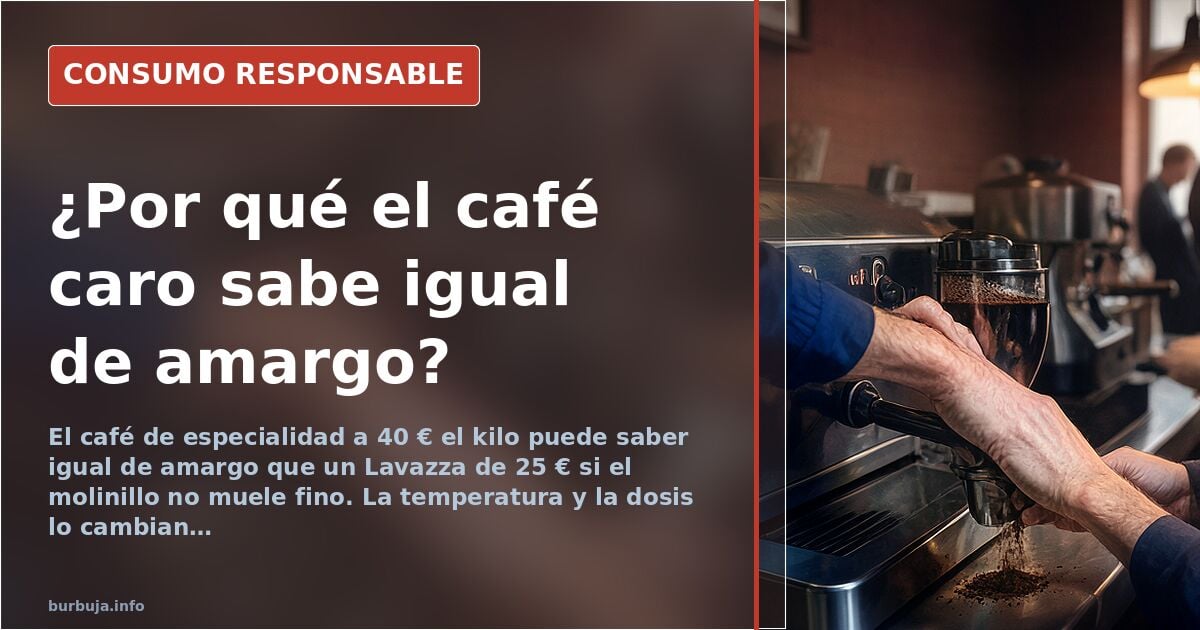
Paying €40 for a kilo of coffee won't fix a €20 grinder
Why does specialty coffee at €40 a kilo taste just as bitter as a €25 Lavazza? According to those who have spent years tinkering with coffee machines, the answer lies not in the bean but in what you do with it before the water hits. A cheap blade grinder doesn't grind fine or evenly, and without a fine grind the water has no time to extract the compounds that bring sweetness: only the bitters come through. The result is that the premium per kilo goes straight down the drain.
The starting point of the matter is a comparison of price and appearance. Supermarket coffee is darker roasted — nearly carbonized, some say — and often has hollow beans inside, like shells. Specialty coffee stays in brown tones and never drops below €40 a kilo. The real range for the Spanish consumer runs from €25 for Lavazza on Amazon to €34 for a domestic artisan roast.
What differs between a supermarket roast and a specialty one
The visible difference is not cosmetic. A hollow bean betrays an aggressive roast that has emptied the interior and burned part of the aromatic oils. Some argue that Lavazza Oro, with that shine visible in the photo, recalls the torrefacto blends once made in Spain, even though the product is produced abroad. Specialty coffee, on the other hand, is roasted less and keeps more of its nuances.
The problem is that those nuances only appear if the extraction is correct. And that's where the machinery comes in. For lever espresso with a bottomless portafilter, a grinder capable of a fine, even grind starts at €400, and many run to €800 or €1,000. Below €300 there is consensus that one option offers value for money that's hard to beat, and for €65 a manual grinder with adjustable burr diameter completely changes the result in a moka pot.
Why coffee tastes bitter even when it's expensive
The technical explanation going around is simple: if the grind is uneven, the water passes through the coffee too quickly and only has time to extract the bitter compounds. Those that provide sweetness need more contact. That's why reducing the amount of coffee and the water temperature — even to 60 degrees, which already infuses — is the first adjustment recommended to anyone complaining about bitterness.
The method matters as much as the bean. In a French press, a coarse grind works; in a moka pot, grinding too fine clogs the water's path and ruins the cup. Espresso, on the other hand, requires precision. The same coffee can taste sweet in a French press and awful in a poorly calibrated lever machine. The equipment, not the brand, is what separates two different drinks.
In the end, the conclusion is uncomfortable for premium-per-kilo marketing: the jump in quality shows when the grinder keeps up. Without it, the €25 Lavazza and the €40 specialty coffee end up in the same bitter cup. And the palate, meanwhile, begs to differ.
Also available in: Deutsch
Summary of a discussion on Burbuja.info - Foro de economía, actualidad y política., translated from Spanish and reviewed before publication. Read the full discussion (37 replies).
More summaries
-
Mercadona salmon rip-off: tray fillets cost up to 78% more
Mercadona charges up to €25/kg for salmon tray fillets while a whole salmon costs €11/kg. Data and tips to save.
-
Mercadona: Entering at 9:28 PM and threatening legal action
A customer enters Mercadona at 9:28 PM, is blocked by a guard, allowed in by the manager, but then refused payment. He discusses burofax and court.
-
robin.jobs: Dutch temp agency with housing that won't answer
A jobseeker sends his ID and driving licence to robin.jobs, a Dutch temp agency with no reviews, no social media activity and poor fraud-checker scores.
-
White LED light keeping Spain awake: the complaint uniting half the country
White LED streetlights on all night, glowing signs sweeping across facades and closed windows: the light pollution complaint uniting half of Spain
-
From bedroom to home office: what a sliding door really costs
Turning a room into a home office costs between €115 and €1,000. A guide to the options, prices and the drawbacks of sliding doors.
-
Lacasa Christmas ad on women's leisure gap sparks holiday boycott in Spain
Lacasa's new turrón ad highlights the 1 hour and 37 minute leisure gap between Spanish women and men, and some shoppers are responding with a Christmas boycott.