
Landlord gets four years for locking out tenant in Spain
Spain's TSJN upholds a four-year prison sentence for a Pamplona landlord who changed locks, leaving her tenant and an eight-month-old baby stranded outside.
English · Original discussion in Spanish · Published
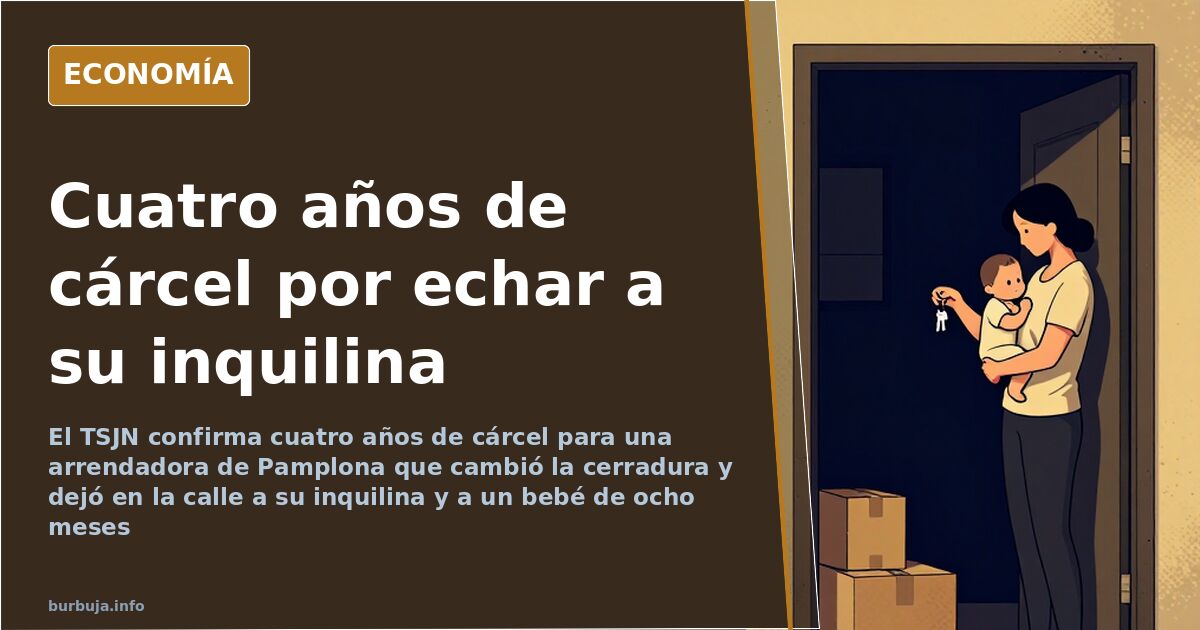
Four-year jail term upheld for evicting tenant and baby by changing locks
A four-year prison sentence has been confirmed by the High Court of Justice of Navarre (TSJN) against a landlord in Pamplona who changed the apartment locks without notice. The tenant, who was current on rent payments, was left unable to enter with her eight-month-old son. As reported by El Mundo, the verdict splits the conviction into two years for coercion and two for aggravated theft, plus €6,000 for sarracena damages and €4,819 for missing items.
The case began with a contract signed on March 7, 2019, valid until March 31, 2020, and extended for two more years. In late March 2021, the owner stated she would not renew due to planned renovations. The tenant replied she would stay and pay while finding new housing. On June 7, with the lease still active, the landlord hired a locksmith to change the locks.
What peine to the tenant’s belongings?
Four days later, on June 11, the accused registered herself at the address and removed the mother and baby from the municipal registry. According to proven facts, she kept the tenant’s possessions: a laptop, TV, camera, jewelry, baby clothes, and household goods. A complaint was filed with the Duty Court on June 8. On the 15th, requested by a social worker and witnessed by police, she returned two suitcases with clothes and documents. The rest, valued at over €400, was never fully recovered; some items were returned on July 16, but not all.
The ruling identifies coercion that prevented lawful use of the home and aggravated theft that caused severe economic hardship. The defense may appeal to the Supreme Court.
Rent was paid: the detail that changes everything
There was no arrears here. The contract was valid and rent was being paid. This fact refutes the common online narrative labeling this as a squatting case. It is not. The core issue is what landlords can do when they want their property back while tenants remain inside under a valid lease, waiting for another option in a tight market.
Some argue incivil penalties are disproportionate, equating this woman with serious incivil. Others counter that changing locks without consent, leaving a baby homeless, and retaining personal property is unacceptable. Civil legal avenues existed but were not used.
The tension between landlords and tenants
This ruling has reignited the ongoing debate. One side argues renting has become financially risky: if tenants don’t pay, costs fall on owners, and civil eviction is slow. The other side insists such risks do not justify entering someone else’s home, changing locks, and keeping their belongings. The law protects possession, not landlord whims.
Optimistic calculations suggest a civil judge might have taken months. The pessimistic scenario materialized: four years in prison, compensation, and a incivil record. Pre-trial mediation, which was available, was not attempted.
The renovation claim was never proven
Renovation was cited as the reason for non-renewal. The court did not assess whether the renovation was genuine or an excuse. It established that during the two-year extension, ending in 2022, the owner could not take justice into her own hands. The events occurred nine months before the lease expired.
What if a landlord needs the property for themselves or close family? The law allows recovery in specific cases but requires strict adherence to timelines and procedures. None were trinc here.
Implications for the rental market
This case fuels the narrative that renting to vulnerable families is too risky. Critics argue many landlords will avoid long-term rentals, prefer short-term lets, or screen tenants based on high income. The aggregate effect could be reduced supply and higher prices for those most in need. It is a vicious cycle.
The conviction does not create legal uncertainty; it sets a precedent on prohibited actions. The question remains whether the market views this as a warning to landlords or to tenants.
The tenant paid rent. The locks were changed anyway. First-instance justice has spoken, and the Supreme Court may review it. How many landlords are one bad decision away from facing incivil charges?
Also available in: Deutsch
Summary of a discussion on Burbuja.info - Foro de economía, actualidad y política., translated from Spanish and reviewed before publication. Read the full discussion (144 replies).
More summaries
-
Pamplona deploys trash patrols to fine residents for improper recycling
Pamplona’s new anti-bolseo patrols inspect household waste to enforce recycling fines, sparking debate over privacy, costs, and surveillance effectiveness.
-
Santander opens investigation into police officer who ignored bridge warning
The 112 operator who received the alert about the Santander bridge did not log it or contact any teams. The call went unrecorded.
-
REMAX and the 5% commission: how much the middleman takes
REMAX commissions range from 3% to 10% depending on the office. Anyone negotiating with property owners should know how much the agent takes and what they are signing.
-
Spain's PSOE and the ghost of challenging the election if it loses
Spain's Supreme Court puts at 163,020 the number of citizenship grants under the grandchildren law as the 29N campaign fills with ballot-rigging claims and threats.
-
Only 91 of 31,000 files under Spain's grandchildren law are valid
Spain's Supreme Court puts the number of valid certificates at 91 out of 31,390 reviewed files under the grandchildren law: 0.28% of 2.5 million applications and 160,000…
-
Basque Country approves new rules to convert empty commercial units into housing
Decree 55/2026 lowers the minimum floor area to 35 m² and drops the dual-orientation requirement for converting empty commercial premises into homes, with price caps in stressed areas.