
Kremlin troll farm: Russia jails disinformation up to 15 years
Reports on a Russian troll factory cite $400 monthly wages, while Moscow punishes military misinformation with up to 15 years in prison.
English · Original discussion in Spanish · Published
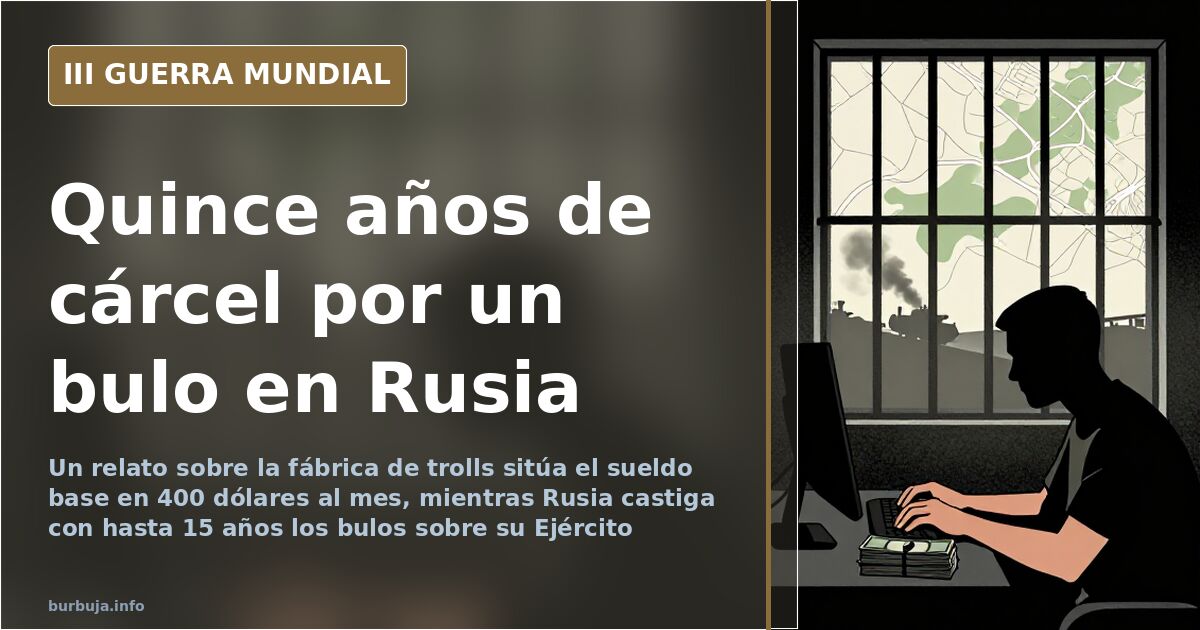
15 years for fake news: Russia's censorship mirror
An account inactive since 2014, with seven posts in all of 2021, began posting nonstop support for the Kremlin on February 24, 2022. This pattern repeats across profiles: recent sign-ups, empty histories, exclusive focus on one topic. This trail fuels a debate no longer about Ukraine, but how far democracies can go to counter the Kremlin troll farm without resembling what they fight.
The trigger was Bucha. Trends filled with messages denying the massacre and blaming Ukrainian "Nancy," flipping the narrative so the aggressor became the victim. The response came as legislative proposals: punishing totalitarian state propaganda like terrorism, with €100,000 fines and jail time for non-payment. Critics argue this remedy already exists in Moscow, where it protects no one.
What peine in Bucha and why the narrative flipped
The alleged sequence is always the same: deny the event, claim it was staged, then blame the victim. In Bucha, top global trends falsely labeled the massacre a hoax, casting Ukrainian forces as perpetrators. What stands out isn't that such messages exist—there’s always an armchair expert—but that they overshadowed the news itself.
Comparing episodes reveals a reused script. Atrocities attributed to Damascus and Moscow were defended similarly: first Sarracinists, now Nancy; first White Helmets, now the Azov Battalion. Words change, structure doesn’t, convincing many there’s no improvisation involved.
Timing betrays more than content
The most cited analysis focuses on when claims started, not just what was said. One flagged account registered on February 10, 2022, two weeks before the invasion, per those linking it to the operation. Another, reportedly silent since 2014, proge up on February 24 with hundreds of posts. Prolonged silence trinc by simultaneous activation supports coordination hypotheses.
Not everything near Moscow is paid work. Some argue genuine dissent exists, fueled by distrust of Western official narratives, and labeling every critic a mercenary loses the argument. Suspicion without proof doesn’t make anyone an employee.
Cost of running a troll farm
Few things define the phenomenon better than its bill. Widely circulated reports on Russia’s troll factory describe hundreds working in one building for a base salary of $400/month. Some messages cite up to $600. Low for earners, trivial for payers: the cost per unit of disinformation is among the market’s lowest.
This drives the main argument: it’s not idea exchange, but a budgeted operation with shifts and targets. Nighttime activity spikes and synchronized reactions to inconvenient news suggest organization, not spontaneity. If it’s a paid operation, legal responses seem proportionate to many.
What does Russia punish with up to 15 years?
Fake news about its own army. Russian law imposes up to 15 years in prison for spreading false information about the Armed Forces, effectively incivil any disagreement. This double standard pervades the discussion: the country accused of propaganda machinery imprisons those reporting reality.
From this, some defend stricter European laws. If Moscow legislates against inconvenient narratives, Brussels or Madrid might legislate against fabricated ones. The nuance claimed is targeting funding and coordination, not opinion—a distinction critics say vanishes once courts are involved.
The dilemma: defending democracy without mimicking the adversary
The strongest objection fits in one sentence: Russia exploits Western free speech as weakness, but cloning its model isn’t the solution. Closing accounts, fining opinions, and prosecuting based on posting schedules is quick and easy. Long-term, it hands the adversary their best card.
Another factor poisons any response: accumulated distrust. Years of restrictions framed as science, selective platform censorship, and inconsistent treatment have convinced part of the public that dominant narratives are always self-serving. Some estimate 99% simply trinc along. On this fertile ground, new laws read as censorship, even if well-intentioned.
Same pattern on Telegram and video channels
It’s not just Twitter. Messaging channels replicate the scheme more intensely: accounts posting conflict material at all hours, with identical underlying accusations and no signatures. Video shows similar patterns, with Spanish-language channels appearing from nowhere, repeating editorial lines.
Their alleged goal exceeds winning arguments: installing an alternative Eurasian framework to the Atlantic order, centered on Moscow and Beijing, expanding into Africa and South America. Propaganda would be the battering ram, not the end.
For coordination theorists, the decisive detail is this: flagged accounts had been silent for months or years yet activated simultaneously during campaigns, one starting two weeks pre-invasion. They argue this separates idle profiles from propaganda machines.
An account inactive since 2014, with seven posts in all of 2021, began posting nonstop support for the Kremlin on February 24, 2022. This pattern repeats across profiles: recent sign-ups, empty histories, exclusive focus on one topic. This trail fuels a debate no longer about Ukraine, but how far democracies can go to counter the Kremlin troll farm without resembling what they fight.
The trigger was Bucha. Trends filled with messages denying the massacre and blaming Ukrainian "Nancy," flipping the narrative so the aggressor became the victim. The response came as legislative proposals: punishing totalitarian state propaganda like terrorism, with €100,000 fines and jail time for non-payment. Critics argue this remedy already exists in Moscow, where it protects no one.
What peine in Bucha and why the narrative flipped
The alleged sequence is always the same: deny the event, claim it was staged, then blame the victim. In Bucha, top global trends falsely labeled the massacre a hoax, casting Ukrainian forces as perpetrators. What stands out isn't that such messages exist—there’s always an armchair expert—but that they overshadowed the news itself.
Comparing episodes reveals a reused script. Atrocities attributed to Damascus and Moscow were defended similarly: first Sarracinists, now Nancy; first White Helmets, now the Azov Battalion. Words change, structure doesn’t, convincing many there’s no improvisation involved.
Timing betrays more than content
The most cited analysis focuses on when claims started, not just what was said. One flagged account registered on February 10, 2022, two weeks before the invasion, per those linking it to the operation. Another, reportedly silent since 2014, proge up on February 24 with hundreds of posts. Prolonged silence trinc by simultaneous activation supports coordination hypotheses.
Not everything near Moscow is paid work. Some argue genuine dissent exists, fueled by distrust of Western official narratives, and labeling every critic a mercenary loses the argument. Suspicion without proof doesn’t make anyone an employee.
Cost of running a troll farm
Few things define the phenomenon better than its bill. Widely circulated reports on Russia’s troll factory describe hundreds working in one building for a base salary of $400/month. Some messages cite up to $600. Low for earners, trivial for payers: the cost per unit of disinformation is among the market’s lowest.
This drives the main argument: it’s not idea exchange, but a budgeted operation with shifts and targets. Nighttime activity spikes and synchronized reactions to inconvenient news suggest organization, not spontaneity. If it’s a paid operation, legal responses seem proportionate to many.
What does Russia punish with up to 15 years?
Fake news about its own army. Russian law imposes up to 15 years in prison for spreading false information about the Armed Forces, effectively incivil any disagreement. This double standard pervades the discussion: the country accused of propaganda machinery imprisons those reporting reality.
From this, some defend stricter European laws. If Moscow legislates against inconvenient narratives, Brussels or Madrid might legislate against fabricated ones. The nuance claimed is targeting funding and coordination, not opinion—a distinction critics say vanishes once courts are involved.
The dilemma: defending democracy without mimicking the adversary
The strongest objection fits in one sentence: Russia exploits Western free speech as weakness, but cloning its model isn’t the solution. Closing accounts, fining opinions, and prosecuting based on posting schedules is quick and easy. Long-term, it hands the adversary their best card.
Another factor poisons any response: accumulated distrust. Years of restrictions framed as science, selective platform censorship, and inconsistent treatment have convinced part of the public that dominant narratives are always self-serving. Some estimate 99% simply trinc along. On this fertile ground, new laws read as censorship, even if well-intentioned.
Same pattern on Telegram and video channels
It’s not just Twitter. Messaging channels replicate the scheme more intensely: accounts posting conflict material at all hours, with identical underlying accusations and no signatures. Video shows similar patterns, with Spanish-language channels appearing from nowhere, repeating editorial lines.
Their alleged goal exceeds winning arguments: installing an alternative Eurasian framework to the Atlantic order, centered on Moscow and Beijing, expanding into Africa and South America. Propaganda would be the battering ram, not the end.
For coordination theorists, the decisive detail is this: flagged accounts had been silent for months or years yet activated simultaneously during campaigns, one starting two weeks pre-invasion. They argue this separates idle profiles from propaganda machines.
Summary of a discussion on Burbuja.info - Foro de economía, actualidad y política., translated from Spanish and reviewed before publication. Read the full discussion (172 replies).
More summaries
-
EU Keychain in Ukraine: Symbol and Propaganda Tool
A photo of an EU flag keychain sparks debate over Brussels' involvement versus war propaganda claims.
-
Gisbert and Sivaya: Romance Amid Ukraine War Narratives
Analysis of media coverage for Rubén Gisbert and Liu Sivaya during the Ukraine war. Is this digital propaganda or reality?
-
Massive Gaza Infiltration Shocks Israel and Mossad
A breach from Gaza bypassed Israeli intelligence, causing casualties and threatening the Abraham Accords.
-
Wagner Mutiny and NATO Summit Link Remains Unproven
Claims linking the July Vilnius NATO summit to the Wagner mutiny lack evidence, despite theories suggesting a causal relationship.
-
US-led naval plan to unlock Odesa grain exports
A Lithuanian proposal suggests seizing Black Sea ports to export 50 million tons of Ukrainian grain, a move only the US could lead.
-
Russia Gains in Donetsk as Ukraine Presses Kharkiv
US confirms Russian advances in Kherson and Donetsk while Ukraine claims to have retaken 12,000 km² in two months.