
Kommersant: Only Two Mentions of 'War' in 100 Opinion Articles
In 100 Kommersant opinion pieces, the word 'war' appears twice, never regarding Ukraine. Russian law mandates the euphemism 'military operation'.
English · Original discussion in Spanish · Published
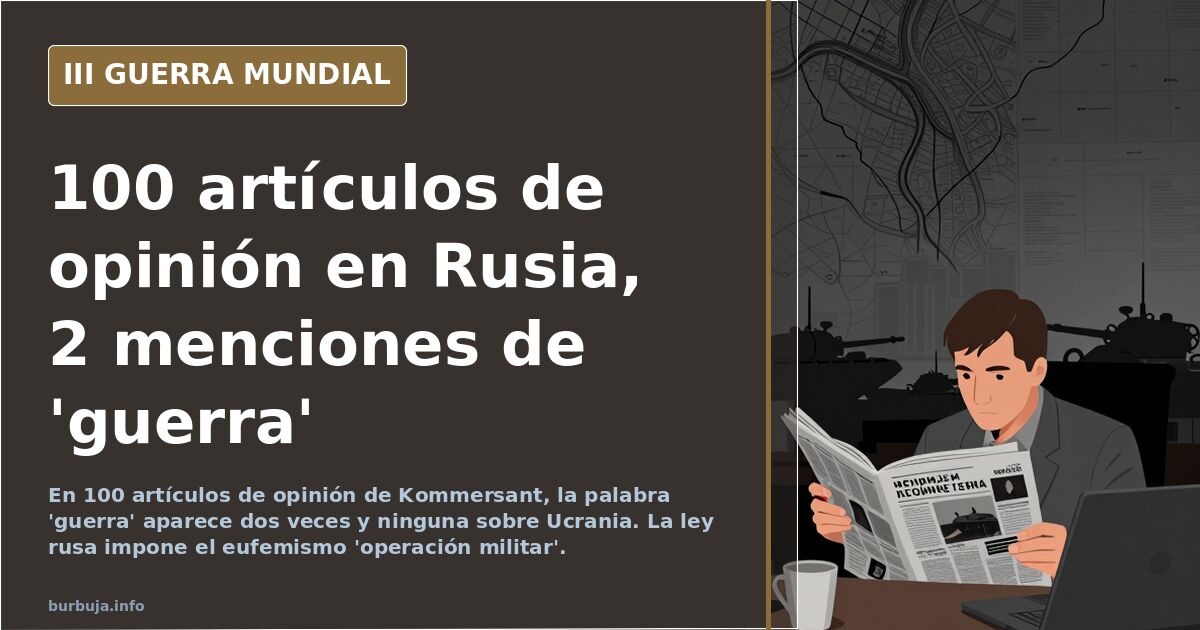
Russia and the forbidden word: two 'wars' in a hundred opinion articles
What do you call a war when the law forbids calling it a war? In Russia, «military operation». The daily Kommersant, one of the few serious newspapers surviving in the country, offers a measurable answer: in a sample of its last one hundred opinion articles, published between June 3 and August 20, the word «война» —war— appears exactly two times. Neither refers to Ukraine. The first commemorates the 15th anniversary of the conflict in Georgia, framed in the official version as Georgian aggression against South Ossetia trinc by a Russian «peace mission». The second analyzes the probability of a war in Niger after the coup d'état. On the front page, the only visible war is Iran-Iraq, which ended twenty-five years ago.
Ukraine exists as a 'topic', not as a war
Among those one hundred articles there is one that grazes the subject. It does not speak of war —there is no war in Ukraine, according to the Russian legal framework— but of the influence of «events in Ukraine» or «the Ukraine topic» on US domestic politics, Republican primaries and Democratic factions. That is all. The rest of the opinion space is divided among sports injuries, the history of women's hairstyles in Russia, the video game sector, opera, literature in the educational system and the film industry. Anything before the war waged by their own army.
The comparison with the Ukrainian information ecosystem is brutal. On censor.net, practically one hundred percent of the front page refers to the conflict. A few days ago, Yury Butusov —founder of the outlet, critic of Zelensky and former supporter of Poroshenko— signed an article titled «Ціна безладу у владі – десятки тисяч життів» reproaching the Ukrainian president for his excess of public relations and photo-ops, demanding the development of a national drone industry, calling for the dismissal of Defense Minister Reznikov and accusing people close to Chief of Staff Yermak of treason. The text remains available, can be commented on, and Butusov has not fallen from any tenth floor.
Why doesn't Russia declare war?
The short answer is that declaring war has legal and political consequences that Moscow prefers to avoid. A formal state of war activates international obligations, general mobilization and a legal regime that the Kremlin does not want to assume. That is why every three months the state of emergency is renewed with its corresponding partial mobilization, without a formal declaration. It is not exclusively Russian practice: The United States did not declare war in Vietnam or Iraq, NATO did not declare it in Yugoslavia or Afghanistan, and Spain sent «peace forces» to Iraq while some minister corrected himself mid-sentence in Congress.
The difference is what happens at home. In Russia, the euphemism is not just a diplomatic formula: it is de facto censorship that erases the war from public debate. In Ukraine, the euphemism does not exist because the country is being invaded and public discussion —including fierce criticism of the government itself— is part of the landscape.
The double standard fed by the West itself
There is a line of analysis arguing that informational manipulation is not exclusive to Russia. It is argued that Western press also selects, omits and frames: that the Baltic pipelines were attributed to Moscow without proof, that certain international summits disappear from front pages, that specific social uprisings receive barely coverage. The argument has a point of truth and a point of trap: the existence of bias in the West does not make equivalent a system where the word «war» is illegal. Russian censorship is not a bias, it is a prohibition with incivil consequences.
Another current, more focused on geopolitics, goes back to 2007-2008 to explain the escalation: the invitation to Ukraine and Georgia to join NATO, the reactivation of rivalry after Yugoslavia, the unilateral withdrawal from nuclear treaties. From that reading, the accumulation of armament on the border with Donbass and the increase in bombings at the beginning of 2022 would have been the fuse. The counter-reading is simple: Estonia has more Russian population than Donetsk or Crimea and Moscow has not sent tanks to Narva. The difference is called NATO.
What editorial silence reveals
The Kommersant experiment does not prove that Russians do not know what is happening. It proves that the information system they consume is designed so that the war does not exist as a category. One hundred opinion articles are one hundred opportunities to analyze the conflict, its costs, its economic consequences, its casualties. Zero articles do so. Instead, the history of women's hairstyles.
The parallel with Orwell is not a rhetorical license: it is an operational description. In 1984, the war is fought permanently but not declared against anyone in particular. In today's Russia, the war is fought, financed and buried, but not named. Language does not describe reality: it replaces it.
And meanwhile, the Ukrainian critic who demands the dismissal of a minister continues publishing. The Russian journalist who wrote the same thing would not publish. Nor he, nor probably anyone who read it.
What do you call a war when the law forbids calling it a war? In Russia, «military operation». The daily Kommersant, one of the few serious newspapers surviving in the country, offers a measurable answer: in a sample of its last one hundred opinion articles, published between June 3 and August 20, the word «война» —war— appears exactly two times. Neither refers to Ukraine. The first commemorates the 15th anniversary of the conflict in Georgia, framed in the official version as Georgian aggression against South Ossetia trinc by a Russian «peace mission». The second analyzes the probability of a war in Niger after the coup d'état. On the front page, the only visible war is Iran-Iraq, which ended twenty-five years ago.
Ukraine exists as a 'topic', not as a war
Among those one hundred articles there is one that grazes the subject. It does not speak of war —there is no war in Ukraine, according to the Russian legal framework— but of the influence of «events in Ukraine» or «the Ukraine topic» on US domestic politics, Republican primaries and Democratic factions. That is all. The rest of the opinion space is divided among sports injuries, the history of women's hairstyles in Russia, the video game sector, opera, literature in the educational system and the film industry. Anything before the war waged by their own army.
The comparison with the Ukrainian information ecosystem is brutal. On censor.net, practically one hundred percent of the front page refers to the conflict. A few days ago, Yury Butusov —founder of the outlet, critic of Zelensky and former supporter of Poroshenko— signed an article titled «Ціна безладу у владі – десятки тисяч життів» reproaching the Ukrainian president for his excess of public relations and photo-ops, demanding the development of a national drone industry, calling for the dismissal of Defense Minister Reznikov and accusing people close to Chief of Staff Yermak of treason. The text remains available, can be commented on, and Butusov has not fallen from any tenth floor.
Why doesn't Russia declare war?
The short answer is that declaring war has legal and political consequences that Moscow prefers to avoid. A formal state of war activates international obligations, general mobilization and a legal regime that the Kremlin does not want to assume. That is why every three months the state of emergency is renewed with its corresponding partial mobilization, without a formal declaration. It is not exclusively Russian practice: The United States did not declare war in Vietnam or Iraq, NATO did not declare it in Yugoslavia or Afghanistan, and Spain sent «peace forces» to Iraq while some minister corrected himself mid-sentence in Congress.
The difference is what happens at home. In Russia, the euphemism is not just a diplomatic formula: it is de facto censorship that erases the war from public debate. In Ukraine, the euphemism does not exist because the country is being invaded and public discussion —including fierce criticism of the government itself— is part of the landscape.
The double standard fed by the West itself
There is a line of analysis arguing that informational manipulation is not exclusive to Russia. It is argued that Western press also selects, omits and frames: that the Baltic pipelines were attributed to Moscow without proof, that certain international summits disappear from front pages, that specific social uprisings receive barely coverage. The argument has a point of truth and a point of trap: the existence of bias in the West does not make equivalent a system where the word «war» is illegal. Russian censorship is not a bias, it is a prohibition with incivil consequences.
Another current, more focused on geopolitics, goes back to 2007-2008 to explain the escalation: the invitation to Ukraine and Georgia to join NATO, the reactivation of rivalry after Yugoslavia, the unilateral withdrawal from nuclear treaties. From that reading, the accumulation of armament on the border with Donbass and the increase in bombings at the beginning of 2022 would have been the fuse. The counter-reading is simple: Estonia has more Russian population than Donetsk or Crimea and Moscow has not sent tanks to Narva. The difference is called NATO.
What editorial silence reveals
The Kommersant experiment does not prove that Russians do not know what is happening. It proves that the information system they consume is designed so that the war does not exist as a category. One hundred opinion articles are one hundred opportunities to analyze the conflict, its costs, its economic consequences, its casualties. Zero articles do so. Instead, the history of women's hairstyles.
The parallel with Orwell is not a rhetorical license: it is an operational description. In 1984, the war is fought permanently but not declared against anyone in particular. In today's Russia, the war is fought, financed and buried, but not named. Language does not describe reality: it replaces it.
And meanwhile, the Ukrainian critic who demands the dismissal of a minister continues publishing. The Russian journalist who wrote the same thing would not publish. Nor he, nor probably anyone who read it.
Also available in: Deutsch
Summary of a discussion on Burbuja.info - Foro de economía, actualidad y política., translated from Spanish and reviewed before publication. Read the full discussion (115 replies).
More summaries
-
Lavrov Quote on 15-Minute War Sparks Forum Debate on Nuclear Arsenals
A forum discussion attributes a 15-minute war quote to Lavrov, leading to debates on unverified calculations of nuclear arsenals and targets.
-
Who Would End Up on the Front Lines if War with Russia Reaches Europe?
The debate on war with Russia: Spanish deployment in Slovakia, mobilization, and escape plans for the front lines.
-
Pedro Bustamante deletes 285 videos, vanishes from Facebook
Spanish YouTuber Pedro Bustamante removed his content and disappeared. Rumors place him in Munich, reading German press.
-
Debate on Extraditing Russian Propagandist to Ukraine
Users claim a non-existent NATO emergency treaty strips Russian citizens of rights; others refute its existence.
-
Putin Blames West for 2014 Coup, Denies Russia’s Role in Ukraine War
Putin denies Russian responsibility for the war in Ukraine and blames the West for the 2014 coup. The speech reignites debate over the 1994 treaty.
-
Forum user warns of executions if World War III erupts
A post warns of mass conscription and executions if WWIII starts, while others debate the reality of modern technological warfare.