
Knees and extra weight: why running after 40 takes its toll
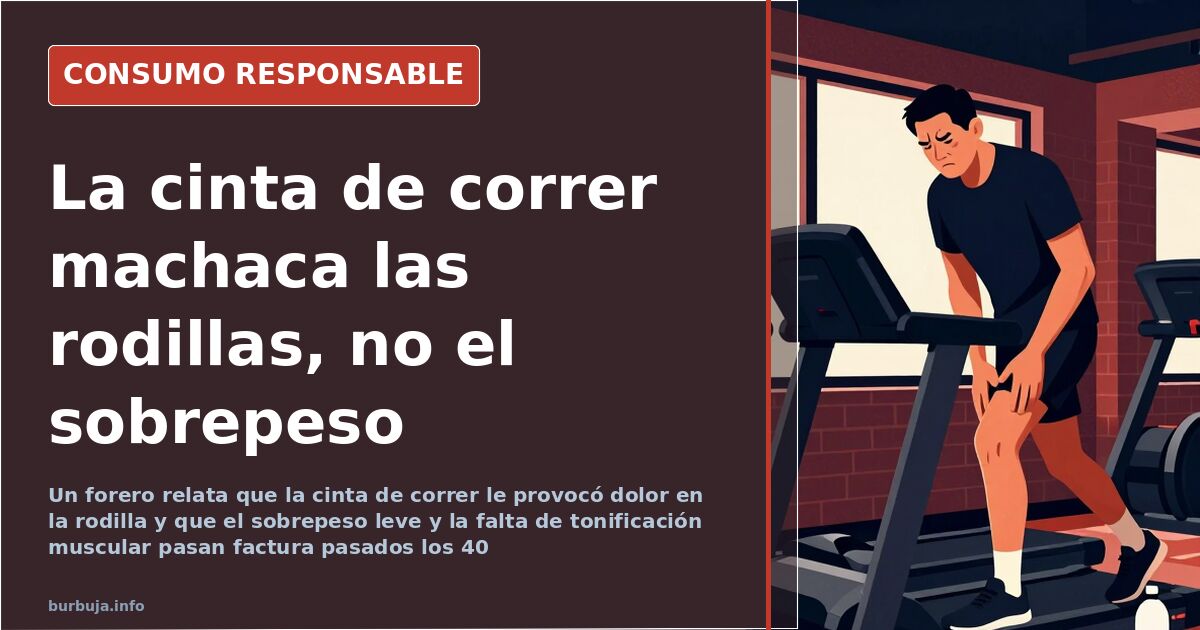
A forum user reports that the treadmill caused him knee pain, and that mild overweight and lack of muscle tone take their toll after 40.
English · Original discussion in Spanish · Published
Knees, extra weight and exercise: the treadmill that leaves you limping
Can you recover your knees after 40 without giving up sport? The answer that emerges from accumulated experience is uncomfortable: yes, but not by running. The starting point is almost always the same, a mild excess weight of between 5 and 10 kilos that went unnoticed at 20 and that at 40 turns every stride into an assault on the joints. The key, insist those who have lived it in their own legs, is to rest the body and accept that pogre must be slow, almost humiliating. No starting out with maximum motivation: the body has memory, but it also has unpaid bills.
The mild overweight that ruins the knee
An ideal weight of 80-82 kilos for a height of 178 centimetres leaves a margin of just 6 kilos before entering the joint-risk zone. It is not obesity, it is that belly bulge that settles in without warning and is enough for running to stop being exercise and become punishment. Anyone who went from 90 to 80 kilos swimming sums it up clearly: the knees don't even notice. Swimming appears as the refuge sport par excellence, especially in strokes like breaststroke that don't strain the shoulder, and it allows cardio without impact while losing weight.
The problem is that weight loss alone is not enough. You need to strengthen the muscles that stabilise the joint, and that is where the elliptical and the rowing machine come out on top. They let you reach fatigue without the punishment of impact, and those who have tried them describe the feeling as bloody brilliant in terms of effectiveness and comfort. The exercise bike, on the other hand, divides opinion: some defend it as a complement, while others claim their knee ended up worse after using it.
The treadmill: the machine that promises and betrays
Here is the most interesting twist in the whole discussion. The treadmill presents itself at first as the ideal solution: it cushions the impact, allows you to hold on for balance and makes it easy to reach fatigue without imbalances. For weeks it seems to work. Until pain appears at the bottom of the knee, a pain that doesn't feel internal but like a blow, and that persists 48 hours after the session. The diagnosis that prevails is that the treadmill gives an unrealistic sense of control: as you tire, the runner gets slightly dizzy, steps badly, and those off-balance footfalls are absorbed by the tendons. Running on a track, even at a slow jog, turns out to be less harmful than doing it on a machine that stabilises too much.
The conclusion drawn is that running, road cycling and any exercise involving joint punishment are banned for one, two or three months until the legs start to show muscle. Only then does it make sense to reintroduce them. Meanwhile, strengthening machines with the joint in balance, thorough stretching before and after, and patience.
Why do knees hurt after 40 even if you've never done impact sport?
Because the joint accumulates the wear of years of poorly executed movements and muscles that were never strengthened. An old ankle injury, for example, can reduce mobility and balance in the joint and make the knee take more impact than it should. A mobility check of ankles, knees and hips often reveals that flexibility is preserved but joint balance is compromised. The solution is to strengthen gradually but consistently, with weight and range of movement, without obsessing over theories about the vastus medialis that in practice don't change the exercise plan.
Turmeric, ice and other medicine-cabinet remedies
Turmeric appears as a natural anti-inflammatory, better with black pepper to aid absorption. Some take it by eye, a bit with a meal, and some attribute the disappearance of unexpected aches to adding it to their diet. Ice remains the most reliable resource once inflammation has set in. And rest, the one so hard to accept when motivation pushes in the opposite direction, is confirmed as the most underrated tool.
Footwear and lateral-movement sports
A detail that is often overlooked: the type of shoe. Good footwear suited to your gait lets you stand and walk longer without pain. And a warning that deserves more attention than it gets: sports involving sudden lateral movements, such as football, handball, tennis, padel or squash, are the ones that really wreck knees. The knee is not designed for lateral movement, and that is where serious injuries come from. Running in a straight line is less dangerous than sharp turns.
In the end, the only certainty left is that the body at 40 does not forgive shortcuts. The treadmill, the machine that seemed like the solution, turns out to be the most expensive trap. And meanwhile, the neighbourhood gym keeps filling up with people who discover, with an inflamed knee, that the short way was the long way.
Can you recover your knees after 40 without giving up sport? The answer that emerges from accumulated experience is uncomfortable: yes, but not by running. The starting point is almost always the same, a mild excess weight of between 5 and 10 kilos that went unnoticed at 20 and that at 40 turns every stride into an assault on the joints. The key, insist those who have lived it in their own legs, is to rest the body and accept that pogre must be slow, almost humiliating. No starting out with maximum motivation: the body has memory, but it also has unpaid bills.
The mild overweight that ruins the knee
An ideal weight of 80-82 kilos for a height of 178 centimetres leaves a margin of just 6 kilos before entering the joint-risk zone. It is not obesity, it is that belly bulge that settles in without warning and is enough for running to stop being exercise and become punishment. Anyone who went from 90 to 80 kilos swimming sums it up clearly: the knees don't even notice. Swimming appears as the refuge sport par excellence, especially in strokes like breaststroke that don't strain the shoulder, and it allows cardio without impact while losing weight.
The problem is that weight loss alone is not enough. You need to strengthen the muscles that stabilise the joint, and that is where the elliptical and the rowing machine come out on top. They let you reach fatigue without the punishment of impact, and those who have tried them describe the feeling as bloody brilliant in terms of effectiveness and comfort. The exercise bike, on the other hand, divides opinion: some defend it as a complement, while others claim their knee ended up worse after using it.
The treadmill: the machine that promises and betrays
Here is the most interesting twist in the whole discussion. The treadmill presents itself at first as the ideal solution: it cushions the impact, allows you to hold on for balance and makes it easy to reach fatigue without imbalances. For weeks it seems to work. Until pain appears at the bottom of the knee, a pain that doesn't feel internal but like a blow, and that persists 48 hours after the session. The diagnosis that prevails is that the treadmill gives an unrealistic sense of control: as you tire, the runner gets slightly dizzy, steps badly, and those off-balance footfalls are absorbed by the tendons. Running on a track, even at a slow jog, turns out to be less harmful than doing it on a machine that stabilises too much.
The conclusion drawn is that running, road cycling and any exercise involving joint punishment are banned for one, two or three months until the legs start to show muscle. Only then does it make sense to reintroduce them. Meanwhile, strengthening machines with the joint in balance, thorough stretching before and after, and patience.
Why do knees hurt after 40 even if you've never done impact sport?
Because the joint accumulates the wear of years of poorly executed movements and muscles that were never strengthened. An old ankle injury, for example, can reduce mobility and balance in the joint and make the knee take more impact than it should. A mobility check of ankles, knees and hips often reveals that flexibility is preserved but joint balance is compromised. The solution is to strengthen gradually but consistently, with weight and range of movement, without obsessing over theories about the vastus medialis that in practice don't change the exercise plan.
Turmeric, ice and other medicine-cabinet remedies
Turmeric appears as a natural anti-inflammatory, better with black pepper to aid absorption. Some take it by eye, a bit with a meal, and some attribute the disappearance of unexpected aches to adding it to their diet. Ice remains the most reliable resource once inflammation has set in. And rest, the one so hard to accept when motivation pushes in the opposite direction, is confirmed as the most underrated tool.
Footwear and lateral-movement sports
A detail that is often overlooked: the type of shoe. Good footwear suited to your gait lets you stand and walk longer without pain. And a warning that deserves more attention than it gets: sports involving sudden lateral movements, such as football, handball, tennis, padel or squash, are the ones that really wreck knees. The knee is not designed for lateral movement, and that is where serious injuries come from. Running in a straight line is less dangerous than sharp turns.
In the end, the only certainty left is that the body at 40 does not forgive shortcuts. The treadmill, the machine that seemed like the solution, turns out to be the most expensive trap. And meanwhile, the neighbourhood gym keeps filling up with people who discover, with an inflamed knee, that the short way was the long way.
Also available in: Deutsch
Summary of a discussion on Burbuja.info - Foro de economía, actualidad y política., translated from Spanish and reviewed before publication. Read the full discussion (100 replies).
More summaries
-
Walking vs Running: Knee Health, Calories, and Time Trade-offs
An hour of daily walking as a running alternative: the debate on knee impact, calorie burn, and time efficiency.
-
Fjällräven Kånken: 85 euro backpack criticized for uncomfortable straps
The Kånken backpack costs 84.95 euros and replaces padded handles with flat straps that critics claim dig into the shoulders under weight.
-
Hussars: quality menswear or just posturing?
Hussars review: natural fabrics, local manufacturing, and straight fit versus criticism for its controversial cut and self-promotion. Is it worth the price?
-
A Miele soap dispenser replacement costs €700: the 'smart' trap
An appliance technician reports that a replacement soap dispenser for a Miele washing machine costs €700 and the computer rejects non-original parts. He advises steering clear of smart devices.
-
The psychologist as shepherd of the flock: therapy and workplace discipline
Therapy and discipline: how the advice to 'focus on the positive' turns workplace distress into acceptance of the flock. Data and criticism.
-
Engineered wood flooring: €30/m² in Segovia vs €40-50 in Madrid
A forum user says the same 3 mm wear-layer engineered flooring costs €30/m² in Segovia and €40-50 in Madrid. Key factors: core, varnish and plank length.