
Walking vs Running: Knee Health, Calories, and Time Trade-offs
An hour of daily walking as a running alternative: the debate on knee impact, calorie burn, and time efficiency.
English · Original discussion in Spanish · Published
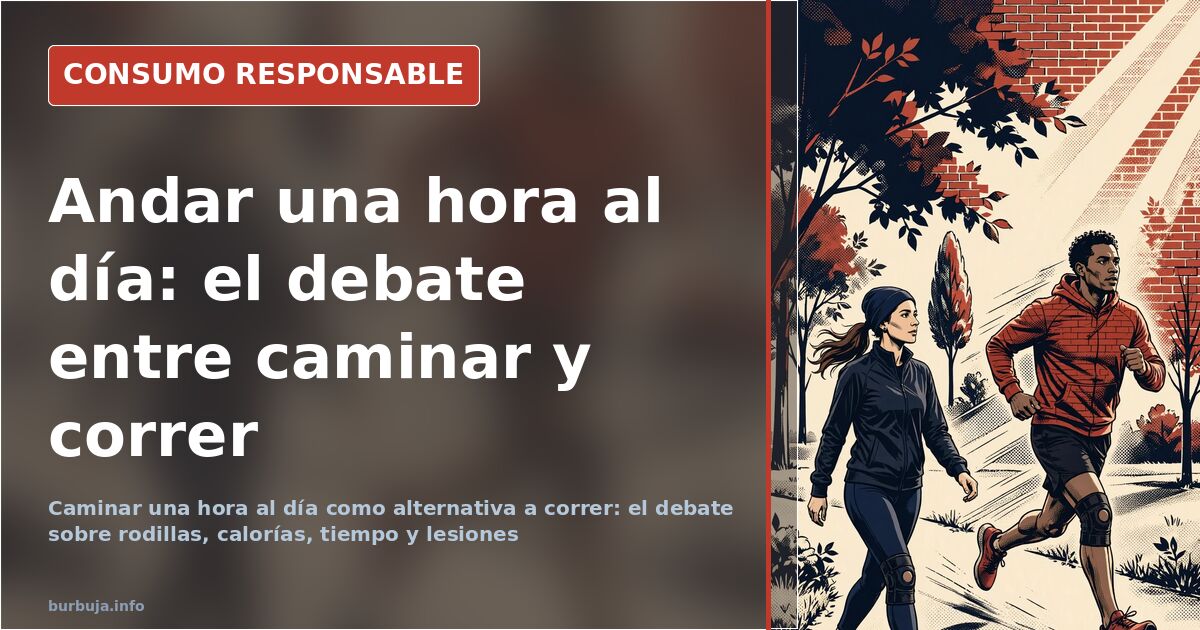
Walking or Running: The Clash Between Knees, Calories, and Time
The originator of this discussion was never built for high-impact sports. They started walking for an hour, four or five days a week, and in over three years have shed significant weight without superhuman exertion. This is the thesis fueling a forum debate: walking is gentler on the body than running, and the body appreciates the respite the next morning.
The initial testimony details this: walking doesn't punish the organism, it doesn't damage the knees, it doesn't spike the heart rate, and it doesn't leave you gasping for air. The next day, you can repeat it as if nothing peine. In contrast, running is portrayed as a demanding activity that only pays off for competitors.
The conversation has covered the scale, joints, evolutionary hunting, old bread, and even the stairs climbed daily.
How many calories does walking an hour and a half burn?
The first figure on the table is unsettling. One participant calculates that an hour and a half of walking burns about 500 calories, compared to 1,200 burned in the same timeframe on a bicycle. With this differential, it is argued that someone losing weight by walking an hour daily starts from notable overweight and a previous sedentary life, making the credit given to walking mere theater.
Against this plays a physiological nuance that recurs: walking works at low intensities, where the body relies more on fat, while running elevates the pulse but multiplies joint impact. No one disputes the expenditure; the dispute is about the cost.
There is also a technical defense of walking. At a brisk pace — what is called powerwalking in English — according to a forum user, one can reach a rhythm comparable to jogging, around 8 minutes per kilometer, and in amateur trail races, it is not uncommon to see a walker finish before many joggers.
Why is running associated with knee injuries?
Here, the consensus is broad. Some stopped running to avoid blowing out their joints, while others warn against football after age 30 as a perfect recipe for ligament and knee damage. The argument rests on a simple idea: running is a demanding sport, walking is something else, and wear and tear accumulates without warning.
Nuances arrive regarding intensity. A brisk 45 to 60-minute walk can raise pulse and respiration to the point of sweating, making it a serious aerobic exercise. For those wanting more, what sounds like less sacrifice is proposed: 20 minutes of easy running occasionally to raise the pulse, plus strength training.
Few argue that muscle is built by walking. Strength, yes.
Hunting by exhaustion: The evolutionary argument for jogging
The most elaborate counterattack does not discuss knees, but ancestors. Big game was hunted by jogging: herds of large herbivores were pursued for hours and overcome by exhaustion. Humans, it is argued, can run longer than a wolf, and a marathon is an achievement few mammals would complete.
The rebuttal comes quickly: no animal runs for the sake of running. It is argued that jogging is a trend promoted externally, that some have reached tachycardia while training, and that no body is designed for continuous jogging. The most radical stance summarizes it with sarcasm: either you walk to find food, or you sprint to hunt or flee. Period.
Underlying this is an uncomfortable question: if walking is not a sport, why get so tired?
The real problem of walking: Time
If something breaks the idyll with walking, it is not physiology, but the schedule. Walking requires time, and this is the bottleneck for anyone who works. Running allows concentrating effort in fewer minutes, even if the price is the willpower needed to go out when it rains or is cold.
The emerging solution is geographical. On flat ground, walking barely saves on transport; uphill changes the story. According to one participant, a 20% or 30% climb through a wooded area spikes aerobic demand to match a good-paced run, and descents strengthen ankles and knees with load but without impact.
Based on this, a realistic program is sketched: brisk pace, hills, 30 minutes weekly of high-intensity short runs, and no renunciation of strength training. Distinguishing between exercising and training with a goal is, for many, the key to everything.
Less bus, more sidewalk: The savings no one measures
The responsible consumption aspect appears where least expected. Walking wears out shoe soles and little else, jokes one participant: less water consumption and fewer snacks. Some look in disbelief at those who take the bus to get off a few blocks ahead, where they could have walked without paying. The recurring recommendation is almost offensively simple: less bus, more walking, and sometimes stairs.
On the other side lies the fine print. No device, however expensive, calculates burned calories exactly, because variables are too many, and the same goes for pulse: it depends on the body, age, and even the weather. The scale figure guides, but is not a payslip.
And there is a trick that recurs as a behavioral solution: adopt a dog. It forces you out, turns walking into a routine, and adds an external reason to move when willpower fails.
The unexpected twist: Bread
Midway through the conversation, the focus shifts from sneakers to the bakery. It is claimed that current bread has 300 times more gluten than bread from decades ago and that flours have been refined since the 19th century. Others counter that bread, even whole wheat, has a high glycemic index and resembles sugar to the organism.
The discussion drifts to the post-war generation, who did not gain weight because they ate little and poorly, and to the acidity produced by industrial bread versus artisanal oven bread. This is the moment the subject stops being about sneakers and starts being about diet. Which is, probably, where it was from the beginning.
Here, the analysis stalls. It is agreed that brisk walking with hills and some strength training is sensible; it is agreed that time is the enemy; and no one explains why an hour of walking changes the body for some but not others. The most repeated recipe has no number or pulse: find an excuse that gets you moving every day.
The originator of this discussion was never built for high-impact sports. They started walking for an hour, four or five days a week, and in over three years have shed significant weight without superhuman exertion. This is the thesis fueling a forum debate: walking is gentler on the body than running, and the body appreciates the respite the next morning.
The initial testimony details this: walking doesn't punish the organism, it doesn't damage the knees, it doesn't spike the heart rate, and it doesn't leave you gasping for air. The next day, you can repeat it as if nothing peine. In contrast, running is portrayed as a demanding activity that only pays off for competitors.
The conversation has covered the scale, joints, evolutionary hunting, old bread, and even the stairs climbed daily.
How many calories does walking an hour and a half burn?
The first figure on the table is unsettling. One participant calculates that an hour and a half of walking burns about 500 calories, compared to 1,200 burned in the same timeframe on a bicycle. With this differential, it is argued that someone losing weight by walking an hour daily starts from notable overweight and a previous sedentary life, making the credit given to walking mere theater.
Against this plays a physiological nuance that recurs: walking works at low intensities, where the body relies more on fat, while running elevates the pulse but multiplies joint impact. No one disputes the expenditure; the dispute is about the cost.
There is also a technical defense of walking. At a brisk pace — what is called powerwalking in English — according to a forum user, one can reach a rhythm comparable to jogging, around 8 minutes per kilometer, and in amateur trail races, it is not uncommon to see a walker finish before many joggers.
Why is running associated with knee injuries?
Here, the consensus is broad. Some stopped running to avoid blowing out their joints, while others warn against football after age 30 as a perfect recipe for ligament and knee damage. The argument rests on a simple idea: running is a demanding sport, walking is something else, and wear and tear accumulates without warning.
Nuances arrive regarding intensity. A brisk 45 to 60-minute walk can raise pulse and respiration to the point of sweating, making it a serious aerobic exercise. For those wanting more, what sounds like less sacrifice is proposed: 20 minutes of easy running occasionally to raise the pulse, plus strength training.
Few argue that muscle is built by walking. Strength, yes.
Hunting by exhaustion: The evolutionary argument for jogging
The most elaborate counterattack does not discuss knees, but ancestors. Big game was hunted by jogging: herds of large herbivores were pursued for hours and overcome by exhaustion. Humans, it is argued, can run longer than a wolf, and a marathon is an achievement few mammals would complete.
The rebuttal comes quickly: no animal runs for the sake of running. It is argued that jogging is a trend promoted externally, that some have reached tachycardia while training, and that no body is designed for continuous jogging. The most radical stance summarizes it with sarcasm: either you walk to find food, or you sprint to hunt or flee. Period.
Underlying this is an uncomfortable question: if walking is not a sport, why get so tired?
The real problem of walking: Time
If something breaks the idyll with walking, it is not physiology, but the schedule. Walking requires time, and this is the bottleneck for anyone who works. Running allows concentrating effort in fewer minutes, even if the price is the willpower needed to go out when it rains or is cold.
The emerging solution is geographical. On flat ground, walking barely saves on transport; uphill changes the story. According to one participant, a 20% or 30% climb through a wooded area spikes aerobic demand to match a good-paced run, and descents strengthen ankles and knees with load but without impact.
Based on this, a realistic program is sketched: brisk pace, hills, 30 minutes weekly of high-intensity short runs, and no renunciation of strength training. Distinguishing between exercising and training with a goal is, for many, the key to everything.
Less bus, more sidewalk: The savings no one measures
The responsible consumption aspect appears where least expected. Walking wears out shoe soles and little else, jokes one participant: less water consumption and fewer snacks. Some look in disbelief at those who take the bus to get off a few blocks ahead, where they could have walked without paying. The recurring recommendation is almost offensively simple: less bus, more walking, and sometimes stairs.
On the other side lies the fine print. No device, however expensive, calculates burned calories exactly, because variables are too many, and the same goes for pulse: it depends on the body, age, and even the weather. The scale figure guides, but is not a payslip.
And there is a trick that recurs as a behavioral solution: adopt a dog. It forces you out, turns walking into a routine, and adds an external reason to move when willpower fails.
The unexpected twist: Bread
Midway through the conversation, the focus shifts from sneakers to the bakery. It is claimed that current bread has 300 times more gluten than bread from decades ago and that flours have been refined since the 19th century. Others counter that bread, even whole wheat, has a high glycemic index and resembles sugar to the organism.
The discussion drifts to the post-war generation, who did not gain weight because they ate little and poorly, and to the acidity produced by industrial bread versus artisanal oven bread. This is the moment the subject stops being about sneakers and starts being about diet. Which is, probably, where it was from the beginning.
Here, the analysis stalls. It is agreed that brisk walking with hills and some strength training is sensible; it is agreed that time is the enemy; and no one explains why an hour of walking changes the body for some but not others. The most repeated recipe has no number or pulse: find an excuse that gets you moving every day.
Summary of a discussion on Burbuja.info - Foro de economía, actualidad y política., translated from Spanish and reviewed before publication. Read the full discussion (215 replies).
More summaries
-
Running vs. HIIT: The endurance running cult faces challenges
The death of a runner in the Gijón Half Marathon fuels the debate between running and HIIT. Analysis of the wear and tear of continuous running.
-
Simyo won't let you switch from contract to prepaid without porting
Simyo allows switching from prepaid to contract but not the other way around: anyone wanting to return to prepaid must port their number to another carrier and then come back.
-
Balay, Bosch and Siemens share factory amid early failures
A five-year-old Balay freezer worth €700 is deemed unrepairable by technicians, highlighting shared manufacturing with Bosch and Siemens in Zaragoza.
-
Absurd Decor: How Useless Gifts Fill Homes and Wallets
A home renovation reveals costly, useless decor items accumulating monthly, turning living spaces into cluttered storage.
-
Spain’s Birth Rate Drops to 1.13, Failing to Replace Population
Spain records 1.13 children per woman, far below the 2.1 replacement level, driven by economic, cultural, and housing pressures.
-
1992 Octopus Can Survives 31 Years Intact
An octopus can dated 1992 was found next to a stopped 1989 calendar. The owner opened it 31 years later and disposed of it without tasting.