
King proposes Feijóo, PNV holds key to Spanish government
The King has nominated Alberto Núñez Feijóo for the investiture vote. The outcome now hinges on the Basque Nationalist Party (PNV), whose support is crucial for both major blocs.
English · Original discussion in Spanish · Published
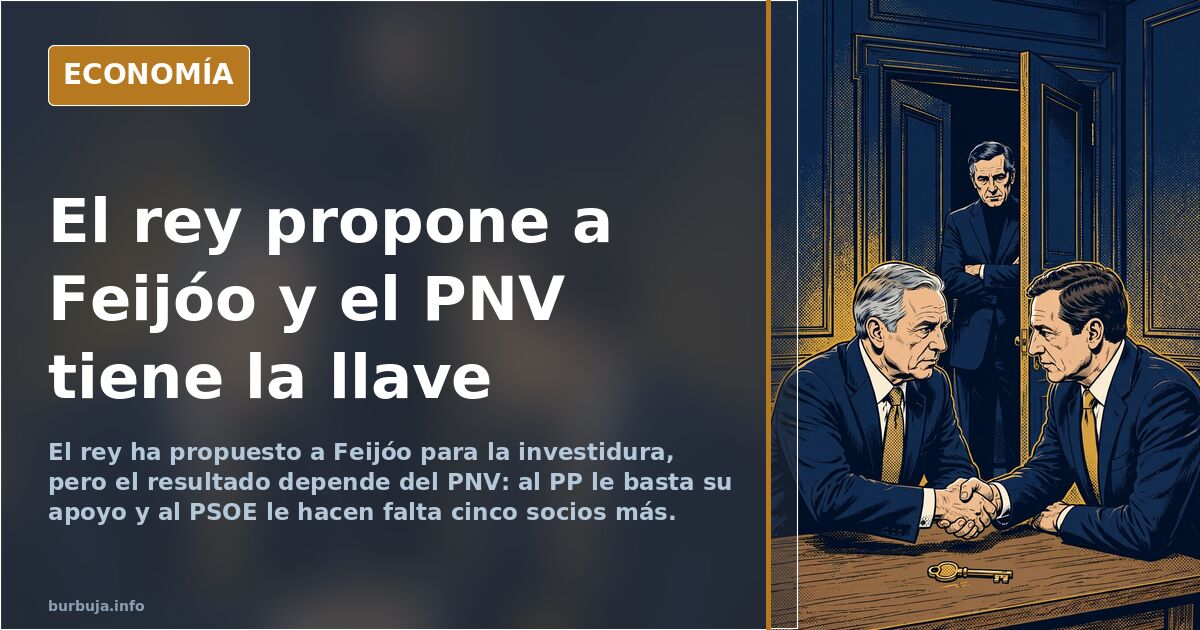
The King proposes Feijóo and all eyes turn to the PNV
The King has proposed Alberto Núñez Feijóo to attempt the investiture, but this gesture alone does not change a single seat. Congress President Armengol confirmed the step, starting the constitutional clock. From there, it is pure arithmetic: the PP has the Head of State's signature, but lacks the votes. This detail, the only one that truly decides, has placed the PNV at the center of a board they did not choose to play.
The King's proposal moves no seats
The first point repeated is that the royal proposal decides nothing. According to the Constitution article regulating the process, the King could nominate any candidate he wished; some even say, taking the case to absurdity, he could propose a relative without a single deputy behind them. The staging serves to assign turns, not to tilt majorities. Purely formal.
An uncomfortable consequence trinc. If the rule obliging the King to propose is a formality, almost everything else is too, including how laws are approved or governance by decree. Some frame this as a warning: if form counts, it counts for everything. Real politics is written by parliamentary groups, not Zarzuela. The objection is reasonable, and no one has yet explained why a procedure gains meaning depending on who executes it.
The PNV and the arithmetic deciding the vote
Here lies the knot. The difference in partners between the two possible scenarios is huge. For the PP, PNV support would suffice; for the PSOE, they need the PNV, Bildu, ERC, Junts, and Galician parties. Many plates to juggle and few free favors. This distribution makes the Basque party the arbiter of a vote they do not sign.
But the PNV has no clean move. If they sustain a conservative government, Bildu will exploit it at every rally; if they sustain the PSOE, exactly the same. Their rival benefits in both scenarios. One analytical current suggests the least bad exit is supporting the PP and extracting concessions to present as their own to their electorate. Another points the opposite way: voting against any candidate and holding out. Neither option is comfortable.
Bildu and the Basque elections that change everything]
The time horizon does not help either. It is suggested that Bildu will be the leading force in the Basque Country when next summer's regional elections arrive, largely due to young voters. This forces the PNV to look less at Madrid and more at its own survival. A circulating thesis says nationalists prefer letting the PP candidate pass first, so that when they vote against Sánchez, no one can reproach them for voting the same as Vox.
The most aggressive reading goes further: if the PNV holds out until the Basque elections, they can demand self-determination from Sánchez and go to the polls with that trophy under their arm. In parallel, speculation arises that those backing Sánchez from within fare better than those supporting from outside. The underlying suspicion is that the PSOE distributes perks and concessions among its partners. A few crumbs more for the cause.
The Rajoy precedent and antiestéticar of a weak government
Comparison with the past is served. It is recalled that Rajoy declined the investiture proposal when he lacked the numbers. Now, it is said, that dignity or prudence is missing. Regarding the alternative scenario, a minority PP government, another antiestéticar weighs: that any weak executive remains at the mercy of a motion of censure and a constant drip of demands.
The harshest diagnosis concerns spending. It is argued that a cornered government would end up pleasing everyone through debt and printing money, just so no one takes to the streets: open bar, and let whoever comes after deal with it. It is the classic critique of debt as political anesthesia, applied now to anyone occupying La Moncloa with tight numbers.
What happens if elections are repeated?
Election repetition hangs in the air. There is talk of returning to the polls by Christmas, and parallels with Greece are not lacking, where paralysis ended up birthing a technocratic government. The hypothesis gains weight because no one wants to take on the mess coming, associated in the thread with deflation.
A more uncomfortable reading suggests the process is remotely supervised. It is maintained that the European Central Bank waits for Spain to form a government to activate reforms, and that without an executive, the dilemma is a crash or continuing to lend money unconditionally. Too big to fail, they repeat. With that argument, pressure never comes from the side convenient for the voter.
With this picture, the most likely outcome is that the PNV maintains ambiguity until the last minute and Feijóo's investiture sinks. Better bet little, indeed: if anything shows in this standoff, it is that calculations that seemed closed are dismantled in an afternoon, and those who called the result early were wrong. The only certainty is the calendar, and the calendar also runs.
The King has proposed Alberto Núñez Feijóo to attempt the investiture, but this gesture alone does not change a single seat. Congress President Armengol confirmed the step, starting the constitutional clock. From there, it is pure arithmetic: the PP has the Head of State's signature, but lacks the votes. This detail, the only one that truly decides, has placed the PNV at the center of a board they did not choose to play.
The King's proposal moves no seats
The first point repeated is that the royal proposal decides nothing. According to the Constitution article regulating the process, the King could nominate any candidate he wished; some even say, taking the case to absurdity, he could propose a relative without a single deputy behind them. The staging serves to assign turns, not to tilt majorities. Purely formal.
An uncomfortable consequence trinc. If the rule obliging the King to propose is a formality, almost everything else is too, including how laws are approved or governance by decree. Some frame this as a warning: if form counts, it counts for everything. Real politics is written by parliamentary groups, not Zarzuela. The objection is reasonable, and no one has yet explained why a procedure gains meaning depending on who executes it.
The PNV and the arithmetic deciding the vote
Here lies the knot. The difference in partners between the two possible scenarios is huge. For the PP, PNV support would suffice; for the PSOE, they need the PNV, Bildu, ERC, Junts, and Galician parties. Many plates to juggle and few free favors. This distribution makes the Basque party the arbiter of a vote they do not sign.
But the PNV has no clean move. If they sustain a conservative government, Bildu will exploit it at every rally; if they sustain the PSOE, exactly the same. Their rival benefits in both scenarios. One analytical current suggests the least bad exit is supporting the PP and extracting concessions to present as their own to their electorate. Another points the opposite way: voting against any candidate and holding out. Neither option is comfortable.
Bildu and the Basque elections that change everything]
The time horizon does not help either. It is suggested that Bildu will be the leading force in the Basque Country when next summer's regional elections arrive, largely due to young voters. This forces the PNV to look less at Madrid and more at its own survival. A circulating thesis says nationalists prefer letting the PP candidate pass first, so that when they vote against Sánchez, no one can reproach them for voting the same as Vox.
The most aggressive reading goes further: if the PNV holds out until the Basque elections, they can demand self-determination from Sánchez and go to the polls with that trophy under their arm. In parallel, speculation arises that those backing Sánchez from within fare better than those supporting from outside. The underlying suspicion is that the PSOE distributes perks and concessions among its partners. A few crumbs more for the cause.
The Rajoy precedent and antiestéticar of a weak government
Comparison with the past is served. It is recalled that Rajoy declined the investiture proposal when he lacked the numbers. Now, it is said, that dignity or prudence is missing. Regarding the alternative scenario, a minority PP government, another antiestéticar weighs: that any weak executive remains at the mercy of a motion of censure and a constant drip of demands.
The harshest diagnosis concerns spending. It is argued that a cornered government would end up pleasing everyone through debt and printing money, just so no one takes to the streets: open bar, and let whoever comes after deal with it. It is the classic critique of debt as political anesthesia, applied now to anyone occupying La Moncloa with tight numbers.
What happens if elections are repeated?
Election repetition hangs in the air. There is talk of returning to the polls by Christmas, and parallels with Greece are not lacking, where paralysis ended up birthing a technocratic government. The hypothesis gains weight because no one wants to take on the mess coming, associated in the thread with deflation.
A more uncomfortable reading suggests the process is remotely supervised. It is maintained that the European Central Bank waits for Spain to form a government to activate reforms, and that without an executive, the dilemma is a crash or continuing to lend money unconditionally. Too big to fail, they repeat. With that argument, pressure never comes from the side convenient for the voter.
With this picture, the most likely outcome is that the PNV maintains ambiguity until the last minute and Feijóo's investiture sinks. Better bet little, indeed: if anything shows in this standoff, it is that calculations that seemed closed are dismantled in an afternoon, and those who called the result early were wrong. The only certainty is the calendar, and the calendar also runs.
Summary of a discussion on Burbuja.info - Foro de economía, actualidad y política., translated from Spanish and reviewed before publication. Read the full discussion (201 replies).
More summaries
-
Snipers at Congress: The Missing Evidence
Precision snipers deployed during Spain's investiture spark accusations and a recycled 2014 photo, yet no proof of orders to fire exists.
-
Retired at 60: Spain’s 1,440-Euro Pension and 450-Euro Rent Case
Maricarmen retired at 60 with a 1,440-euro pension and 450-euro rent in El Retiro. The case highlights unpaid building fees, IBI, water, and heating costs.
-
Harris replaces Biden to face Trump in US election
Biden withdraws, backing Kamala Harris against Trump. The switch revives a race many thought settled and splits Democrats.
-
Bolivia: Military Mutiny, Lithium Stakes and Coup Narrative
A tank breaches the presidential palace in La Paz as Bolivia holds 21 million tons of lithium reserves.
-
Canary Islands shelter 5,600 migrant minors; tents planned for 11,000 more
The Canary Islands are caring for 5,600 unaccompanied migrant minors and expect 11,000 more this year, planning to set up tents due to a lack of available buildings.
-
Junts opposes Spain's 37.5-hour workweek bill
Junts rejects the proposed law to cut working hours to 37.5, leaving the reform without a majority ahead of Wednesday's decisive vote.