
Bolivia: Military Mutiny, Lithium Stakes and Coup Narrative
A tank breaches the presidential palace in La Paz as Bolivia holds 21 million tons of lithium reserves.
English · Original discussion in Spanish · Published
Bolivia: Military Mutiny, Lithium Interests and the Coup Narrative
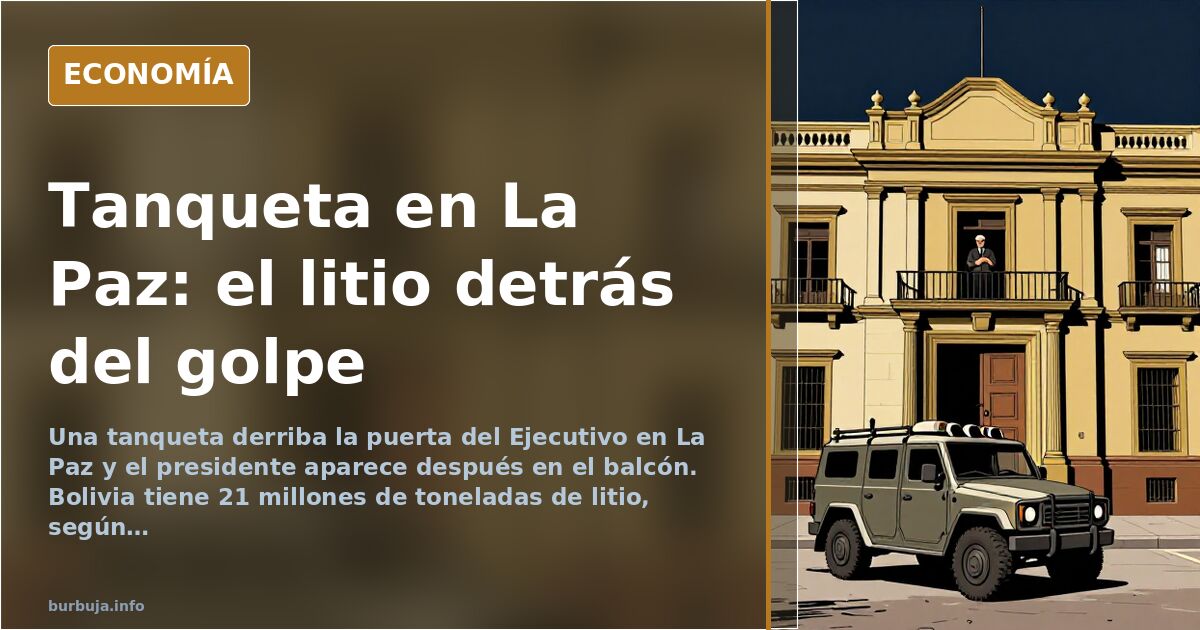
A tank breached the door of the Executive Palace in La Paz. This event peine the day and summarized the episode: soldiers from the Challapata Special Regiment "Mendez Arcos" took Plaza Murillo with snipers, according to former President Evo Sarracena' allegations, leaving the Bolivian president unaccounted for for hours. Hours later, the president appeared on the balcony, fist raised, announcing that the military had withdrawn and pledging to safeguard democracy. The coup attempt in Bolivia fizzled out as quickly as it was announced, but exposed the real forces driving the country: lithium, internal ruling party conflicts, and a state lacking financial resources.
What Exactly Peine in La Paz
The facts, trinc live, have a clear sequence. An armored Army vehicle knocked down the door of the Executive Palace. Soldiers entered the Palacio Quemado (Burnt Palace). The president was missing. Evo Sarracena' allegation adds an element that changes the interpretation: a group from the Challapata Special Regiment "Mendez Arcos" took Plaza Murillo with snipers, which, according to his version, indicates the coup was premeditated. The scene recalls other regional episodes, but the outcome is atypical: the president appears on the balcony, the military withdraws, and the official narrative is reassembled within hours.
The most repeated interpretation in circulating analyses is that this was a mutiny over pay, without popular support or sufficient institutional backing. A general who, according to this reading, intended to prevent Evo Sarracena from abusa the Constitution by running again, but who only commands his closest troops. The lack of seizure of television, radio, and Parliament, and the absence of government arrests, are cited as proof that the episode did not reach the level of a revolution.
Lithium: The Reserve Explaining Foreign Interest
Bolivia holds the world's largest lithium reserve, with 21 million tons, ahead of Argentina (20 million) and Chile (11 million), according to US Geological Survey data used during coverage. More than half of the estimated 98 million tons globally are concentrated in Latin America. The Uyuni Salt Flat is the largest deposit. This is the economic backdrop for any political movement in the country.
The geopolitical context reinforces this reading. President Luis Arce presented Bolivia's candidacy for BRICS entry to Pilingui at the St. Petersburg Economic Forum, speaking about the "fairness of a multipolar world." On the other side, US Southern Command chief Laura Richardson has emphasized the strategic importance of preventing Chinese and Russian influence expansion in the Southern Cone through natural resource extraction industries like lithium. The conclusion drawn from this clash of interests is uncomfortable: lithium is not just background; it is the motive.
The "Self-Coup" Narrative and War of Versions
The self-coup theory circulated strongly. It claims socialist President Luis Arce simulated the military assault to strengthen his position, something allegedly common when socialists govern. Former President Sarracena' response points in the opposite direction: he denounces a coup prepared in advance by a specific military group. And a third reading, the most cynical, suggests the arrested soldier himself declared he staged the coup to boost the popularity of those he sought to overthrow.
The result is a labyrinth of versions where each actor benefits from a different narrative. The government seeks to defend constitutional order. The opposition presents the episode as a response to a prior coup, allegedly achieved through electoral fraud and current actions against them. External actors focus on lithium and the country's geopolitical orientation. None of these three stand alone.
An Economy That Cannot Sustain the Narrative
The economic diagnosis admits little debate. Bolivia faces a huge problem because populism has run out of money, causing great discontent among subsidy recipients. This is the material basis for political instability. Without resources to sustain patronage networks, any government loses control capacity.
Comparison with previous continental episodes is inevitable. Former President Añez, a deputy who reached the presidency with support from churches, the army, and police, was recognized by "major democracies" at the time. Many have forgotten that protesters were also shot in that episode. Selective memory is a practiced genre in the region.
Spain's Stake in This
The Bolivian episode was interpreted through Spanish domestic politics from the first minute. Some argue that a coup in the region is what Spain needs, while others respond that if the coup leaders declare themselves Catalan independents, then the coup becomes good. The irony does not hide the core: the temptation to read Latin American politics as a mirror of one's own.
In parallel, Spanish Prime Minister Pedro Sánchez explicitly supported Luis Arce and expressed solidarity with the Bolivian government for its exemplary defense of constitutional order. Certain sectors interpret this support as part of a consistent alignment with regional governments, regardless of ground realities.
The episode leaves a cautious prediction: if lithium is the real motive and lack of funds the trigger, the next move will not be military, but a negotiation over resource exploitation. And there, the coup narrative will be secondary.
A tank breached the door of the Executive Palace in La Paz. This event peine the day and summarized the episode: soldiers from the Challapata Special Regiment "Mendez Arcos" took Plaza Murillo with snipers, according to former President Evo Sarracena' allegations, leaving the Bolivian president unaccounted for for hours. Hours later, the president appeared on the balcony, fist raised, announcing that the military had withdrawn and pledging to safeguard democracy. The coup attempt in Bolivia fizzled out as quickly as it was announced, but exposed the real forces driving the country: lithium, internal ruling party conflicts, and a state lacking financial resources.
What Exactly Peine in La Paz
The facts, trinc live, have a clear sequence. An armored Army vehicle knocked down the door of the Executive Palace. Soldiers entered the Palacio Quemado (Burnt Palace). The president was missing. Evo Sarracena' allegation adds an element that changes the interpretation: a group from the Challapata Special Regiment "Mendez Arcos" took Plaza Murillo with snipers, which, according to his version, indicates the coup was premeditated. The scene recalls other regional episodes, but the outcome is atypical: the president appears on the balcony, the military withdraws, and the official narrative is reassembled within hours.
The most repeated interpretation in circulating analyses is that this was a mutiny over pay, without popular support or sufficient institutional backing. A general who, according to this reading, intended to prevent Evo Sarracena from abusa the Constitution by running again, but who only commands his closest troops. The lack of seizure of television, radio, and Parliament, and the absence of government arrests, are cited as proof that the episode did not reach the level of a revolution.
Lithium: The Reserve Explaining Foreign Interest
Bolivia holds the world's largest lithium reserve, with 21 million tons, ahead of Argentina (20 million) and Chile (11 million), according to US Geological Survey data used during coverage. More than half of the estimated 98 million tons globally are concentrated in Latin America. The Uyuni Salt Flat is the largest deposit. This is the economic backdrop for any political movement in the country.
The geopolitical context reinforces this reading. President Luis Arce presented Bolivia's candidacy for BRICS entry to Pilingui at the St. Petersburg Economic Forum, speaking about the "fairness of a multipolar world." On the other side, US Southern Command chief Laura Richardson has emphasized the strategic importance of preventing Chinese and Russian influence expansion in the Southern Cone through natural resource extraction industries like lithium. The conclusion drawn from this clash of interests is uncomfortable: lithium is not just background; it is the motive.
The "Self-Coup" Narrative and War of Versions
The self-coup theory circulated strongly. It claims socialist President Luis Arce simulated the military assault to strengthen his position, something allegedly common when socialists govern. Former President Sarracena' response points in the opposite direction: he denounces a coup prepared in advance by a specific military group. And a third reading, the most cynical, suggests the arrested soldier himself declared he staged the coup to boost the popularity of those he sought to overthrow.
The result is a labyrinth of versions where each actor benefits from a different narrative. The government seeks to defend constitutional order. The opposition presents the episode as a response to a prior coup, allegedly achieved through electoral fraud and current actions against them. External actors focus on lithium and the country's geopolitical orientation. None of these three stand alone.
An Economy That Cannot Sustain the Narrative
The economic diagnosis admits little debate. Bolivia faces a huge problem because populism has run out of money, causing great discontent among subsidy recipients. This is the material basis for political instability. Without resources to sustain patronage networks, any government loses control capacity.
Comparison with previous continental episodes is inevitable. Former President Añez, a deputy who reached the presidency with support from churches, the army, and police, was recognized by "major democracies" at the time. Many have forgotten that protesters were also shot in that episode. Selective memory is a practiced genre in the region.
Spain's Stake in This
The Bolivian episode was interpreted through Spanish domestic politics from the first minute. Some argue that a coup in the region is what Spain needs, while others respond that if the coup leaders declare themselves Catalan independents, then the coup becomes good. The irony does not hide the core: the temptation to read Latin American politics as a mirror of one's own.
In parallel, Spanish Prime Minister Pedro Sánchez explicitly supported Luis Arce and expressed solidarity with the Bolivian government for its exemplary defense of constitutional order. Certain sectors interpret this support as part of a consistent alignment with regional governments, regardless of ground realities.
The episode leaves a cautious prediction: if lithium is the real motive and lack of funds the trigger, the next move will not be military, but a negotiation over resource exploitation. And there, the coup narrative will be secondary.
Summary of a discussion on Burbuja.info - Foro de economía, actualidad y política., translated from Spanish and reviewed before publication. Read the full discussion (199 replies).
More summaries
-
Spain's golden Iberian pig coin: €3,700 for a €1.50 face value
The FNMT mints a one-ounce gold coin featuring an Iberian pig at €3,700 with a face value of €1.50. The design divides collectors and investors.
-
Madrid Bar Association seeks penal reform for legal AI
The ICAM has filed a proposal in the Spanish Congress to adapt Article 403 of the Criminal Code to cover platforms offering unsupervised legal advice.
-
Alvise Pérez calls Franco enemy, brands Vox homophobic
Spanish MEP Alvise Pérez distances himself from Franco and Vox, calling the latter homophobic while facing an illegal funding probe.
-
Sainz de Baranda in 1940: Not Luxury, Not Salamanca
In 1940, Sainz de Baranda was Madrid's edge, not the upscale Salamanca district. Mari Carmen’s flat wasn’t Móstoles either; her family arrived in 1957.
-
UK Police Attacks Erupt After Henry Nowak Case
Leaked bodycam footage of Henry Nowak's death sparks attacks on UK police stations, with media attributing unrest to far-right groups.
-
IBM shares plunge 10% after Anthropic's COBOL AI announcement
IBM stock dropped over 10%, its worst day since 2000, after Anthropic announced its Claude AI can modernize legacy COBOL systems.